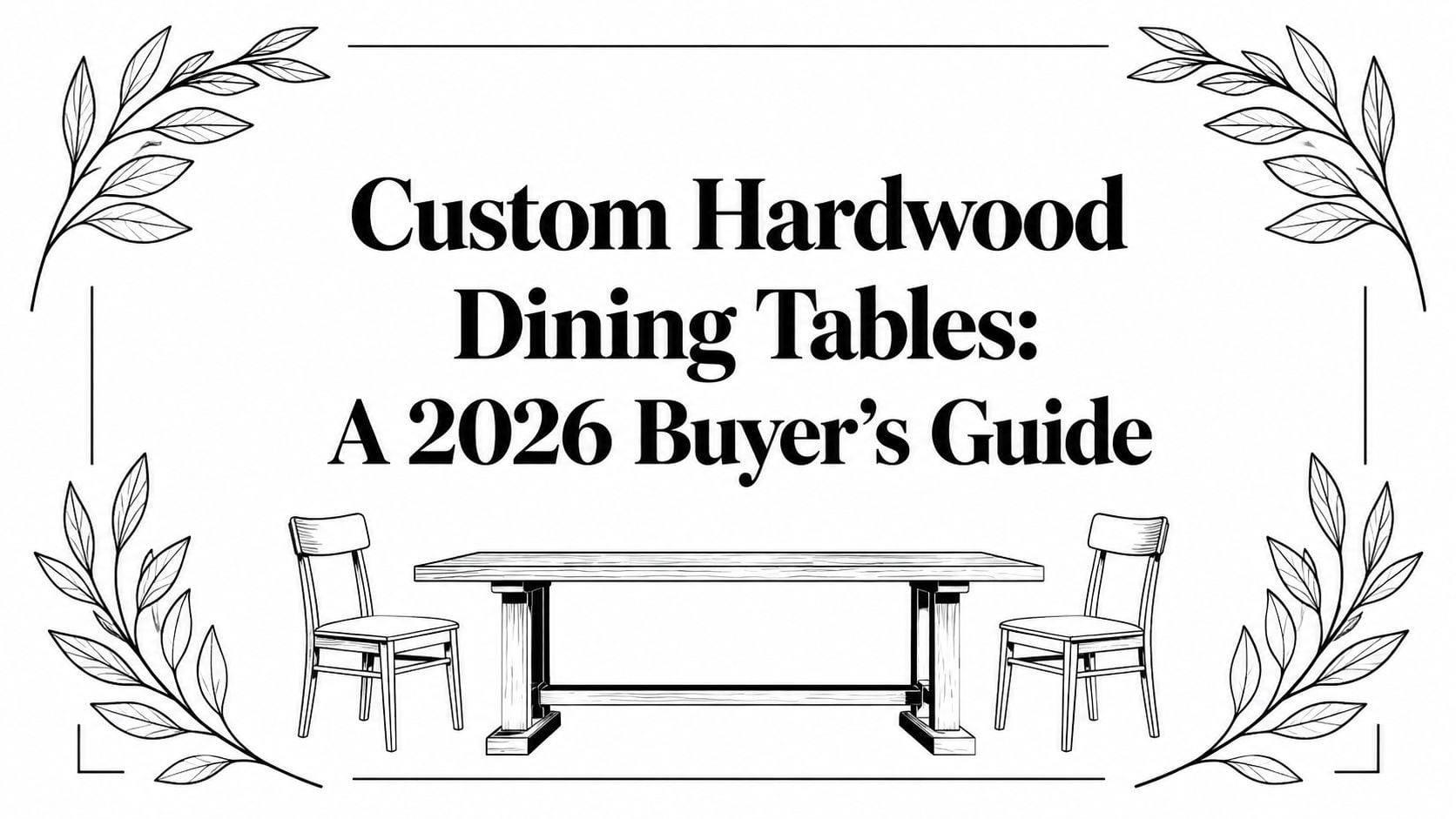
Custom Hardwood Dining Tables: A 2026 Buyer’s Guide

A holiday gathering exposes every weakness in a dining table. Chairs collide because the room is tighter than the showroom suggested, the tabletop wobbles when someone leans on it, and the finish already shows scratches from ordinary family use. For homeowners in Albany, Schenectady, Troy, and throughout the Greater Albany Capital Region, a custom hardwood dining table solves those problems by starting with the home and the household, not a mass-market template.
Tip Top Furniture & Mattresses has served Freehold, NY, and surrounding communities since 1978, with Professional Design Services available since 1984. That local experience matters when a dining room has unusual proportions, narrow stairways, older-home construction, or several generations sharing the same table. This guide focuses on the decisions that determine satisfaction years after delivery, including species, sizing, construction, moisture movement, finishes, lead times, financing, and the custom-order process.
Why Custom Hardwood Dining Tables Are Worth the Investment
A large family settles around the table for Thanksgiving. One person shifts a plate, another steadies a loose leg, and someone at the end has to eat with a chair angled into the walkway. The table technically fits, but it doesn't serve the room. That distinction is why many Capital Region homeowners move toward custom hardwood dining tables instead of replacing inexpensive furniture whenever it fails.
Custom sizing is the first practical advantage. Older homes around Albany and Freehold often have dining rooms that don't match standard furniture dimensions. A custom builder can adjust length, width, leg placement, apron design, and leaf storage so the table fits the room's actual clearances. The result isn't merely a better-looking piece. It gives chairs room to move and lets the household use the dining area without navigating around furniture every day.
Wood selection also follows real life. A household with young children may prioritize a harder surface that resists dents. A formal dining room may call for a richly colored species with a more pronounced visual presence. A busy family that uses the table for meals, homework, and remote work needs a finish and construction method suited to repeated contact, spills, and movement.

Why the category has staying power
Wood isn't a fringe material in dining furniture. One market report valued the global wood dining table market at USD 4.58 billion in 2025, with a projection of USD 8.36 billion by 2034 at a 7.03% CAGR. The same source reported that wood represented 39.45% of the dining-table market in 2025, while the full dining-table market was valued at USD 8.68 billion in 2025 and projected to reach USD 12.52 billion by 2031. These figures support a straightforward conclusion: hardwood dining tables occupy the strongest material category in a large furniture market, not a niche corner of it. (Market data on the wood dining table category)
Tables also remain foundational within wooden furniture. A North American market report placed the tables segment at 28.3% of the regional wooden furniture market in 2024, the largest product type in that report, while another industry estimate valued the global wooden furniture market at USD 112.84 billion in 2026. (North American wooden furniture market analysis)
Practical rule: A custom table earns its premium when it solves a specific room or household problem that a stock table can't solve.
That premium can become an heirloom value rather than a disposable expense. Solid hardwood can be repaired, refinished, and adapted as a household changes. Amish furniture, in particular, is commonly associated with handcrafted construction in the USA and a premium, heirloom-quality standard.
For shoppers comparing dining furniture, bedroom pieces, living room seating, flooring, or mattresses at the same time, Tip Top's one-stop model keeps those decisions connected. A table's wood tone can coordinate with flooring, adjacent storage, and the broader interior plan, while custom ordering allows the size and finish to follow the room rather than forcing the room to follow the product.
Choosing the Right Wood Species for Your Lifestyle
Species selection should begin with use, not a color chip. White oak and hard maple are strong choices for active households, while cherry and walnut serve buyers who want a more distinctive visual statement. Red oak and hickory offer their own balance of cost, grain, and character.
The available hardness data is especially useful for narrowing the field. White oak has a Janka hardness rating of about 1,360 lbf, and hard maple measures about 1,450 lbf. Those ratings make both suitable for demanding dining use, with hard maple offering greater dent resistance and white oak bringing a warmer, more visible grain. (White oak hardness and dining-table suitability) (Hard maple furniture hardness)
Hardwood species comparison for custom dining tables
| Wood Species | Janka Hardness | Grain Character | Color Over Time | Best For | Relative Cost |
|---|---|---|---|---|---|
| Red oak | Not specified in the verified data | Open, prominent grain with a traditional appearance | Often develops a deeper, warmer tone | Practical family tables and farmhouse interiors | Moderate |
| White oak | About 1,360 lbf | Strong but refined grain, often suited to modern and transitional rooms | Warm tones can become richer with age and finish | Active households seeking durability and versatility | Moderate to high |
| Hard maple | About 1,450 lbf | Tight, subtle grain with a clean appearance | Generally stays lighter and more restrained | High-use tables where dent resistance matters most | Moderate to high |
| Cherry | Not specified in the verified data | Smooth grain and naturally warm character | Darkens with UV exposure | Formal rooms and traditional statement pieces | High |
| Walnut | Not specified in the verified data | Rich, dramatic grain and deep color | Can mature into a more blended, patinated appearance | Design-focused rooms and premium interiors | High |
| Hickory | Not specified in the verified data | Highly varied grain and strong rustic character | Variation remains a central visual feature | Rustic, casual, and farmhouse settings | Moderate to high |
For a busy family, hard maple is the direct recommendation when surface dent resistance outranks everything else. White oak is the better all-around choice when durability, adaptable color, and visible grain all matter. Cherry works beautifully in a formal dining room, but buyers should expect its color to change with light. Walnut can justify its premium price for dramatic design impact, yet its surface is softer than hard maple, so careful daily use matters.
All solid hardwood responds to indoor humidity changes. The key isn't finding a species that ignores climate. It's choosing a properly dried board and a builder who designs the table to move naturally. Buyers comparing additional details can use this guide to choosing the best wood for tables before visiting the showroom.
Sizing Your Table to Fit Your Space and Seating Needs
A table should be sized from the room's usable footprint, not from the number printed on a product tag. Start by measuring the dining area, then subtract the space required for chairs and traffic. A reliable working rule is at least 36 inches between the table edge and walls or other furniture, so chairs can pull out and people can pass behind them.
A 12-by-14-foot room can often accommodate a 72-inch table seating six, provided the surrounding furniture doesn't consume the clearance. A 10-by-12-foot room is better suited to a 60-inch table for four when the layout needs comfortable circulation. Those examples aren't substitutes for measuring the actual room, especially in older homes with radiators, door swings, built-ins, or unusually deep trim.
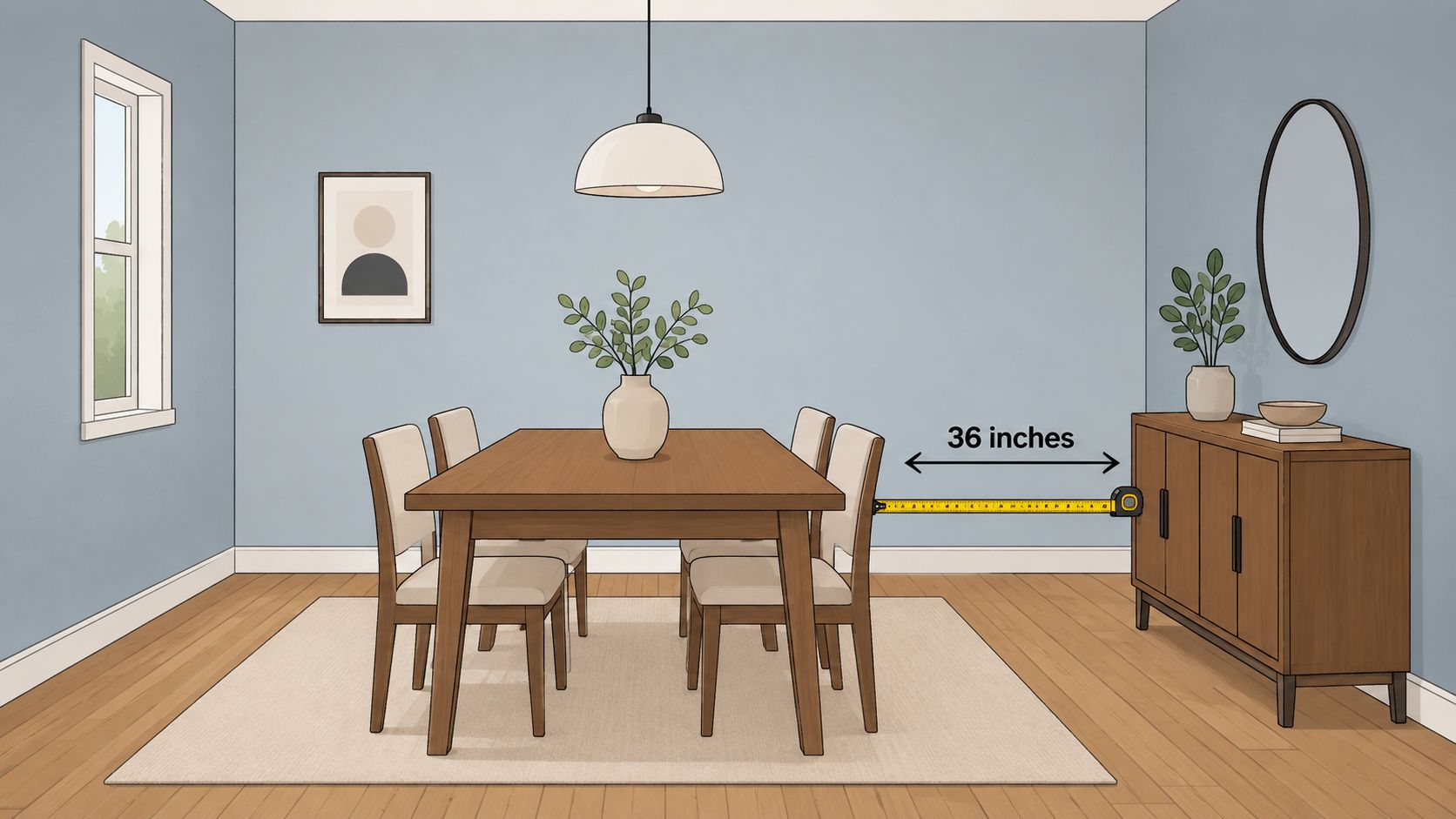
A practical measurement sequence
Measure the clear room: Record the usable length and width after accounting for doorways, cabinets, heating elements, and fixed furniture.
Protect the chair zone: Keep the 36-inch circulation allowance around the table wherever possible. A narrow passage may look acceptable on a floor plan but feel frustrating during every meal.
Choose table proportions: Dining tables commonly stand at 30 inches high, with widths from 36 to 42 inches. Narrower tops conserve space, while wider tops create more room for place settings and centerpieces.
Select the shape: Rectangular tables suit long rooms and traditional layouts. Round and oval tables soften tight spaces, remove sharp corners, and make conversation easier, but a pedestal or carefully placed base is important for comfortable legroom.
Plan for occasional expansion: Extension leaves let a household keep a manageable everyday footprint while accommodating larger gatherings. Hidden leaves preserve a cleaner appearance, while removable leaves may offer more flexibility during storage.
For households evaluating a six-foot rectangular table, a practical seating reference is this guide to how many guests fit at 6ft tables. It helps establish a starting point, but chair width and leg placement still determine whether guests feel comfortable.
Benches can increase flexibility along one side, especially in casual kitchens or farmhouse layouts. Chairs provide better individual support and make it easier to accommodate different body sizes. The final calculation should account for the table apron, base position, and the height of the seating, not just the tabletop dimensions. Tip Top's dining table size guide and free room-planning service can help Capital Region households visualize placement before committing.
Construction Details That Determine Long-Term Durability
A thick tabletop alone doesn't make a table heirloom quality. The structural connections underneath determine whether the piece remains stable after years of use, especially in a climate where winter heating dries indoor air and summer moisture raises it.
Traditional joinery gives high-stress areas more mechanical strength than staples and glue alone. A mortise-and-tenon joint places one piece inside another, creating a strong connection at an apron or leg. Dovetails resist pulling forces and are especially associated with drawer and casework construction. Dowel joints use aligned wooden pins to reinforce a connection, but their quality depends on accurate drilling and adequate glue surface.
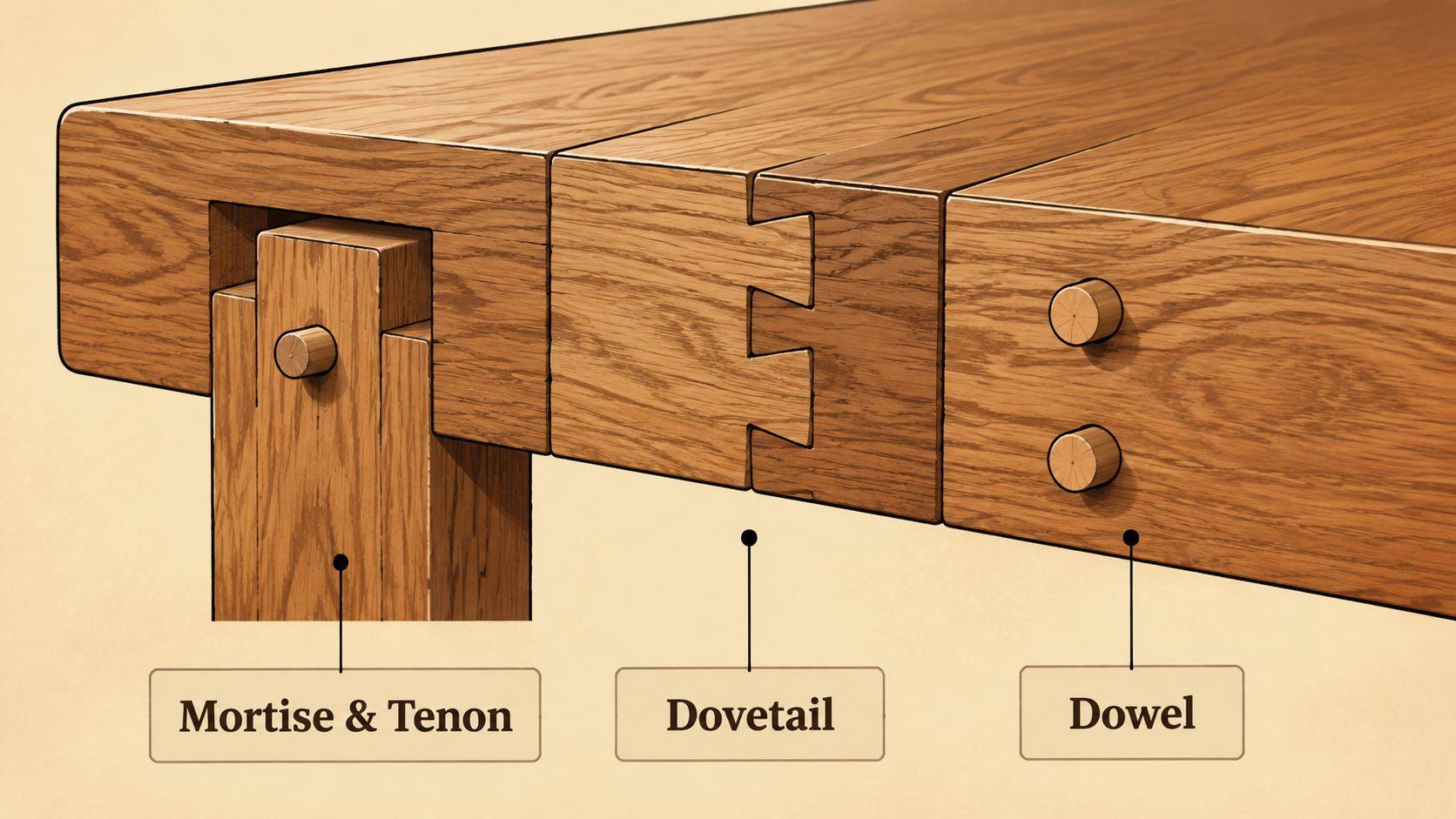
Moisture movement in Upstate New York
Furniture-grade hardwood is commonly dried to about 6% to 8% moisture content for conditioned indoor use, because interior environments typically stabilize wood near 6% to 8% EMC. That target helps minimize shrinkage, swelling, cracks, and joint failure. (Guidance on furniture moisture content and wood movement)
Wood moves primarily across the grain, not along its length. If a tabletop is assembled too wet and later equilibrates in a drier room, the wide panel can shrink enough to stress fasteners and joints. Flat-grain hardwood can shrink around 1% for every 4% change in moisture content, according to practical woodworking guidance, so a 12-inch-wide board may move about 1/8 inch or more during ordinary seasonal changes. (Practical guidance on humidity-related wood movement)
A responsible design lets the top move independently from the base. Common solutions include:
- Breadboard ends: End pieces help control the tabletop visually while allowing the main panel to expand.
- Floating panels: Panels sit in grooves rather than being locked rigidly in place.
- Slotted screw holes: Slots allow fasteners to hold the top down while permitting cross-grain movement.
- Figure-eight attachments: These connectors pivot as the top changes size.
A buyer inspecting a custom table should look beneath the surface. Check whether the base-to-top attachments allow movement, ask how the lumber was acclimated, examine the underside joinery, and request clear warranty language for structural defects. The explanation of what a mortise-and-tenon joint is can help shoppers ask more precise questions during a consultation.
Finish Options and Maintenance Trade-Offs
Finish choice changes how a table behaves in daily life. A surface that looks beautiful under showroom lighting may be a poor fit for a household that places hot dishes, school supplies, laptops, and craft materials on the table every day.
Polyurethane finishes create a protective film and generally support simple wipe-down care. Oil-based polyurethane tends to warm the wood's appearance and may yellow over time. Water-based polyurethane keeps a clearer appearance and dries without the same warm cast, while conversion varnish offers a hard, professionally applied surface when wear resistance takes priority.
Natural oils penetrate the wood rather than creating the same type of surface film. They highlight grain and make spot repairs easier, but they require more ongoing attention. Wax adds a soft, tactile appearance, yet it shouldn't be treated as the first choice for a heavily used family dining surface.
Finish options comparison
| Finish Type | Durability | Maintenance Level | Repair Ease | Best For |
|---|---|---|---|---|
| Oil-based polyurethane | Strong protection against everyday wear, with a warmer appearance | Low | Moderate, usually requires careful blending | Traditional rooms and active households |
| Water-based polyurethane | Strong protection with a clearer color profile | Low | Moderate | Families wanting a durable, less color-changing finish |
| Conversion varnish | Very hard professional surface | Low | More difficult, often best handled professionally | Frequent entertainers and high-use dining rooms |
| Natural oil finishes | Good protection when maintained properly | Moderate to high | High for localized wear | Owners who value natural appearance and repairability |
| Wax | Light protection and a soft sheen | High | Relatively easy, but frequent renewal may be needed | Decorative or lightly used tables |
A household with young children should usually choose a durable polyurethane or professionally applied varnish in a satin sheen. Frequent entertainers should prioritize water and scratch resistance over a delicate high-gloss surface. Buyers focused on natural materials may prefer a penetrating oil, provided annual maintenance is acceptable.
Daily care stays simple. Use coasters and trivets, wipe spills promptly with a soft damp cloth, avoid abrasive cleaners, and don't leave standing moisture on joints or end grain. Cloudy patches, persistent dullness, exposed bare wood, and recurring water marks indicate that the finish needs professional evaluation. Tip Top's custom wood finishes service can help align appearance and maintenance expectations before the build begins.
The Custom Order Process from Sketch to Delivery
A good custom order starts before the showroom visit. The household should bring room measurements, inspiration photos, saved design images, rough sketches, and a list of functional requirements. A builder can't interpret “farmhouse” or “modern” reliably without visual references for the edge profile, leg shape, wood tone, and finish sheen.
The consultation should also cover details that shoppers often remember too late. These include extension leaves, corner clearance, seating type, base placement, delivery access, and whether the table needs to coordinate with existing furniture. A hand-drawn sketch is useful even when it isn't precise. It communicates proportion and priorities.
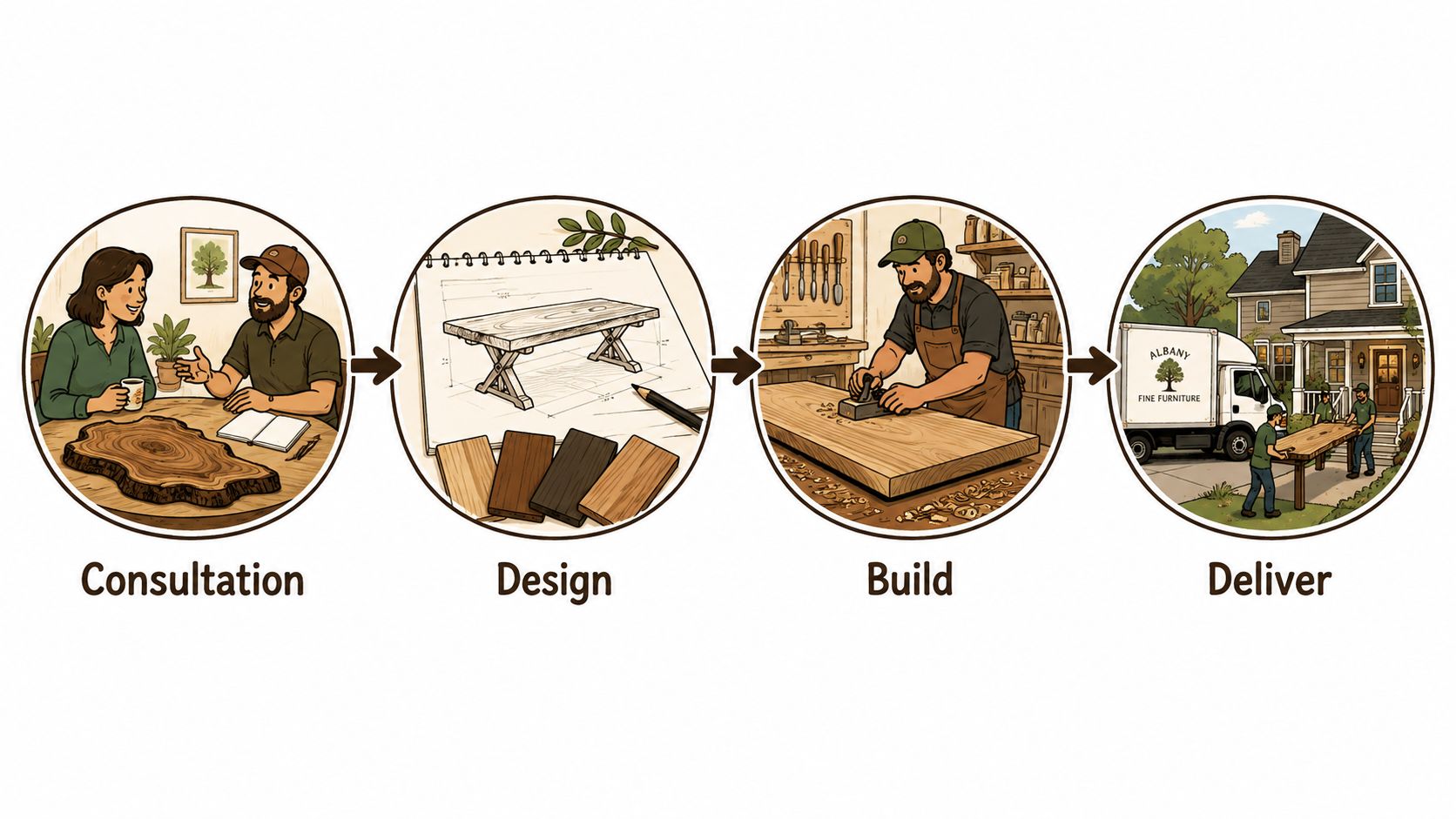
What happens after approval
The process generally moves through several distinct stages:
Design confirmation: Dimensions, shape, base, edge, species, finish, leaves, and delivery conditions are documented. Change orders become more complicated after materials are cut, so unresolved preferences should be addressed early.
Material preparation: The selected wood is milled and prepared for assembly. Proper drying and acclimation matter more than rushing a board into production.
Construction: The craftsman builds the base and tabletop, incorporating movement-friendly attachments and joinery suited to the design.
Finish approval: A sample should be reviewed under the home's lighting when possible. Small changes in stain or sheen can alter how grain and color appear.
Inspection and delivery: The completed table is checked for finish consistency, stable joinery, smooth edges, and correct dimensions before delivery is scheduled.
Custom orders commonly show a wide lead-time range. Public workshop guidance lists timelines from about 4 to 6 months, 8 to 14 weeks, and 10 to 16 weeks, depending on the builder and project. (Custom dining table lead-time guidance) For a straightforward order, 8 to 16 weeks is a reasonable planning range to discuss, not a promise that applies to every table.
A quality table isn't made faster by skipping acclimation, finish curing, or inspection.
Customers should ask how progress updates work, when the finish sample is approved, what deposit terms apply, and how the shop handles a changed dimension or unavailable material. Tip Top's custom-order starting guide gives shoppers a framework for preparing those conversations. A written order summary protects both sides and prevents a verbal description from becoming an expensive misunderstanding.
Pricing Expectations and Financing Your Custom Table
Custom hardwood dining tables cost more because the buyer is paying for material selection, skilled labor, careful milling, custom dimensions, joinery, finishing, inspection, and delivery coordination. Amish-built furniture often carries a premium because it is associated with handcrafted construction in the USA and heirloom-quality production. The comparison shouldn't stop at the checkout total. A table used for daily meals over many years can provide better value than repeatedly replacing furniture that fails early.
Exact pricing varies too much by builder and specification to reduce responsibly to invented dollar ranges. A useful budget framework is feature-based rather than falsely precise:
| Tier | Price Range | Typical Features |
|---|---|---|
| Entry custom | Quoted per project | Straightforward shape, readily available domestic hardwood, standard base, simpler finish |
| Mid-range custom | Quoted per project | More size flexibility, upgraded species or base, extension leaves, refined edge details |
| Premium custom | Quoted per project | Select hardwood, complex base or sculptural details, specialized finish, extensive consultation and delivery coordination |
Budget should follow the parts that affect daily satisfaction. Spend first on the correct dimensions, sound construction, suitable species, and a finish that matches household use. Decorative edge profiles and elaborate base details can come later if the budget is constrained.
Financing can make a larger project easier to manage, but promotional terms require careful reading. The Synchrony HOME credit card offers promotional financing of 6 months on purchases from $299 to $1,998.99 and 12 months on purchases of $1,999 or more. Select retail partners may offer promotional terms of up to 60 months on qualifying purchases. (Synchrony HOME financing terms) Customers should confirm current eligibility, promotional details, and repayment requirements with the retailer before ordering.
Tip Top offers flexible financing options, including special financing available with a Synchrony Home Card, subject to store terms. The store's Clearance section can also help shoppers allocate more of the project budget to a custom table while furnishing other rooms with immediately available pieces.
Common Questions About Custom Hardwood Dining Tables
How long does a custom table take?
Lead times depend on material readiness, design complexity, finish selection, and the workshop queue. Public custom-furniture guidance ranges from several months to shorter project windows, so the order agreement should state the expected range and the conditions that could change it. Holiday meals, move-ins, and renovations deserve early planning.
Can a new table match existing furniture?
Yes, but matching requires more than naming a wood species. Existing pieces may have aged, darkened, or developed a different sheen. Finish samples, photos in natural light, and measurements of nearby furniture help a designer coordinate the new table without promising an artificial exact match.
How should households manage Upstate New York seasons?
Keep the table in a conditioned indoor environment, wipe spills promptly, use trivets, and avoid placing it directly beside a heat source. Solid wood will respond to seasonal humidity, so movement-friendly construction matters more than trying to prevent all movement.
What happens if the table develops marks?
Minor character marks and surface wear can often be repaired or incorporated into future refinishing. Structural cracking, loose joints, or warping should be documented and reviewed under the builder's warranty terms. A reputable order should clearly distinguish normal wood character from a structural defect.
How does delivery work?
Delivery planning should account for staircases, narrow halls, door dimensions, and whether the table arrives assembled or in sections. A consultation can identify tight-space risks before construction begins, which is far better than discovering an access problem on delivery day.
Can shoppers see the design before committing?
A careful consultation can use scaled measurements, sketches, finish samples, and layout planning to make the proposal more tangible. Tip Top's professional design consultants can also coordinate dining furniture with décor, flooring, and other rooms, while its broader showroom serves homeowners across Freehold, Albany, Schenectady, Troy, Greene County, and the surrounding Capital Region.
Tip Top Furniture & Mattresses offers custom ordering for dining tables, including choices of size, shape, wood type, color, finish, and accessories, along with Amish furniture, local design services, delivery, financing, flooring, mattresses, and Clearance options. Visit Tip Top Furniture & Mattresses in Freehold, NY, to review hardwood choices and discuss a table designed for the room, climate, and household using it.