Best Dining Room Tables with Leaves Stored in Table

A lot of Capital Region homeowners reach the same point around the holidays. The dining room works fine for everyday meals, then a birthday, Thanksgiving, or a last-minute dinner with relatives turns into a shuffle of extra chairs, place settings, and not quite enough table space. The old fix was to pull a separate leaf out of a closet or basement and hope nobody forgot where it was stored.
That's why dining room tables with leaves stored in table keep coming up in real showroom conversations. They solve a practical problem without asking a household to dedicate extra storage space to a piece of furniture that only gets used a few times a year. For families around Albany, Schenectady, Troy, and Greene County, that convenience matters just as much as style.
Since 1978, local shoppers have also wanted the same thing from a dining table. It needs to look right in the room, work smoothly when company comes over, and hold up for years. A self-storing table can do that, but only if the mechanism, dimensions, wood selection, and extension capacity all match the way the table will be used.
Table of Contents
- The End of Awkward Holiday Seating
- How Self-Storing Dining Tables Really Work
- Measuring for Your New Table in the Capital Region
- Choosing Materials and Finishes for Lasting Quality
- Your Smart Shopper Checklist for the Perfect Table
- Caring for Your Investment and Troubleshooting Tips
- Common Questions and Your Next Step
The End of Awkward Holiday Seating
A familiar scene plays out in many Upstate New York homes. The meal is planned, the house is full, and the dining room suddenly feels one place setting too small. Someone starts checking the spare room, then the basement, then the back of a closet, looking for the loose leaf that was put away carefully and is now nowhere convenient.
A self-storing table changes that routine. Instead of carrying a separate panel through the house, the leaf stays protected inside the table itself until it's needed. That's one reason most self-storing dining tables are engineered to hold exactly one or two leaves, with internal cavity space determining capacity and making 1 to 2 leaves the functional standard for 95% of self-storing models according to this explanation of self-store leaf design.
For a host, the advantage isn't abstract. It means the table can shift from a smaller daily footprint to a larger gathering setup without a storage hunt before dinner. It also keeps the leaf folded inside the table's apron or center cavity, where it's protected rather than leaning against a wall somewhere else in the house.
Everyday convenience matters more than people expect
This is the kind of furniture choice that pays off in small moments. A weeknight dinner for four stays simple. A holiday meal expands quickly. A house in Freehold or the greater Albany area doesn't need to give up precious storage space for a table component that should have been integrated from the start.
Self-storing tables work best for households that entertain often enough to need flexibility, but not so rarely that the extension system becomes an afterthought.
Hosting also usually involves more than seating. For readers planning a full holiday setup, this Australian holiday wine guide is a helpful companion when matching bottles to a festive meal. For home setup ideas beyond the table itself, the holiday hosting guide from Tip Top is worth a look as well.
How Self-Storing Dining Tables Really Work
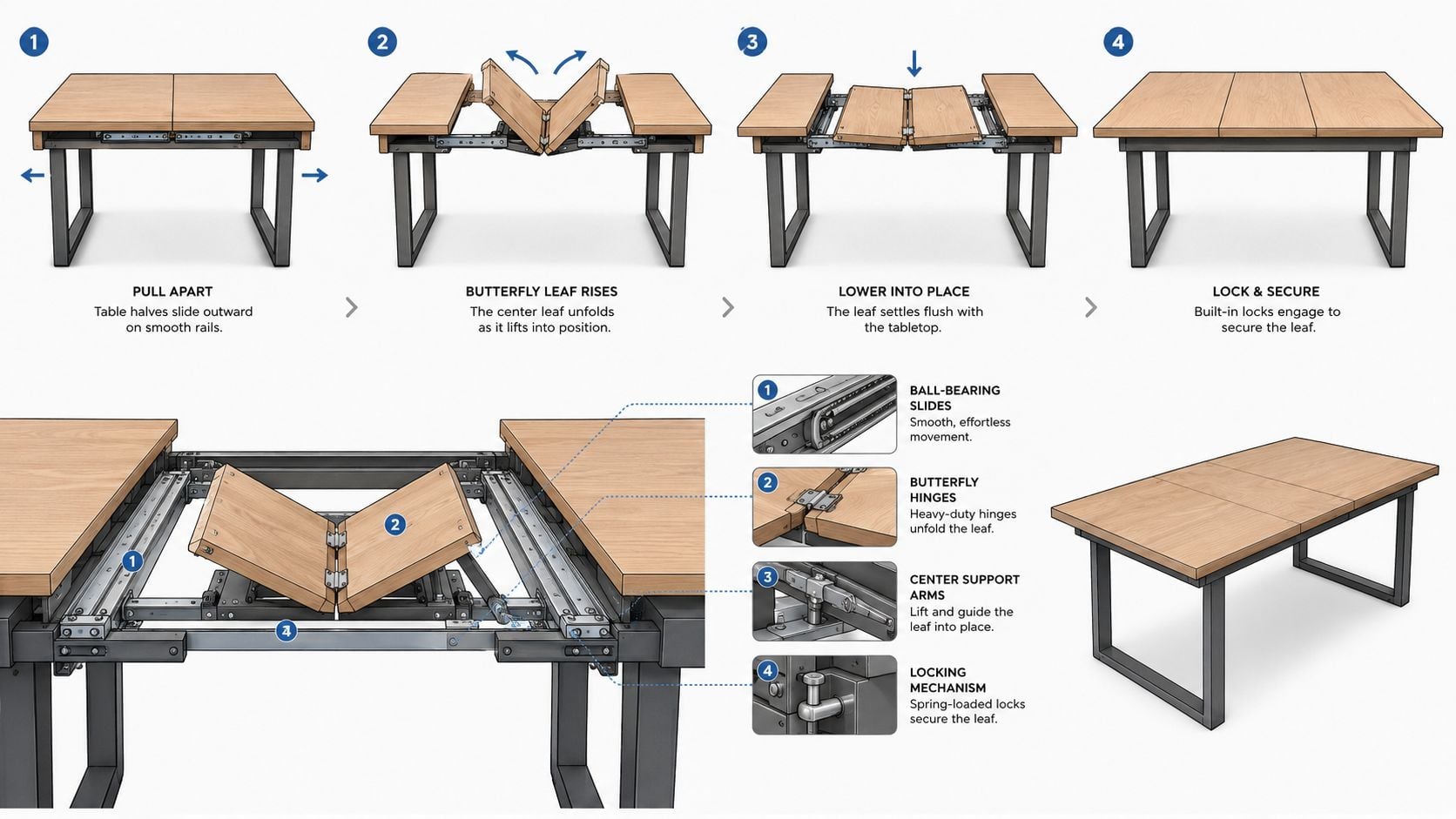
The basic idea is simple. The table opens at the center, the hidden leaf is brought into position, and the top closes back together around it. What matters in practice is how the leaf is stored and how smoothly the mechanism operates when real people use it.
Two common self-storing systems
The two styles shoppers usually encounter are butterfly leaves and stored flat leaves beneath the top.
A butterfly leaf folds in on itself and lives inside the center of the table. When the top is pulled apart, the folded section lifts, opens, and settles into place. This design appeals to buyers who want a cleaner one-person setup and a fast change from closed to open.
A stored flat leaf is kept underneath the tabletop in a built-in compartment. The table still opens from the center, but the leaf is retrieved from below and positioned for use. This can feel more modular, especially on larger tables where the construction allows for more than one panel arrangement.
| Mechanism | How it feels in daily use | What to watch for |
|---|---|---|
| Butterfly leaf | Fast, compact, often easier for one person to manage | Folding action and center seam need to feel precise |
| Stored flat leaf | Flexible and straightforward, especially when the table has multiple configurations | Access under the top and track alignment matter |
What changes as tables get larger
Not every expandable table follows the same rules. Self-storing Dutch leaf tables can integrate up to three distinct leaves, enabling expansion from four to twelve people. Specialized pedestal designs like the Oakland Double Pedestal Table can self-store up to four leaves, two with skirts and two without, providing a maximum capacity that supports up to 16 seats while maintaining structural stability, as shown in this Dutch leaf table demonstration.
That sounds generous, and it is. But larger capacity also means buyers should pay attention to base design, slide quality, and whether the table was built for that exact extension range.
Practical rule: The larger the extension plan, the less room there is for guesswork. A table should feel stable both closed and fully opened.
The engineering side matters more than many shoppers realize. A self-storing table depends on slide alignment, a clean meeting line where sections close together, and support logic that keeps the tabletop from racking or twisting under load. When those parts are well made, the mechanism feels easy. When they aren't, even a beautiful table becomes frustrating to use.
A quick showroom test tells a lot. Pull the table open evenly. Watch whether both halves track smoothly. Then close it and check the joint line with a hand across the surface. Good construction usually announces itself in those few seconds.
Measuring for Your New Table in the Capital Region
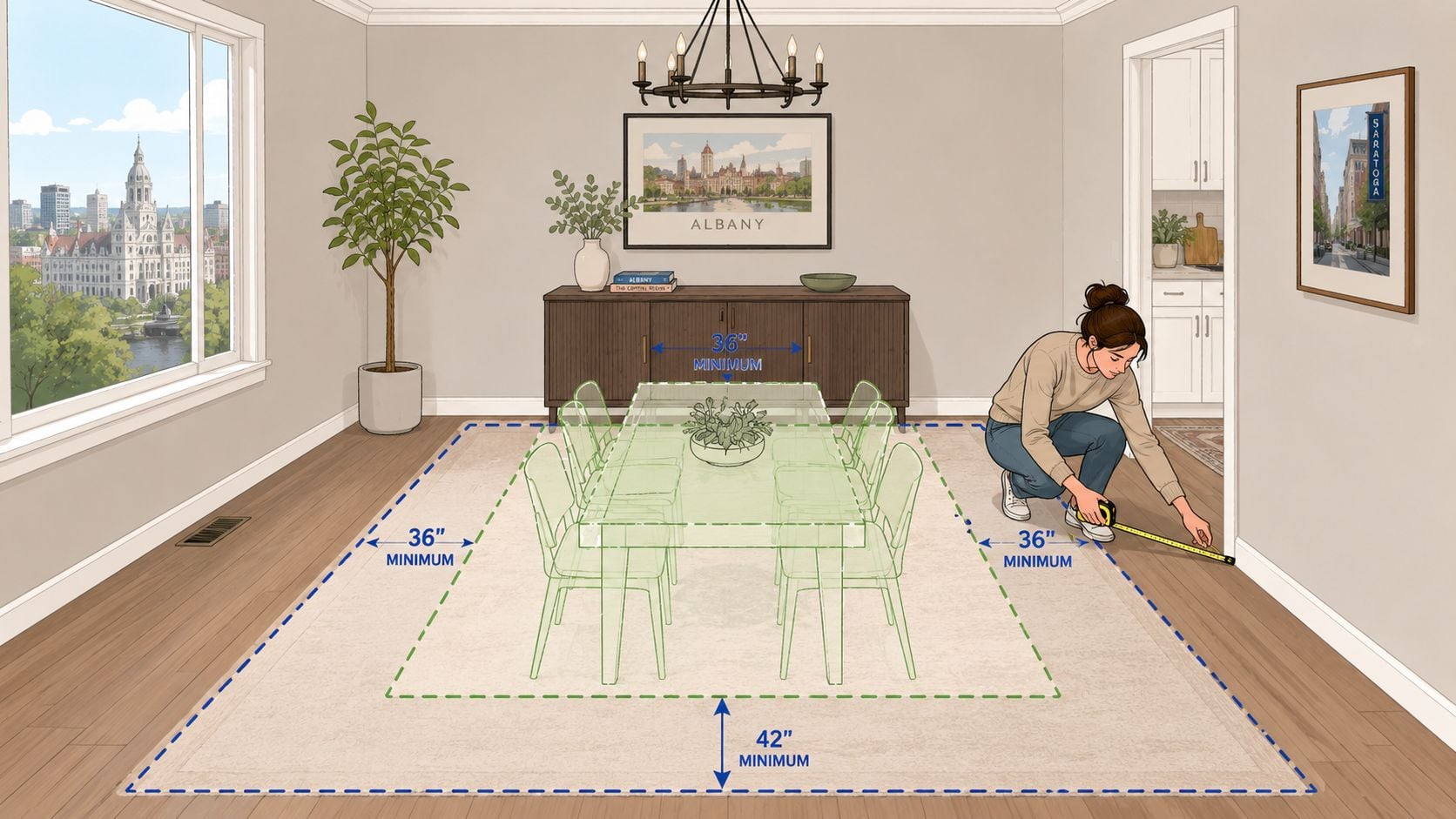
A table can be perfect on paper and wrong for the room. That happens often in older Capital Region homes, where dining rooms may look spacious until chairs are out and the table is extended. The measurement that gets missed most often isn't the closed size. It's the space required to open the table.
Measure the room in its everyday state
Start with the room as it is used most days. Include sideboards, radiators, nearby walls, and traffic paths to the kitchen or hallway. A table has to work when it's closed, not just when it's dressed for guests.
Then measure the table in both positions. Shoppers should know the compact size and the fully extended size before they compare styles.
A sizing reference can help when planning seat counts. This guide for 6ft rectangular table seating gives a useful general frame for how rectangular dining surfaces tend to seat people.
Check the extension path before buying
The extension mechanism itself needs room to move. Dining tables with leaves stored internally require a minimum clearance of 18 inches between the table edge and adjacent walls or furniture to allow the leaf to be fully extended without obstruction, according to Tip Top's interior design guidance.
That's a mechanical issue, not just a comfort guideline. If the table can't open cleanly, the self-storing feature won't feel convenient.
A practical measuring routine looks like this:
- Mark the closed footprint with painter's tape on the floor.
- Mark the extended footprint so the room can be viewed both ways.
- Check the full opening zone around the table edge, especially toward buffets, walls, and nearby case pieces.
- Walk the traffic path someone would take while others are seated.
In smaller dining rooms, the table that fits best closed and opens occasionally often serves a household better than a permanently oversized table.
For households that want a digital preview before visiting a showroom, the dining table size guide is a useful place to start.
Choosing Materials and Finishes for Lasting Quality
The extension mechanism gets attention first, but the material choice often decides whether a self-storing table still works well years later. A dining table is opened, closed, wiped down, loaded with serving dishes, and lived with. That's why wood movement, surface durability, and construction quality matter as much as style.
Why solid wood still matters
Solid wood remains a strong choice for buyers who want an heirloom feel and a table that can be customized to suit the room. It also fits naturally with the kind of USA-made Amish furniture many Upstate New York families prefer when they want craftsmanship over short-term fashion.
The hidden leaf should match the rest of the table, not just visually but physically. The leaf-storage mechanism is most reliable when the leaf is made of the same wood species and finish as the main table, as mismatched wood types cause differential expansion and contraction that can jam the sliding mechanism over time, according to this guidance on leaf and wood compatibility.
That point gets overlooked because a buyer usually sees the table closed. But the extension system depends on parts moving together consistently across changing indoor conditions.
Finish choices and custom order decisions
Finish affects both appearance and maintenance. A darker stain can ground a traditional dining room. A lighter finish can make a smaller room feel less heavy. Sheen matters too. Lower sheen often hides daily wear better, while a smoother polished look can feel more formal.
For many homes in Albany, Troy, and Greene County, a custom order makes more sense than settling for a close-enough option off the floor. That's especially true when a household wants to match existing case goods, coordinate with flooring, or choose a specific wood species.
A useful decision list includes:
- Wood species fit for the household's style and long-term expectations
- Finish tone that works with wall color, flooring, and chair upholstery
- Base style that leaves enough knee room and fits the room's architecture
- Leaf configuration that matches how often the table will be expanded
Professional design help can simplify that process, especially when furniture, décor, and flooring need to work together. Since 1984, design services have been part of the support many local shoppers use to avoid mismatched finishes and sizing mistakes.
For readers comparing wood options in more detail, the best wood for tables guide is a practical next read.
Your Smart Shopper Checklist for the Perfect Table
A good self-storing table should feel easy before it ever reaches the house. The safest way to shop is to treat the showroom visit like a test drive. Open the table. Close it. Look underneath. Ask how it handles the exact way the household plans to use it.
What to test in the showroom
Open and close the mechanism yourself. Don't rely on a quick demonstration alone. A self-storing table should move evenly and settle into place without forcing one side ahead of the other.
Check the seam at the center. Run a hand lightly across the meeting line. A clean fit usually points to careful construction and better long-term alignment.
Look at the base when extended. A table can feel solid closed and less convincing open. The support structure matters most in the fully expanded position.
Notice the weight. Tables with built-in leaf compartments beneath the top typically weigh 25 to 35% more than non-expandable tables of the same footprint because of the reinforcement needed for the mechanism, according to this furniture weight analysis. That extra weight often adds stability, but it also affects moving, delivery paths, and room rearranging.
A table that expands beautifully but is difficult to position in the room isn't the right fit for every home.
Questions worth asking before ordering
Some questions save a lot of frustration later.
How many leaves does this table self-store? Many shoppers assume bigger automatically means more hidden storage. It doesn't.
What happens if a household needs very large extension capacity? Tables with five or more leaves cannot self-store any leaves due to mechanical constraints, which means buyers planning very large gatherings should expect external panel storage, as explained in this overview of self-store limits.
Is service access built into the hardware area? Hidden hardware should still be reachable for adjustment if alignment ever needs attention.
What's the actual storage cavity built to hold? Regional furniture design specifications used by family-owned showrooms standardize the leaf-storage compartment depth at 3.5 inches to accommodate 12 to 14 inch wide leaves while maintaining 1 inch of clearance above the leaf for smooth sliding, as noted in these regional design specifications. Those details affect how cleanly the mechanism operates.
A few buying reminders are worth carrying into any visit:
- Bring room measurements
- Bring photos of the dining room
- Think about daily seating first, holiday seating second
- Ask about delivery access, especially staircases and tight entries
- Review financing if timing matters for a larger home project
- Check clearance inventory if immediate availability is important
- Use design assistance when matching other wood furniture in the home
For shoppers who want a planning reference before stepping onto the sales floor, the guide to picking the right dining room table helps organize those decisions. Tip Top Furniture & Mattresses also offers custom ordering, financing options, and a clearance section for buyers who need either personalization or faster availability.
Caring for Your Investment and Troubleshooting Tips
A self-storing dining table doesn't need complicated care, but it does need consistent care. The mechanism lives inside the table, which means dust and grit can gradually build up if the table isn't opened and checked from time to time.
Simple maintenance that prevents bigger problems
Dust accumulation in the mechanism can increase friction by up to 25%, which can lead to uneven extension and hardware misalignment, according to this technical explanation of self-storing leaf hardware. That's why a table that once opened smoothly may start feeling resistant if the internal area is neglected.
A simple routine works well:
- Open the table periodically so the interior doesn't sit untouched for long stretches
- Wipe accessible hardware areas gently to keep grit from interfering with the slide path
- Use even force from both sides when opening the table
- Protect the top during heavy serving with pads or layers that help preserve the finish
For broader household restoration ideas, this guide on deep cleaning old furniture offers useful cleaning context.
What to do when a table starts sticking
If the table begins to drag, stop forcing it. First check for dust in the mechanism area and confirm the table is being opened evenly. Then inspect whether the leaf is seated correctly before closing the top back together.
Most minor extension issues start with debris, uneven pulling, or a leaf that isn't positioned squarely.
Routine finish care matters too. The wood furniture care guide is a solid reference for protecting the tabletop surface over time.
Common Questions and Your Next Step
A few questions tend to come up right before a buyer is ready to decide.
Quick answers shoppers usually want before deciding
Are self-storing tables sturdy enough for regular use?
Yes, when the table is properly engineered. Stability depends on slide quality, base design, and how well the table supports itself in the open position.
Can a self-storing table work for small daily meals and larger gatherings?
That's exactly where it shines. The closed footprint keeps the room comfortable day to day, and the hidden leaf setup makes occasional expansion much easier.
Are these tables harder to move?
Often, yes. The added mechanism and stored leaf can make the table noticeably heavier than a non-expandable version, so delivery access and room placement should be part of the buying decision.
Is custom ordering worth it?
For many households, yes. It can make sense when the dining room needs a specific size, a certain wood species, or a finish that coordinates with existing furniture, flooring, or architectural details.
For homeowners across Freehold, Albany, Schenectady, Troy, and the wider Capital Region, the right table is the one that fits the room, opens smoothly, and still looks right years from now. A well-made self-storing table can bring together convenience, craftsmanship, and a cleaner everyday setup without asking the house to store extra parts somewhere else.
Visit Tip Top Furniture & Mattresses to explore dining options in person, compare extension styles, ask about custom ordering, review flexible financing, or work with a design consultant on a room plan that fits the way the home is used.