Stunning Entryway Mirror Ideas for a Welcoming Home

Your entryway does a lot of work. It catches boots, bags, wet coats, school papers, dog leashes, and that last quick glance before you head out the door. It also sets the tone for the rest of the house, whether you live in a classic Albany-area colonial, a newer build in the Capital Region, or a farmhouse-style home outside town.
That's why good entryway mirror ideas aren't just about decoration. The right mirror can bounce light deeper into a hallway, make a tight entrance feel more open, and give the space a finished look that feels intentional instead of improvised. Design guidance also supports that practical value. A wide rectangular mirror can spread natural light across a hallway, while a tall mirror can make a small entry feel more open and visually higher, according to this entryway mirror shape guide.
At Tip Top Furniture & Mattresses, we've spent more than 45 years helping families in Freehold and across the Greater Albany Capital Region pull these spaces together in a way that works for real life. Since 1984, our design team has helped homeowners match mirrors with console tables, Amish-made case pieces, flooring, and custom finishes so the entry feels connected to the rest of the home. If you want fresh entryway mirror ideas that look good and hold up to everyday use, these are the styles and setups worth considering.
1. Statement Large-Scale Mirrors
A large-scale mirror changes the whole mood of an entry fast. In a narrow hall, it can keep the wall from feeling boxed in. In a taller foyer, it gives the eye somewhere to land so the room feels designed instead of empty.
That's why oversized mirrors work so well in Capital Region homes with stair halls, open foyers, or long front entries. In spaces with height, floor-to-ceiling mirrors are often recommended for high-ceiling foyers, and full-length mirrors are commonly used in narrow halls because they maximize reflection and perceived depth, as noted in the design guidance referenced earlier.
Where large mirrors work best
A sleek black-framed mirror works well in a modern entry with a slim console and matte hardware. A polished-edge piece fits a cleaner, more contemporary foyer. In a traditional home, a larger gold or silver frame can fill the wall without looking sparse.
The mistake people make is hanging a big mirror too high. If it floats way above the console, it looks disconnected. If it's undersized for the wall, it loses the statement effect completely.
Practical rule: Big mirrors need real support. Before you buy for size alone, make sure the wall, anchors, and hanging method can handle the weight.
A large mirror is also one of the few pieces that can justify custom sizing. If your wall sits between a closet door and a staircase, a standard size might look awkward. That's where local guidance helps. Our team often helps customers in Albany, Troy, and Schenectady match mirror scale to the console, the ceiling line, and the walkway clearance.
If you're handling installation yourself, this step-by-step guide to hanging your picture with precision is a useful place to start.
2. Ornate and Vintage-Inspired Frames
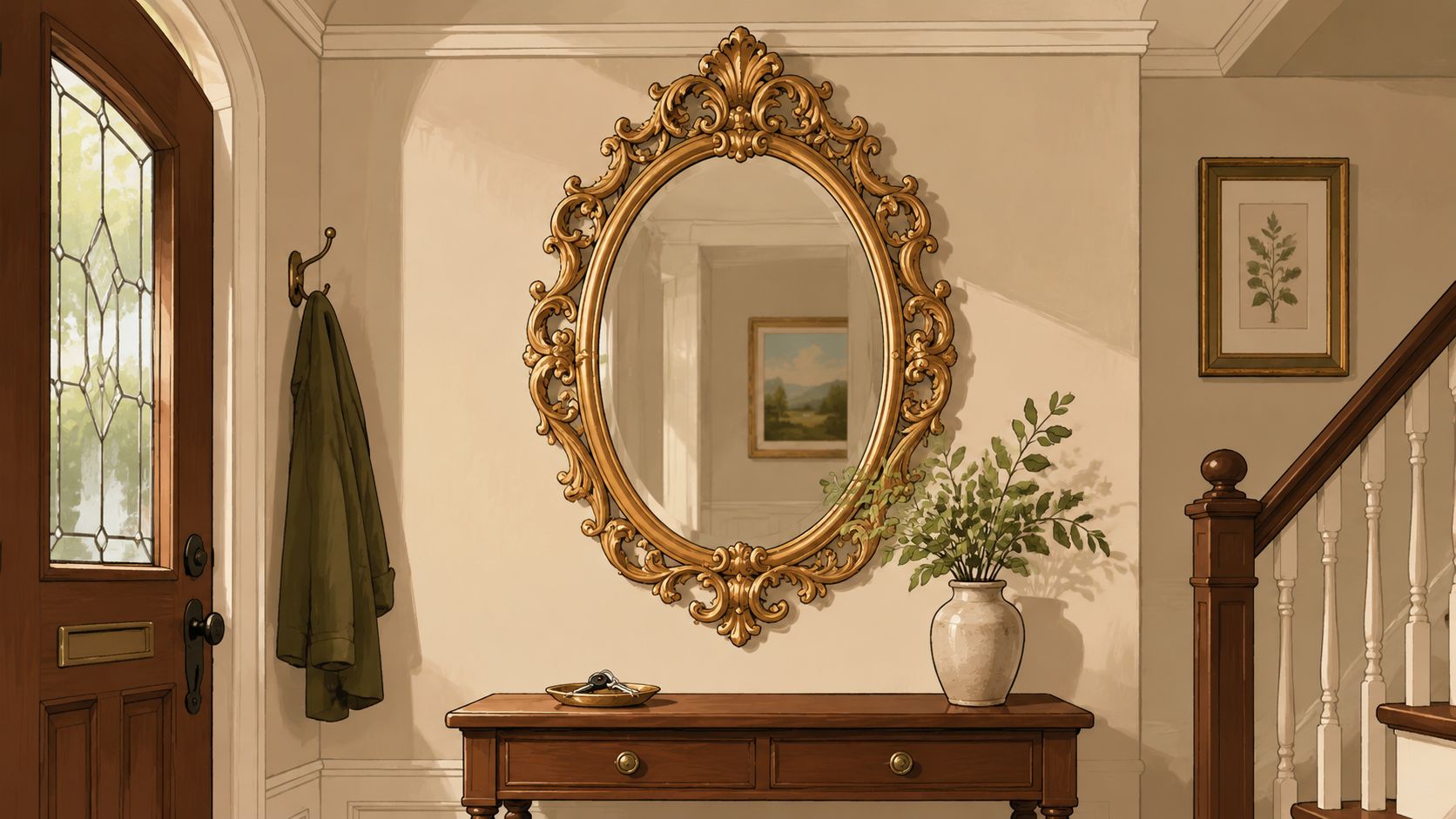
Some entryways need softness and character more than they need clean lines. An ornate mirror does that immediately. It brings detail to a plain wall and pairs especially well with older homes in the Capital Region that already have trim, molding, or a more traditional front room layout.
A carved gold leaf look, an antique silver finish, or a mirror with a lightly distressed frame can make a foyer feel collected rather than newly assembled. This style works best when there's at least one other classic element nearby, such as a dark wood console, a bench with turned legs, or a patterned runner.
How to keep ornate mirrors from feeling dated
The frame should look intentional, not theatrical. In most homes, one decorative mirror is enough. If the console, lamp, rug, and wall art all compete, the entry starts to feel crowded.
A good balance looks like this:
- Use one standout finish: Let the mirror carry the decorative detail, then keep nearby hardware and accessories simpler.
- Repeat a classic material: Wood, brass, or aged metal elsewhere in the space helps the mirror feel grounded.
- Match the home's architecture: Ornate frames look more natural where there's trim, paneling, or a traditional stair rail nearby.
This is also where mixing styles matters. A carved mirror over a clean-lined console can look better than a full period-style set because the contrast keeps the space fresh. If you're trying to blend traditional and updated pieces, these ideas for mixing furniture styles for a cohesive look can help.
For homeowners who want an heirloom feel, this is one of the easiest categories to personalize through custom ordering. A frame finish that echoes nearby dining furniture or a wood tone from an Amish-made accent piece can make the entry feel tied into the rest of the house.
3. Minimalist and Frameless Mirrors
Frameless mirrors are often the best answer when the entry is already busy. If the front door has heavy panels, the staircase has decorative balusters, or the flooring carries a lot of pattern, a simple mirror gives the eye a break.
This style works particularly well in smaller homes, condos, and updated ranch layouts around Albany where every inch has to stay visually light. A polished edge or soft bevel adds enough detail without turning the mirror into a feature that dominates the room.
Why simple often works harder
A frameless mirror reflects exactly what's around it. That's its strength and its weakness. If the view includes a nice sconce, a good lamp, or daylight from an adjacent room, it helps the whole entry. If it reflects clutter, open coats, or the side of a crowded shoe rack, it amplifies the mess too.
That's why I usually suggest frameless mirrors in entryways that already have some discipline built in. Think closed storage, a slim table, and a limited color palette.
Keep the styling restrained. Frameless mirrors look best when the wall below them isn't overloaded with baskets, signs, greenery, and trays all at once.
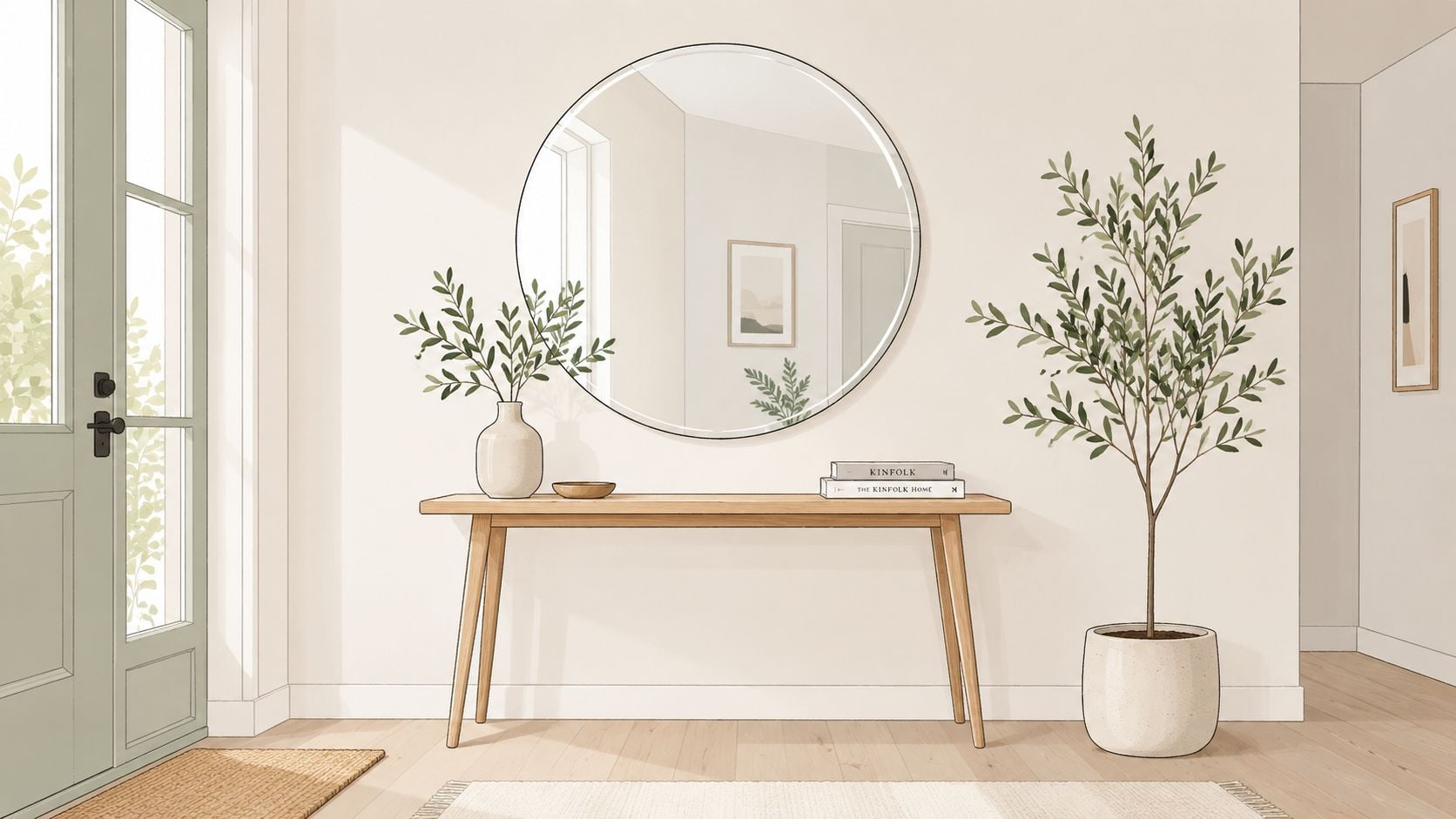
A round frameless mirror can soften a boxy entry. A tall rounded rectangle works well over a narrow console. In a very compact entrance, it can be the cleanest option because there's no visual weight from the frame.
If you're moving a delicate older piece into a new home and want to preserve it for a secondary space, working with expert antique movers in Boston can be helpful for specialty transport planning.
4. Wooden Frame Mirrors with Natural Finishes
Wood-framed mirrors are some of the most forgiving and livable entryway mirror ideas. They add warmth, they hide fingerprints better than glossy finishes, and they work with everything from farmhouse to transitional to classic American interiors.
In Upstate New York homes, they also make practical sense. A natural oak, cherry, or walnut frame softens painted walls and pairs easily with solid wood furniture. If you already have hardwood flooring or wood-look flooring near the entry, a wood frame can connect those surfaces so the space feels settled.
Best matches for wood-framed mirrors
Species and stain matter here. Pale oak feels lighter and more casual. Dark walnut reads dressier. Reclaimed or rougher textures lean farmhouse and rustic.
A few combinations that hold up well:
- Natural oak with light walls: Good for cottage, Scandinavian, or relaxed transitional homes.
- Walnut with black accents: A strong fit for mid-century and updated traditional spaces.
- Reclaimed wood with woven textures: Works well in farmhouse entries with runners, baskets, and matte metal hardware.
Wood-framed mirrors also pair beautifully with Amish-made pieces. If a customer is ordering a solid wood console or hall chest, matching or complementing the mirror frame can make the entry feel custom without overcomplicating the design.
The trade-off is maintenance. Real wood needs occasional care, especially near front doors where humidity, dry winter air, and temperature swings are part of daily life. It's still one of the safest bets if you want an entryway that feels warm rather than stark.
5. Metal Frame Mirrors Industrial and Modern
Metal-framed mirrors bring definition. They outline the glass clearly, sharpen the architecture, and work well when the rest of the entry needs some contrast. In homes with simple trim and neutral walls, that crisp edge can keep the space from falling flat.
Black metal is the easiest version to live with. Brass can look beautiful too, but it needs the right supporting pieces nearby. If the hardware, lighting, and table finish all pull in different directions, the mirror can feel like it wandered in from another house.
When metal frames make the most sense
Metal frames tend to work best in these situations:
- You need visual structure: A black frame can anchor a wall that feels too open.
- Your home already has metal accents: Door hardware, lighting, or furniture legs can tie the look together.
- You want a cleaner silhouette: Metal often feels lighter than thick carved wood but more finished than frameless glass.
The style range is wider than people think. A thin black steel frame can feel modern. A warm brushed brass frame can skew mid-century. A grid-style mirror gives more of an industrial or loft feel, though that style needs enough wall area to breathe.
If you want help pulling those finishes together, what you should know about metal accents offers a useful overview. And if you're building or customizing a structure where steel plays a larger design role, these creative steel frame home designs show how metal can shape an interior aesthetic.
One more practical note. In busy entryways, thinner metal frames can show chips or scratches sooner than wood. That doesn't make them a bad choice. It just means placement and finish quality matter.
6. Decorative Sunburst and Geometric Mirrors
Not every mirror has to be quiet. A sunburst or geometric mirror can act more like wall art, which is useful in entryways that don't need a lot of reflection but do need a focal point.
This is a smart solution for a wider wall where a standard rectangle would feel too plain. It's also a nice fit for homeowners who want personality right at the front door. Mid-century-inspired homes, eclectic interiors, and transitional spaces often handle this style best.
How to keep decorative mirrors from looking busy
The mirror should be the feature, not one feature among five. If you choose a sunburst shape, keep the console styling pared back. If you choose a faceted geometric frame, skip overly patterned wallpaper right behind it unless you want a bold layered look.
A few pairings that usually work:
- Sunburst with a simple wood console: Lets the mirror carry the personality.
- Geometric frame with a neutral bench: Good when you want a modern edge without clutter.
- Metallic finish with restrained accessories: A lamp, a tray, and one vase are often enough.
A decorative mirror needs negative space around it. If it's pressed tight between a coat rack, a gallery wall, and a tall plant, the shape gets lost.
This style works best when the mirror is centered and given enough wall space. In a tight or narrow hall, it can feel fussy. In an open foyer, it often lands perfectly.
7. Console Table Mirrors
You walk in with groceries in one hand and your keys in the other. A mirror over a console table gives that daily drop zone some order, so the entry works hard without looking improvised.
This setup earns its keep in Capital Region homes because it handles two jobs at once. You get a mirror for a quick check on the way out, and you get a landing spot for the small items that otherwise spread across the nearest chair or kitchen counter. In older Albany homes with narrower halls, that matters.
The pairing works best when the scale is right. A bulky console can pinch the walkway fast, especially near a front door that swings inward. A mirror that is too narrow above it can look disconnected from the furniture below.
A few sizing rules help:
- Keep console depth in check: Slim profiles usually work better in tighter foyers and center-hall colonials.
- Match the visual width: The mirror should relate clearly to the table width so the arrangement feels intentional.
- Control the top surface: A tray for keys, a bowl for mail, and one lamp or vase is often enough.
If your entry is compact, the mirror can also help the room feel more open. Tip Top shares a few useful ideas in this guide on how to make a small room feel big.
If you're choosing both pieces together, this guide to finding your perfect console entry table is worth bookmarking.
We help Albany-area homeowners customize this look all the time at Tip Top Furniture. One home needs a narrow Amish-made console in solid maple. Another needs a custom-framed mirror sized to fit between trim details or sconces. Sometimes the right answer is a painted finish that ties into existing millwork. Those details are what keep an entryway from feeling generic.
8. Leaning Floor Mirrors
Leaning mirrors have a casual look people love, but they're not right for every entry. In the right spot, they add height, make the room feel more open, and give you a full outfit check on the way out. In the wrong spot, they create a safety problem.
That's the part most style roundups skip. Entryways are busy transition zones. Bags swing, kids run through, pets cut corners, and doors open wider than expected. Safety and installation deserve more attention here, especially in homes with children, pets, or older layouts where clearances are tighter, as discussed in this entryway mirror ideas article focused on practical considerations.
Where a leaning mirror works and where it doesn't
A leaning mirror works best in an entry-adjacent space, not always directly in the traffic lane. Think side wall near a mudroom transition, a dressing nook near the front hall, or a spacious foyer with enough breathing room.
It tends to work poorly when:
- The front door swings toward it
- The walkway is narrow
- Shoes, backpacks, or pet gear collect at the base
- The floor is uneven or slippery
Worth remembering: A leaning mirror should still be secured, especially in a family home. “Leaning” doesn't mean “leave it loose.”
If your entrance is compact, a wall-mounted full-length mirror often gives you the same visual benefit with less risk. In tighter homes, these ideas for making a small room feel big can help you get the open look without sacrificing function.
9. Arched and Curved Frame Mirrors
Arched mirrors solve a design problem that a lot of entryways have. The walls, door casings, stair rails, and console edges are all hard lines. A curved top softens the whole composition without making the space feel overly decorative.
That's why arched and rounded-rectangle mirrors have become such durable entryway mirror ideas. They work in farmhouse homes, updated traditional interiors, and transitional spaces that need a little architectural interest without a lot of fuss.
Why curved shapes feel more welcoming
A curved mirror can echo a doorway, break up boxy furniture, and make the wall arrangement feel more graceful. It's especially effective over a console with straight legs or drawers because the contrast between the table and the mirror makes both pieces look better.
In practical terms, this style is forgiving too. It doesn't read as severe as a sharp rectangle, and it doesn't ask for as much wall width as a very wide horizontal mirror. That makes it useful in medium-size entryways where you need presence but not bulk.
A few smart pairings include:
- Black arched metal frame with a slim wood console
- Warm wood arch above an Amish-made hall table
- Rounded rectangle mirror with transitional lighting and neutral walls
If you're decorating a home in Freehold, Albany, or the surrounding towns and want a shape that can bridge classic and current styles, this is one of the safest choices. It has personality, but it won't box you into one look five years from now.
10. Custom and Mixed-Media Mirrors
Sometimes the right mirror isn't sitting on a shelf. That's especially true when the entry has unusual dimensions, the home mixes several materials, or you're trying to match a specific piece of furniture.
Custom and mixed-media mirrors are where a local furniture and design resource really helps. A wood frame with metal inlay, a reclaimed look that echoes your flooring, or a frame finish tied to nearby case goods can make the entry feel planned from the start.
When custom is worth it
The mirror usually deserves custom treatment in three situations. First, when the wall size is awkward and standard dimensions look either undersized or crowded. Second, when you're already investing in a custom console, bench, or Amish-made accent piece. Third, when you want the entry to connect to several nearby finishes and there isn't an off-the-floor option that gets there cleanly.
This approach also fits broader buying habits. The overall mirror market was estimated at USD 145.51 billion in 2025 and is projected to reach USD 276.45 billion by 2034, with a projected 7.39% CAGR, according to this mirror market report. For local homeowners, that broad demand shows up as more style options, but also more variation in finish quality and sourcing consistency.
Within the U.S. mirror market, sourcing still depends heavily on imports, which can affect lead times, finish consistency, and price positioning for retail and custom projects, as noted in the same report. That's one reason custom guidance matters. It helps narrow what will hold up and arrive as expected.
At Tip Top, custom ordering gives customers in the Capital Region a practical way to get the scale, material mix, and finish they need, instead of settling for a close-enough piece that never quite fits.
Top 10 Entryway Mirror Ideas Comparison
| Mirror Type | 🔄 Implementation complexity | ⚡ Resource requirements | 📊 Expected outcomes | 💡 Ideal use cases | ⭐ Key advantages |
|---|---|---|---|---|---|
| Statement Large-Scale Mirrors | High, professional installation and wall reinforcement often required | High, large glass, framing, and installation cost | Strong, dramatic sense of space and increased light | High ceilings, narrow foyers, modern/luxury entries | Maximizes perceived space and light; full-body view |
| Ornate and Vintage-Inspired Frames | Medium–High, heavy artisan frames and careful mounting | High, handcrafted materials and finishes raise cost | Strong, timeless elegance and art-like presence | Traditional, eclectic, and maximalist entryways | Adds sophistication and heirloom character |
| Minimalist and Frameless Mirrors | Low, simple mounting with hidden hardware | Low, minimal materials; lower customization cost | Moderate, clean, airy aesthetic that enlarges space | Modern, Scandinavian, loft, and minimalist homes | Versatile, easy to maintain; unobtrusive design |
| Wooden Frame Mirrors with Natural Finishes | Medium, wood finishing and coordination with finishes | Medium–High, solid hardwoods or reclaimed wood cost more | Moderate, warm, classic appeal that complements wood interiors | Farmhouse, cottage, rustic, and traditional homes | Brings warmth; durable and pairs well with wood furniture |
| Metal Frame Mirrors (Industrial and Modern) | Medium, metal fabrication and appropriate mounting | Medium, metal frames are often moderate cost; finish care needed | Moderate, sleek, modern accent that defines a space | Industrial lofts, modern apartments, eclectic interiors | Durable, lightweight relative to ornate pieces; contemporary edge |
| Decorative Sunburst and Geometric Mirrors | Medium, multi-piece assembly or complex framing | Variable, from affordable to premium artisan pieces | Strong, bold sculptural focal point and visual movement | Eclectic, contemporary, mid-century inspired entryways | High visual impact; serves as artful conversation starter |
| Console Table Mirrors | Medium, coordination of mirror and furniture sizing/placement | Medium–High, combined cost for mirror + console | High, functional organization plus aesthetic cohesion | Organized entryways needing storage and a grooming station | Integrates storage and style; convenient daily-use setup |
| Leaning Floor Mirrors | Low, no wall installation; stability and placement considerations | Medium, large size and sturdy frame required | Moderate, casual, flexible aesthetic and full-length view | Renters, dressing areas, flexible or changing layouts | Portable, no wall damage, easy to relocate |
| Arched and Curved Frame Mirrors | Medium, specialized shaping and proportioning | Medium, curved frames can cost more than simple rectangles | Moderate, soft architectural interest and focal balance | Transitional, farmhouse, and above-console placements | Adds architectural softness and graceful silhouette |
| Custom and Mixed-Media Mirrors | High, bespoke design process and artisan coordination | High, custom materials, labor and longer lead times | Very high, unique, personalized statement piece | Personalized interiors, custom furniture pairings, owners seeking unique pieces | One-of-a-kind designs; tailored to décor; supports artisans |
Bring Your Entryway Vision to Life in the Capital Region
You walk in with groceries, keys, a bag, and wet shoes from a Capital Region winter. If the entryway is doing its job, everything has a place, the room feels brighter, and a mirror helps the space look finished instead of improvised.
A good entryway mirror solves a few problems at once. It can bounce light into a darker hall, help a tight foyer feel more open, and give you a quick last look before heading out. The right one also needs to fit the way your household uses the space. In a busy home, that means thinking about scale, reflection, frame durability, and safe placement near the door.
Trends matter less than fit. A large statement mirror can add depth in a narrow entry. A wood-framed mirror can warm up a space with painted trim and cooler flooring. A console-and-mirror setup often makes the most sense for families who need a landing spot for keys, mail, and bags. Smart features are getting more attention in premium categories too, especially built-in lighting and touch controls, but for many homeowners the better investment is still a well-sized mirror with the right frame and placement.
Local shopping helps because entry pieces are hard to judge online. A mirror that looks balanced in a product photo can feel undersized over your console, or too heavy for the wall it's going on. At Tip Top Furniture & Mattresses, homeowners from Albany, Schenectady, Troy, Freehold, and the surrounding area can compare finishes in person, pair mirrors with consoles and benches, and ask for help matching a piece to existing flooring, trim, or adjacent furniture. That matters if you want the entry to connect with the rest of the home instead of feeling like an afterthought.
The store's range is useful here. Some homes need a custom-sized frame to fit a tight wall between the front door and a closet. Others call for an Amish-made console with enough weight and storage to anchor a larger mirror. In older Capital Region homes, I often recommend checking wood tone, frame width, and hardware finish together before making a decision. Those small calls are what keep a foyer from feeling mismatched.
If you want help narrowing it down, start here:
- Book a personalized design appointment: Get practical advice on size, shape, placement, and finish before you buy.
- Visit the Freehold, NY showroom: See mirrors, consoles, accent furniture, and décor in person so scale is easier to judge.
- Explore custom order possibilities: Match wood species, finish, and style to the rest of your home.
- Review payment options: Use flexible financing options to spread out a larger update.
If your plans include broader renovation or new construction inspiration, these ideas for custom home building for NC homeowners can also spark thoughts about how entry design fits into the whole house.
If you're ready to compare entryway mirror ideas in person, explore custom options, or pair a mirror with the right console, bench, flooring, or accent furniture, visit Tip Top Furniture & Mattresses. Homeowners across Freehold, Albany, Schenectady, Troy, and the Greater Capital Region can also browse living room furniture, review custom order options, or check the clearance section for in-stock finds.