8 Piece Sectional Sofa Buying Guide for Upstate NY

A lot of Upstate New York homeowners arrive at the same point the same way. The family room looks generous on paper, but once everyone sits down, the seating feels scattered, crowded, or oddly disconnected from the room itself.
That problem shows up even more in older homes around Greene County, Freehold, Albany, Schenectady, and Troy. A room may have wide floor space but awkward corners, radiators, offset windows, or a hallway that cuts through the layout. An 8 piece sectional sofa can solve those problems beautifully, but only if you choose and plan it with care.
Why choose an 8 piece sectional sofa
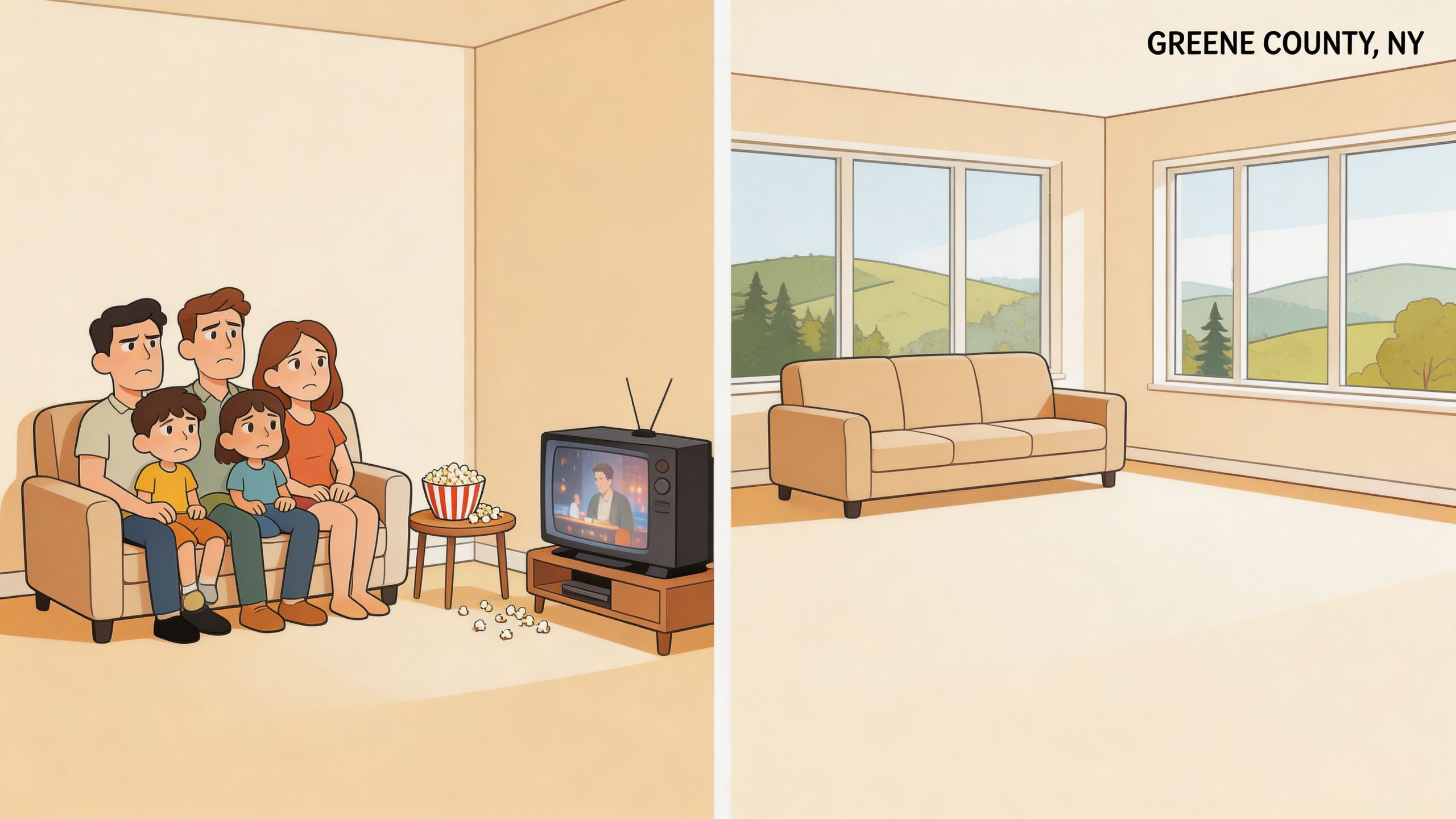
Movie night is where many people notice the issue first. Two people claim the sofa. Someone drags in a dining chair. One person ends up half on an ottoman, half leaning against the arm. The room may be nice, but it doesn’t support how the family lives.
That’s where an 8 piece sectional sofa starts to make sense. It creates one shared seating zone instead of several unrelated ones. The room feels calmer because everyone has a place.
It suits the way families gather now
Open living spaces changed what people expect from seating. A sectional isn’t just for sitting upright and entertaining guests for an hour. It has to handle streaming nights, homework, afternoon naps, visiting relatives, and the dog who thinks every cushion belongs to him.
The category is large for a reason. The global sectional sofa market reached USD 38.4 billion in 2024 according to DataIntelo’s sectional sofa market report. That demand reflects how many households want flexible, space-conscious seating rather than a sofa-and-loveseat setup that locks the room into one use.
Bigger doesn’t have to feel bulky
People sometimes hear “8 piece sectional” and assume “oversized.” That’s not always true. The better way to think about it is distributed seating.
Because the sofa is made of modules, it can define a conversation zone, anchor a TV wall, or soften the edges of a large room without looking like one giant block. In a historic home near Freehold, that can be especially helpful when the architecture gives you charm but not perfect symmetry.
A few signs an 8 piece sectional sofa may fit your life well:
- You host often: Family holidays, weekend visitors, and casual drop-ins need real seating.
- Your room does more than one job: The same space may be used for relaxing, talking, and keeping an eye on kids.
- You want one visual anchor: A sectional can make a large room feel settled.
- You’re tired of mismatched pieces: One coordinated seating system usually looks cleaner than collecting chairs over time.
Practical rule: If your room regularly needs to seat a group without pulling in extra chairs, you’re already in sectional territory.
Comfort also includes atmosphere. If you’re refreshing the whole room for cooler seasons, Sammi’s Attic has a thoughtful guide on how to create a cozy home retreat, which pairs nicely with sectional planning.
Understanding 8 piece sectional sofa
In an older Upstate New York home, the phrase 8 piece sectional sofa can be misleading at first. One room has a fireplace off center. Another has a radiator under the only long wall. A third has a doorway that cuts through the corner where a standard sectional would usually turn. In houses like these, “8 piece” matters less as a size label and more as a planning system.
An 8 piece sectional sofa is a group of separate upholstered sections that lock together to form one seating arrangement. The number refers to the modules in the set, not to one fixed shape. One retailer may count an ottoman as a piece. Another may build the same seating capacity with a wedge, two corners, and more armless seats. That is why two sofas can both be called 8 piece sectionals and fit very differently in the same room.
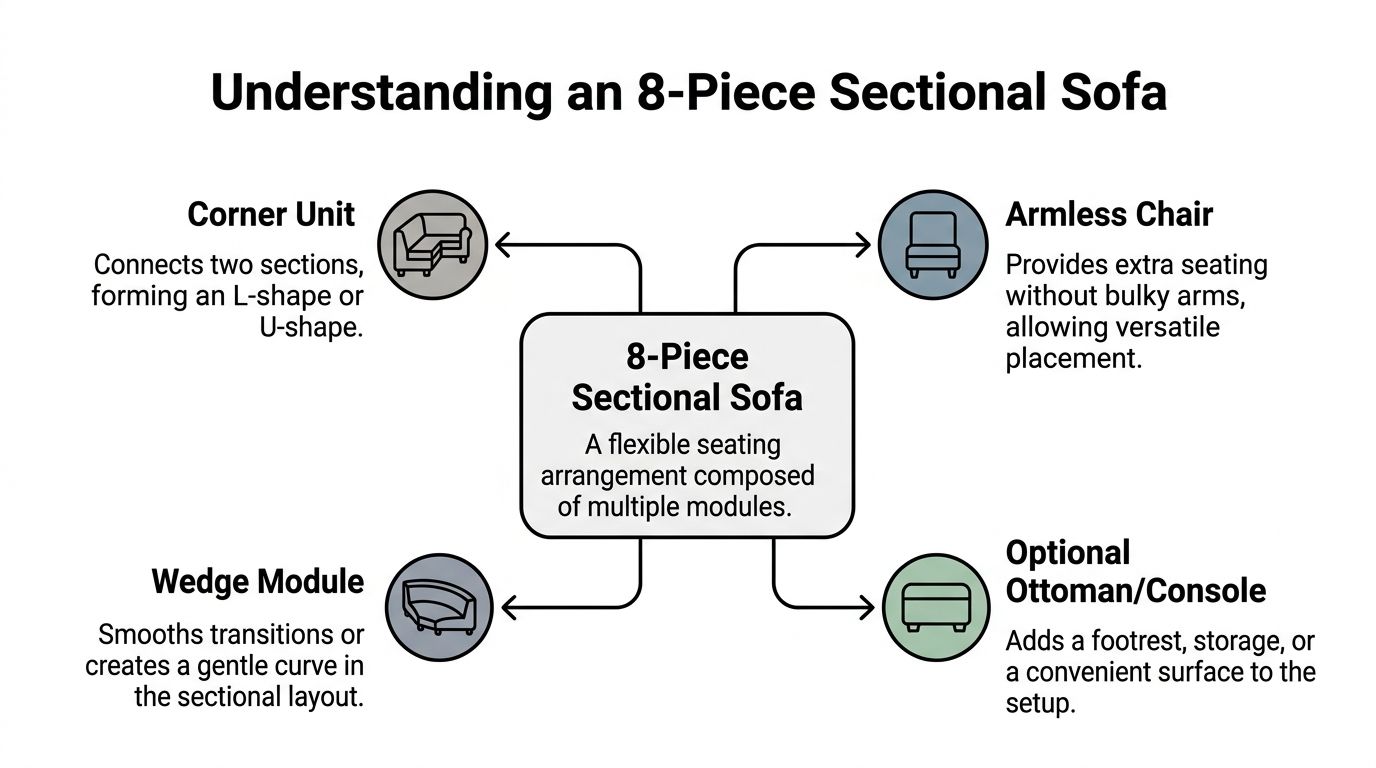
A simple way to read one is to treat it like a floor plan made of upholstered blocks. Each block has a job. Some create length. Some make the turn. Some soften the corner or add a footrest. In a newer rectangular room, that flexibility is convenient. In a Hudson Valley farmhouse or a Victorian near Albany with uneven walls and narrow entries, it can be the difference between a room that works and a room that always feels forced.
What the pieces usually include
Most 8 piece sets are built from a mix of these components:
- Corner units: the anchor pieces that create the turn
- Armless chairs: the straight run that adds seats without widening the profile
- A wedge or curved corner: a softer transition where a sharp 90 degree corner would feel too tight
- An ottoman or console in some sets: a movable piece that can serve as a footrest, table surface, or storage spot
The details inside those modules matter as much as the count. Seat depth changes posture. Back height changes support. Arm width changes how much visual weight the sectional brings into the room. A deep, low profile set encourages lounging. A slightly higher seat and firmer cushion usually feels easier for older family members who do not want to sink in and struggle to stand up.
That distinction causes confusion for many shoppers. They compare “8 piece” to “8 piece” and assume they are comparing equals. They are really comparing ingredients, proportions, and how those parts behave in a room.
This is also where local planning helps. At Tip Top, the conversation often starts with the quirks of the house itself, especially in historic Upstate homes that were never built around large modern furniture. A modular sectional can sometimes be reworked around a bay window, shifted to keep a wood stove clear, or built as a custom Amish order when standard modules leave awkward dead space. If you want a stronger foundation before choosing parts, Tip Top’s guide on what you should know before buying a sectional explains the basics clearly.
One more point is easy to miss. The modules may fit the room on paper but fail at the front door, stair landing, or tight hallway. In older homes around Saratoga, Troy, and the hill towns, that access check matters early, not after the order is placed.
A good 8 piece sectional is less like one giant sofa and more like a kit of parts shaped to the room you have.
Common configurations and dimensions
A good layout on paper can still feel wrong once it meets a real room. That happens often in older Upstate New York houses, where one wall jogs out a few inches, a radiator claims the obvious corner, or a bay window changes where the long side should go.
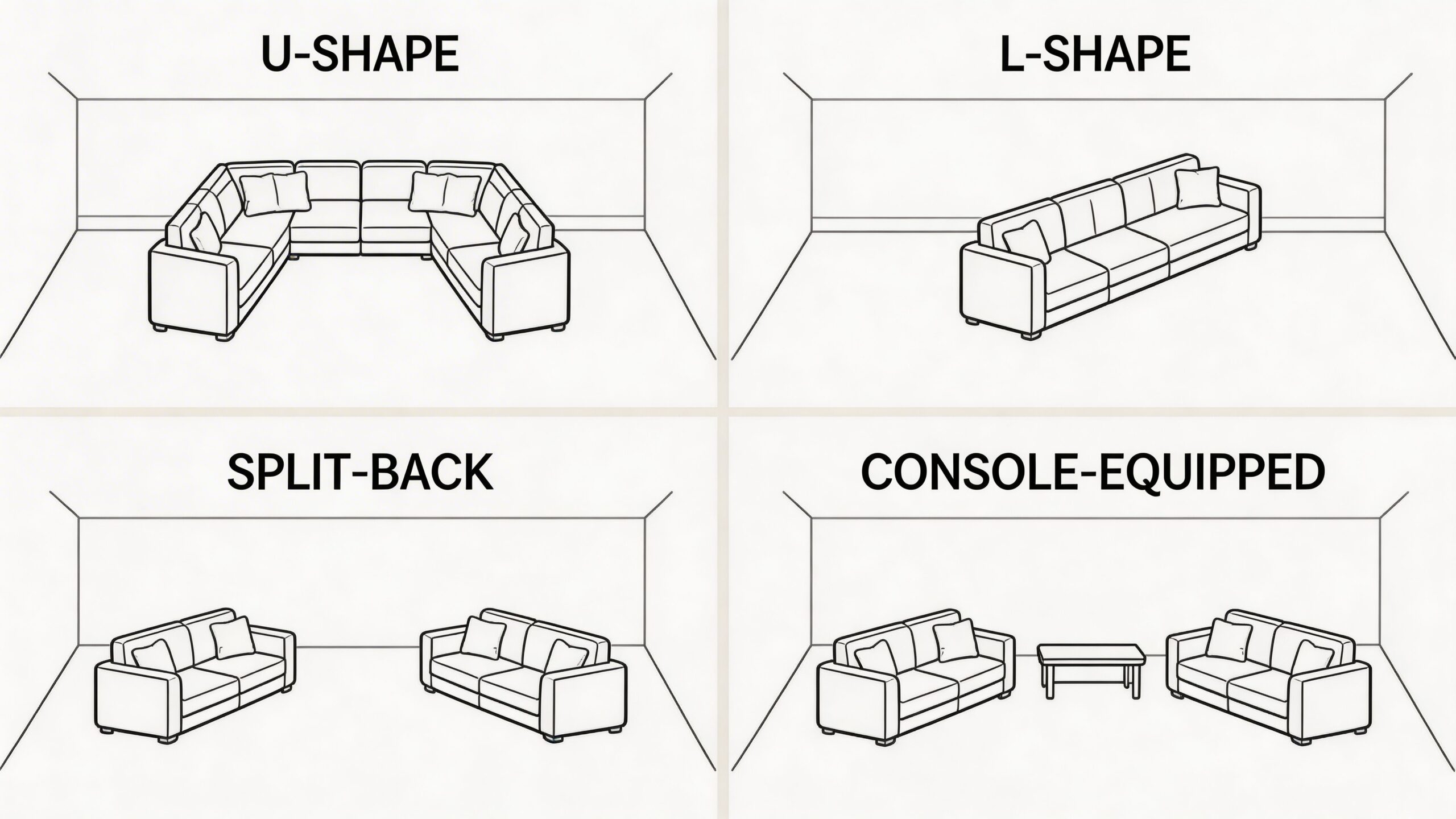
The useful way to compare 8 piece sectional sofa layouts is to start with the room shape, then match the modules to it. An 8 piece set works like building blocks. The same count of pieces can form a gathering zone, a corner arrangement, or two related seating groups with very different footprints.
U shape for gathering rooms
A U shape suits rooms where conversation or TV viewing stays at the center. It creates a clear seating zone and gives several people a direct sightline to the same focal point.
In a square or nearly square family room, that can feel balanced. In a narrow historic living room, it can also crowd the walk path if one side reaches too far toward a doorway or stair opening. That is why Tip Top often maps the opening widths, fireplace clearance, and window trim depth before recommending a U shape for older homes in Saratoga, Troy, and nearby towns.
As noted earlier from the Gardner White planning example, U style 8 piece layouts can stretch into the mid 150 inch range in width. That sounds manageable until you remember the side returns also project into the room. Homeowners are often surprised by how much floor area those returns claim.
L shape for open layouts
An L shape is usually easier to place because it defines the seating area while leaving one edge open. That open side matters in homes where the living room feeds into a dining room, kitchen, or front hall.
It also handles irregular architecture better. If one wall has a radiator, built in cabinet, or off-center window, the shorter leg can often shift to the cleaner side of the room. In custom Amish orders, that flexibility gets even better because the module lengths and arm styles can sometimes be adjusted to avoid awkward dead corners that standard retail sizes leave behind.
For some households, this is the layout that answers the "Do we really need eight pieces?" question. Comparing an 8 piece setup with a 5 piece sectional for smaller living rooms and simpler layouts often makes the tradeoff easier to see.
Console and split arrangements
Some 8 piece sectionals include a console between seats. In daily use, that is less about luxury and more about reducing clutter. Remotes, chargers, drinks, and reading glasses get one predictable home instead of drifting across every cushion.
Split arrangements solve a different problem. They let you break the set into two coordinated groupings instead of forcing one continuous shape. That approach helps in older homes where a single large sectional would block a wood stove clearance zone, press too close to a piano, or leave an unusable wedge of space near a curved wall.
A split layout often works well in historic homes because the architecture already divides the room. One half of the sectional can anchor the main conversation area while another module pair sits near a window or bookcase as a secondary perch.
A quick comparison
| Layout | Best for | What to watch |
|---|---|---|
| U shape | Big family rooms and conversation zones | Side sections can narrow walkways fast |
| L shape | Open floor plans and corner placement | The long leg needs careful alignment with windows, doors, and radiators |
| Console-equipped | Media rooms and everyday storage needs | Console position should match who actually sits there |
| Split modular layout | Irregular rooms and flexible use | Takes planning so the room feels intentional rather than leftover |
Modular design helps most when the house refuses a perfect rectangle. In many Upstate homes, the smartest plan is not the biggest shape. It is the one that keeps a natural path from doorway to doorway and still lets the room breathe.
If you are also planning for pets, kids, or seasonal wear, modular sofa covers can influence which configuration makes the most sense, especially if individual sections will see uneven use.
Pros and cons of 8 piece sectional sofa
An 8 piece sectional sofa solves several problems at once. It can also create a few if the room, construction, or household habits don’t match the piece.
The most practical way to evaluate one is to compare gains and trade-offs side by side.
Where it shines
The strongest advantage is capacity with cohesion. Instead of combining a sofa, loveseat, and occasional chairs, you get one seating system that looks unified.
Other benefits tend to follow:
- Flexible arrangement: Modular pieces let you adapt the setup to the room.
- Stronger visual anchor: Large rooms often feel more grounded with one substantial seating zone.
- Better group use: Families can sit together instead of spreading around the perimeter.
- Useful extras: Some models include consoles, storage, or chaise-like lounging sections.
Where buyers get tripped up
Size is the obvious issue, but it isn’t the only one. The less obvious concern is construction stress across more connection points and seams.
Verified data notes that 8-piece sectionals show 40% higher seam failure rates than 5-piece models after three years, which challenges the easy assumption that “more modular” always means “more durable,” according to Theater Seat Store’s referenced page.
That doesn’t mean an 8 piece sectional sofa is a poor choice. It means buyers should look harder at upholstery quality, stitch consistency, and how the family will use the sofa.
If kids jump between modules or people always drop into the same corner seat, the weak point shows up faster.
A balanced buying lens
A simple decision frame helps:
- Choose an 8 piece sectional sofa if your household needs generous, shared seating and your room can support the footprint.
- Pause if your room already feels tight, your household rarely gathers in one place, or you’d be happier with a lighter visual look.
- Upgrade your standards if you know the sofa will take daily wear from children, pets, or frequent guests.
For some homeowners, the better answer isn’t “yes” or “no.” It’s “yes, but only with stronger materials and a smarter layout.”
How to measure and plan your space
A family in an 1890s Upstate New York home can have a living room that looks generous at first glance, then turns tricky the moment a large sectional is on the way. The front door may be narrow, the hallway may dogleg near the stairs, and the “long wall” may lose a foot of usable space to trim, a radiator, or a fireplace that sits slightly off center. That is why measuring an 8 piece sectional sofa takes more than checking room width and calling it done.
Tip Top sees this often in older homes across Greene County and nearby towns. National guides usually assume square rooms and straight delivery paths. Historic homes rarely cooperate that neatly.
Measure the room like a floor plan, not a box
Start by measuring each wall on its own. In older houses, opposite walls can differ slightly, and corners are not always perfectly square. A sectional made of several modules gives you flexibility, but it still needs a footprint that respects the room you have, not the room you assume you have.
Record these details as you go:
Each wall length
Measure baseboard to baseboard, and note any spots where trim reduces usable depth.Windows, radiators, and heat sources
Mark how far they project into the room. A sofa that looks fine on paper can crowd a radiator or block airflow.Door swings and walking paths
Leave enough open space for daily movement. A good layout should feel natural on a quiet weeknight, not only during holiday gatherings.Outlets, vents, and floor registers
These matter more than buyers expect, especially if one module sits against a vent or you want a lamp beside the sectional.
Measure the delivery path with the same care
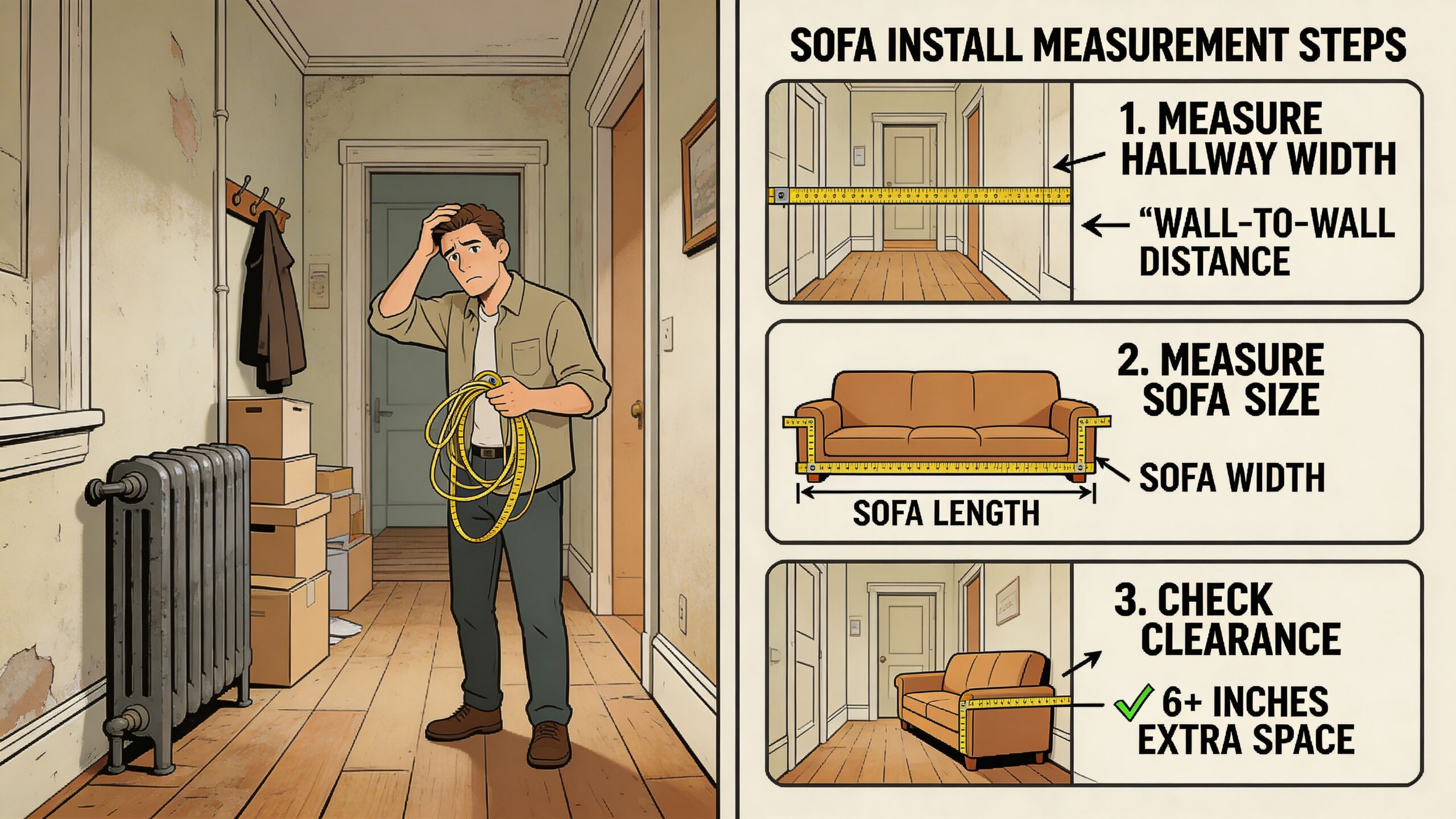
An 8 piece sectional sofa enters your home one piece at a time, but each piece still has to clear the tight spots. The smallest choke point usually decides whether delivery goes smoothly.
Check the full route:
- Entry door width and height
- Storm door clearance
- Hallway width
- Interior door openings
- Stair landings and turns
- Ceiling height near stairs or bends
- Corners where a bulky module has to pivot
As noted earlier, some larger modular pieces need more doorway clearance than buyers expect. If a path looks close, measure diagonally too. That often answers the question, which is whether the piece can turn, not just whether it can pass straight through.
Every module must fit through the tightest point of the route, then turn through the next one.
Mark the footprint on the floor
Painter's tape works like a full-scale draft drawing. Once the outline is on the floor, room planning becomes much easier to judge with your eyes and your feet.
Tape off the sectional’s full shape, then live with it for a few minutes. Walk from the doorway to the kitchen. Open the windows. Stand where a coffee table would go. Sit in a nearby chair and check the view toward the television or fireplace. What feels roomy in a product photo can feel crowded fast in a historic living room with uneven walls and deep trim.
Pay close attention to:
- Corner pinch points
- Clearance in front of fireplaces or stoves
- Space between seating and coffee table
- Sight lines to windows and TV
- Room to clean around the sofa
Plan around the house’s fixed quirks
Older Upstate homes have habits of their own. A radiator under the best window may rule out a long straight run. Baseboard heat can keep a sectional from sitting flush to the wall. Sloped floors may create slight gaps between modules, which is one reason some homeowners prefer custom solutions with dimensions adjusted to the room.
That is where local experience helps. Tip Top often helps homeowners configure sectionals around features that mass-market room planners barely account for, especially in homes with offset fireplaces, narrow parlors, or rooms that open into one another without a clear rectangle. In some cases, a custom Amish build is the smarter answer because it lets you adjust module width, arm style, or overall depth instead of forcing the room to accept a standard size.
Sketch the room before you shop
A simple drawing prevents a surprising number of mistakes. Use graph paper, a notes app, or an online tool. Mark windows, doors, trim, radiators, and anything else that steals space.
If you want a clear step-by-step method, this guide on how to measure a room for furniture perfectly is a practical place to start.
A quick pre-order check
Before you place an order, confirm five things:
- The sectional fits the usable room dimensions
- Each module fits the delivery route
- Walkways stay comfortable
- Heat sources and vents remain clear
- The layout matches how your household uses the room
Good sectional planning feels a bit like fitting cabinetry into an older kitchen. The room sets the terms first. Once those terms are clear, an 8 piece sectional sofa becomes much easier to configure well.
Choosing fabrics frames and comfort features
Once the size and shape are right, the long-term quality comes down to three things. Frame, cushion, and upholstery. If one of those is weak, the whole sofa will feel older faster.
That matters even more with an 8 piece sectional sofa because more seats and more seams mean more daily stress.
Frame quality decides the lifespan
Verified product guidance notes that in high-end 8-piece sectional sofas, a hardwood frame paired with high-density foam cushioning offers better structural integrity and longevity than plywood frames or lower-density foam, according to Lara Furniture’s Nevada sectional page.
In plain language, that means the sofa is more likely to stay square, supportive, and stable over time.
When you shop, ask what the frame is made of. “Wood frame” is too vague. A better answer is kiln-dried hardwood.
Cushion feel changes daily comfort
Two sectionals can look nearly identical and feel completely different after twenty minutes of sitting. Some have a relaxed sink-in feel. Others feel more supportive and upright.
For family use, the goal is often a middle ground:
- Soft enough for lounging
- Supportive enough for getting up easily
- Resilient enough not to flatten quickly
That’s why high-density foam matters. It tends to hold shape better under repeated use than lower-grade cushioning.
Comfort isn’t only about softness. Good support feels better after a long evening than a cushion that collapses.
Fabric should match the household
Shopping for style alone can go wrong. The prettiest fabric in the showroom may be the wrong one for the way your home runs.
Think about your real life:
- Pets: Claws, hair, and repeated spot cleaning change the equation.
- Kids: Snacks and spills ask for easier-care upholstery.
- Sun exposure: Large windows can be beautiful and demanding.
- Daily use: A formal room and a TV room don’t need the same textile.
Performance fabrics often make sense in busy homes because they’re easier to live with. Texture matters too. Some woven surfaces hide wear better than very smooth fabrics, while some soft chenilles feel wonderful but may require more maintenance depending on the weave.
If upholstery choices feel overwhelming, this guide on how to choose upholstery fabric is a practical place to sort through durability, feel, and appearance.
Small comfort features that matter
Buyers often focus on size and fabric, then overlook the daily-use details.
Check for:
- Arm height if someone likes to nap against the arm
- Seat depth if shorter family members need easier back support
- Back cushion style for upright versus lounge seating
- Storage or consoles if clutter tends to collect nearby
The best sectional isn’t the one with the longest feature list. It’s the one whose construction and comfort line up with the way your household uses the room.
Custom orders delivery and financing
A large sectional works best when it doesn’t force you to accept close enough. In many Upstate homes, close enough creates the very problems people were trying to solve in the first place.
That’s where custom ordering becomes more practical than many shoppers expect. If your room has an awkward depth, a tricky corner, or a very specific finish palette, customization can prevent compromise.
Custom ordering helps irregular rooms
A custom order lets you think beyond whatever happens to be on a showroom floor that week. For many homeowners, the biggest advantages are:
- Scale choices: A room may need the feel of an 8 piece sectional sofa without one oversized side.
- Fabric selection: You can match the upholstery to children, pets, or sun exposure.
- Style consistency: A custom piece can align better with traditional, transitional, or farmhouse architecture common across the Capital Region.
- American-made and Amish options: These appeal to buyers who want heirloom quality and more control over details.
That’s especially useful in and around Freehold, where many homes have character but not standard dimensions. A custom approach gives you a better chance of fitting the room instead of forcing the room to fit the sofa.
Delivery is part of the purchase
Large furniture should always be planned as a full process, not as a product drop-off.
Good delivery planning includes:
- reviewing the access path ahead of time
- confirming piece count and orientation
- checking whether assembly happens on site
- protecting floors and tight corners during placement
- testing the final arrangement before the team leaves
For large modular seating, white-glove delivery and in-room setup often make far more sense than a basic doorstep approach. A sectional that arrives in eight parts still needs to become one intentional layout once it’s inside.
Financing can make better planning easier
An 8 piece sectional sofa is often a considered purchase rather than an impulse buy. That’s why financing matters for many households. It can make it easier to choose the right construction and configuration now rather than settling for a temporary option and replacing it sooner.
For some shoppers, another smart route is comparing made-to-order seating with immediate-availability pieces. Clearance can be a strong option when the dimensions and style happen to line up with your room. The key is staying disciplined. A “deal” isn’t a deal if the sectional is wrong for the house.
If you’re considering personalization, this page on getting started with custom order gives a useful overview of how the process works.
When custom is worth it
Custom ordering usually makes the most sense when one of these is true:
- your room has architectural quirks
- you want Amish or USA-made craftsmanship
- you need a very specific fabric or finish direction
- you’d rather invest once than adjust around a compromise
A sectional is one of the largest visual and functional pieces in the home. Taking more care with ordering, delivery, and budget planning often pays off in a calmer room and fewer regrets.
Conclusion and next steps
An 8 piece sectional sofa can be a smart answer for the way many Upstate New York families live. It offers shared seating, layout flexibility, and a strong visual anchor for rooms that need more than a standard sofa can give.
The key is planning it like a whole-room decision. The right shape depends on traffic flow. The right size depends on the room and the delivery path. The right comfort depends on frame quality, cushion support, and fabric that matches daily life.
Historic homes around Freehold, Greene County, Albany, Schenectady, and Troy make that planning step even more important. Uneven walls, narrow entries, radiators, and offset focal points can all affect whether a sectional feels natural or frustrating. That’s why measuring carefully matters as much as choosing a style you love.
If you’re still deciding, keep your focus on three questions:
- Does the layout support how your household gathers?
- Can the sectional fit the room and the route into it?
- Will the materials hold up to the way you live?
When those answers line up, an 8 piece sectional sofa can turn a difficult room into the most comfortable and useful space in the house.
If you’re ready to compare layouts, test materials, or map out a tricky room in the Capital Region, Tip Top Furniture & Mattresses is a strong local place to start. Visit the Freehold, NY showroom, explore living room options, ask about custom Amish and USA-made choices, browse the Clearance Corner, or look into flexible financing for a project that fits your home and budget.