Low Profile Platform Bed Frame Buyer’s Guide


A lot of Capital Region shoppers don't start by asking for a low bed. They start by saying the bedroom feels crowded, the mattress looks too bulky, or the room in an older Albany or Troy home needs to breathe a little. Then they swap in a lower frame, step back, and the room suddenly looks calmer.
That shift isn't just about style. A low profile platform bed frame changes where the eye lands, how high the mattress sits, whether there's storage underneath, and how the mattress is supported night after night. For shoppers heading to a real showroom in Freehold, NY, those details matter more than the label on the tag.
Tip Top Furniture & Mattresses has served Upstate New York since 1978 and has offered professional design services since 1984, so the practical questions tend to come up fast. Families want to know whether a lower frame will work with a thick mattress, whether the bed will feel too close to the floor, and whether the slats are tight enough to protect the mattress they already own. Those are the questions that make the difference between a bed that looks good for a week and one that feels right for years.
Why a Low Profile Platform Bed Frame Feels Different
A common bedroom moment goes like this. A homeowner replaces a taller bed with a lower one, leaves everything else where it was, and the room feels larger before a single dresser or nightstand is moved. The window line looks more open. The ceiling seems higher. Even the lamp on the nightstand can look more in proportion.
That happens because the bed usually carries the most visual weight in the room. When the frame sits closer to the floor, the mattress doesn't cut across the room at the same height, so sight lines stay cleaner. In compact bedrooms across the Greater Albany Capital Region, that can make a noticeable difference in how the room reads from the doorway.
The room changes before the square footage does
A lower bed often helps in bedrooms with:
- Shorter wall space where a tall bed can dominate the room
- Visible windowsills that feel boxed in by a higher mattress setup
- Sloped ceilings in upstairs rooms where every inch of visual breathing room matters
- Thicker modern mattresses that already add height on their own
Practical rule: A low bed doesn't make the room bigger. It makes the room feel less interrupted.
There's also a comfort side to it. Some sleepers like the grounded feeling of a lower setup. Others realize quickly that a lower frame changes how they sit, stand, tuck in sheets, and store extra blankets. That's why this category trips people up. The frame may look simple, but the decision isn't just visual.
It's a full sleep setup decision
A low profile platform bed frame affects several things at once:
- Sleep height
- Ease of getting in and out
- Mattress support
- Under-bed clearance
- Overall bedroom scale
That's where many online guides stop too soon. They praise the look, but they don't explain how height, slat spacing, and mattress thickness work together in a real home. For a shopper standing in a showroom near Freehold after driving over from Albany, Schenectady, or Troy, that's the part worth understanding before delivery day.
What Counts as a Low Profile Platform Bed Frame
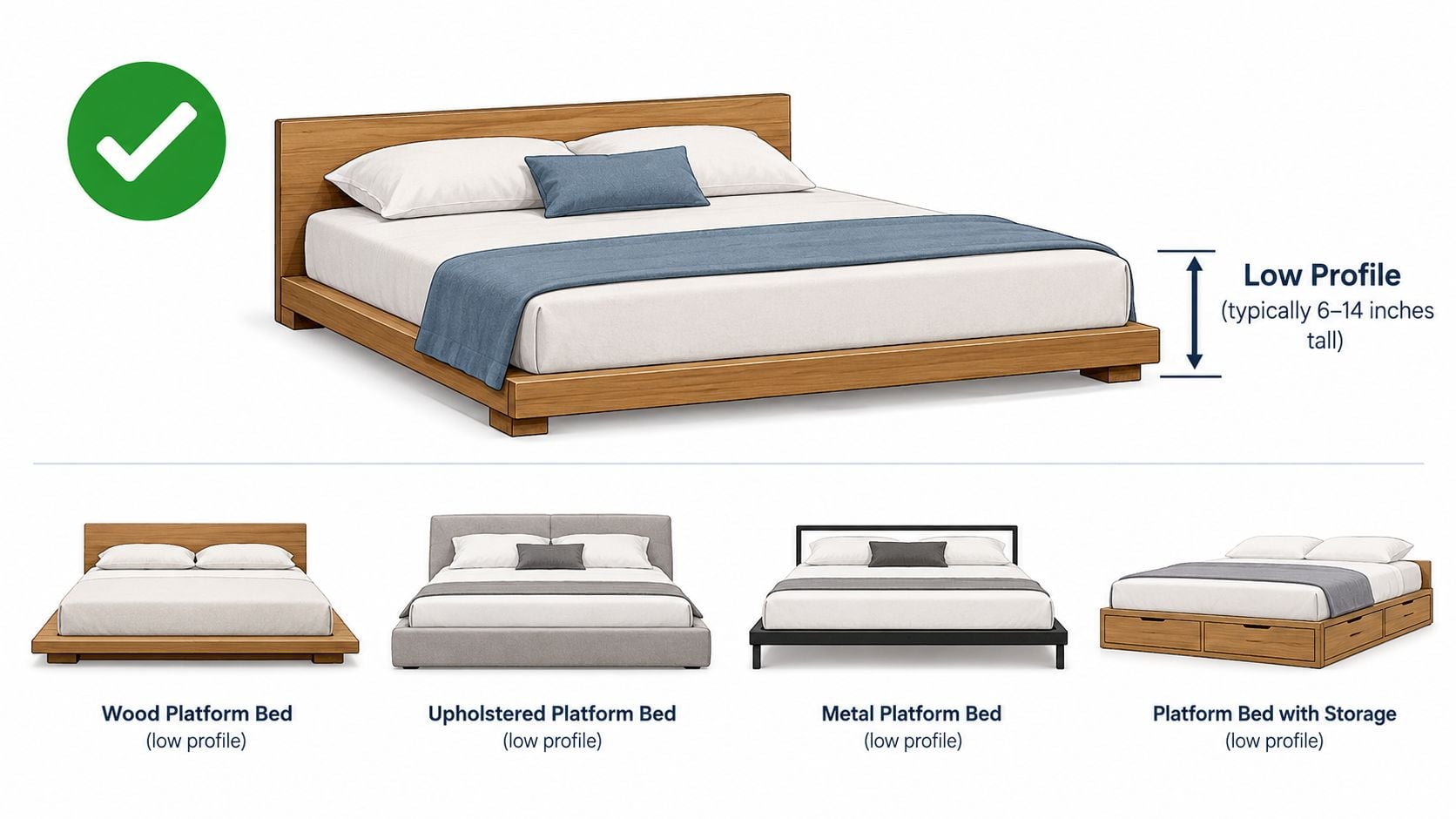
A low profile platform bed frame is usually defined by height, not by style. One market guide notes that low profile frames are commonly treated as sitting under 12 inches from the floor to the top of the sleeping surface before the mattress is added, and many listings place the frame itself at about 3 to 10 inches high (low profile frame measurements and examples). Another guide describes low-profile platform beds as sitting about 4 to 10 inches above the floor at the platform or slat level, compared with standard platform beds that are often around 14 to 18 inches high (platform and mattress profile height guide).
Height category, not decorating category
That means a low-profile frame can be:
- Solid wood and traditional in feel
- Minimal and modern
- Upholstered and soft-looking
- Headboard or no headboard
What it isn't is the same thing as a floor mattress or a futon frame. A true platform frame still lifts the mattress, supports it across slats or a solid surface, and usually removes the need for a box spring. Many product listings specifically state that platform beds are designed to work with or without a box spring, which reflects the support already built into the frame (low-profile mattress and support overview).
A quick tape measure check
Shoppers can sort options fast with a simple measuring habit:
- Measure from the floor to the top of the slat or platform surface
- Ignore the headboard height
- Don't guess based on photos
- Add mattress thickness separately
A frame can look low and still sit higher than expected once a thick mattress is on top. That's why a frame should be judged by its support height first.
For shoppers who want an example of a storage-forward variation on the concept, a bookcase platform bed shows how platform construction can be combined with additional function without changing the basic support idea.
The safest way to judge a low bed is with a tape measure, not a product photo.
How Low Profile Designs Change Daily Comfort
A lower frame changes daily life more than most shoppers expect. The difference shows up in four places first: getting in and out of bed, how open the room feels, what fits under the frame, and how high the mattress ends up once everything is assembled.
Where the tradeoffs show up
A guide to platform beds notes that most platform beds fall in the 6 to 20 inch height range, and standard mattress sizes remain highly consistent across markets, which is one reason platform designs are so adaptable (platform bed dimensions and height range). In practical use, the lower models push the room toward a cleaner, more relaxed look, but they also give up some storage and can feel lower at the knees when sitting down.
Another mattress guide notes that a low-profile setup often lands in the mid-teens to low-20s inches total sleeping height, depending on mattress thickness. The same source contrasts that with standard platform setups that often land around 22 to 30 inches total (floor bed frame and total sleep height examples).
| Comfort Factor | Low Profile (7-11 in) | Standard Platform (14-18 in) |
|---|---|---|
| Getting in and out | Often feels lower and more grounded | Often easier for people who prefer a higher seated position |
| Visual scale | Usually makes the room feel more open | Usually creates a more substantial furniture presence |
| Under-bed storage | Often limited or minimal | Usually offers more usable clearance |
| Mattress pairing | Thick mattresses can balance the low frame well | Thinner or medium mattresses often still reach a moderate sleep height |
The frame height doesn't tell the whole story
Shoppers get tripped up. They hear “low profile” and assume the bed will feel extremely low. Sometimes it will. Sometimes it won't.
A lower frame paired with a thick mattress can still create a sleep surface that feels comfortable for everyday use. A lower frame paired with a thin mattress can place the sleeper much closer to the floor. That can suit a child's room, a minimalist space, or a sleeper who likes a tucked-in look. It may not suit someone who wants easier standing height.
A bed's real comfort height is the frame plus the mattress, not the frame by itself.
In smaller bedrooms around Albany and Schenectady, many shoppers choose low-profile frames because the visual payoff is immediate. The room feels less crowded. The tradeoff is that they need to think harder about mattress thickness and daily movement than they would with a taller platform.
Slat Spacing and Mattress Compatibility Explained
A low bed can look sturdy and still be wrong for the mattress on top of it. The reason is usually hidden under the mattress. Slat spacing does support work on many platform beds, and that spacing can affect both comfort and warranty protection.
Why slat gaps matter
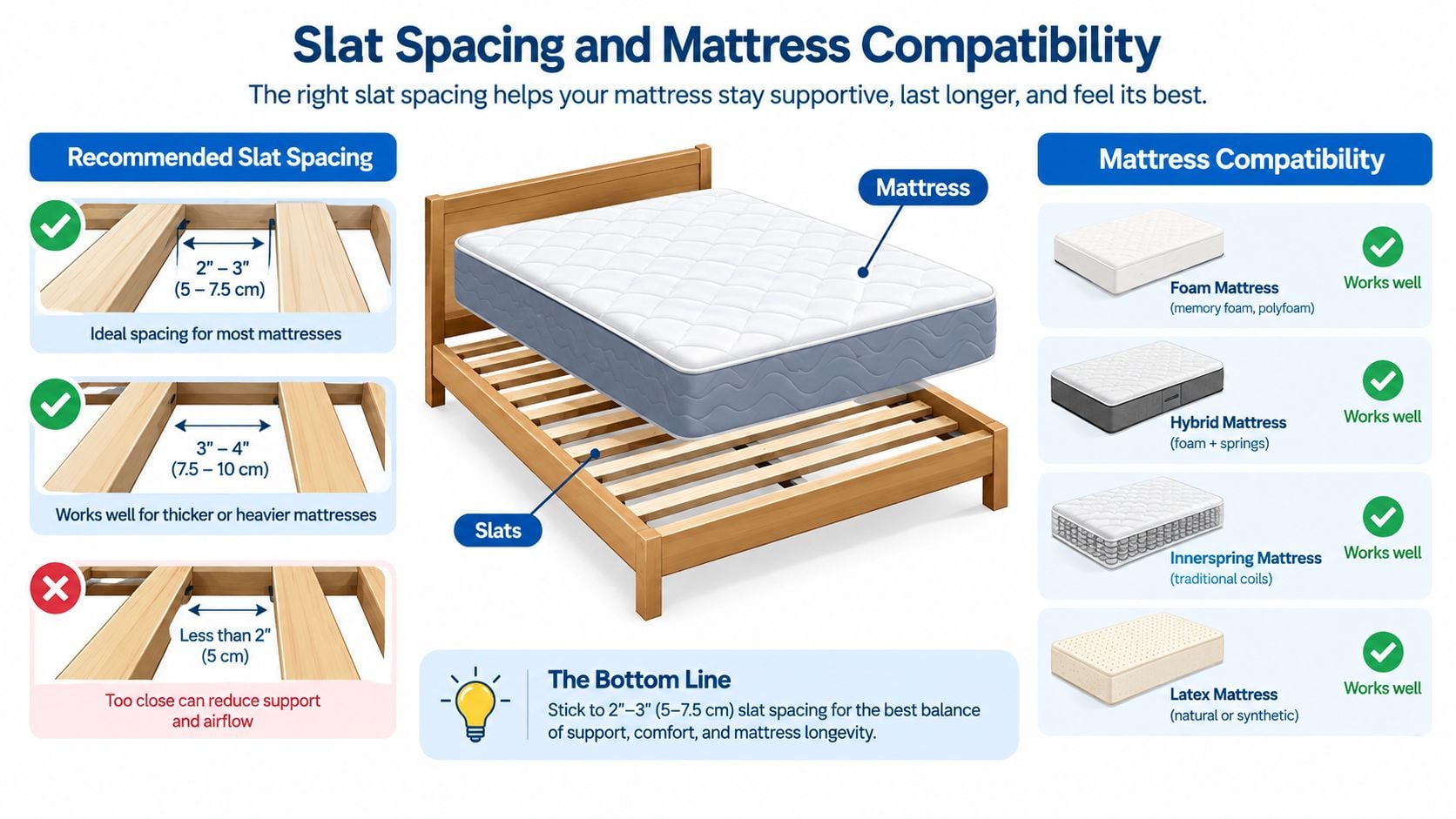
Independent mattress-support guidance points to a practical maximum slat gap of about 2 to 3 inches, with memory foam and latex generally performing best at the tighter end because larger gaps let the foam push down between supports and take more localized stress (bed frame slat spacing mattress support guide).
A separate low-profile guide puts the warning in even plainer terms. It notes that one source says spacing wider than about 2.75 inches can void memory foam or latex warranties, while another recommends 2.5 inches or less and center support for queen and king frames (low-profile support and warranty discussion).
What to check in the showroom
A shopper doesn't need a technical background to judge mattress support. A few checks usually tell the story:
- Measure the gap between slats, not just the width of the slats themselves.
- Look for a center support rail on queen, king, and California king sizes.
- Ask for the mattress warranty card and compare the support requirement directly.
- Press down between slats mentally, not physically. If the spacing looks wide, foam mattresses may notice it over time.
Memory foam and latex are usually the most sensitive because they rely on even support across the surface. Hybrids can also benefit from tighter support. Traditional innerspring models may be more forgiving, but shoppers still need to verify the manufacturer's requirements instead of assuming.
For households planning a move at the same time as a bed replacement, practical handling matters too. A guide on moving a mattress in Sydney gives a useful overview of keeping a mattress protected and upright during transport so the support core isn't stressed before it even reaches the new frame.
A simple compatibility mindset
One useful local option for learning the differences among constructions is mattress types explained, which helps shoppers sort out how foam, latex, hybrid, and innerspring models behave on a platform base.
The right question isn't “Will the mattress fit?” It's “Will the mattress be supported the way its warranty requires?”
That's the gap many buying guides miss. A low profile platform bed frame can work beautifully with a modern mattress. It just needs the right slat pattern and the right structure underneath.
Matching Mattress Sizes to a Low Profile Frame
Bed size labels sound straightforward until a shopper starts measuring a tight bedroom wall, a stair turn, or the gap between a dresser and the foot of the bed. Mattress size is standardized, but the frame footprint is always a little larger.
Standard mattress sizes and what they mean in the room
Standard mattress dimensions used with platform frames are widely consistent: Twin 39 x 75 inches, Full 54 x 75 inches, Queen 60 x 80 inches, King 76 x 80 inches, and California King 72 x 84 inches. A guide to platform beds also notes that a queen platform frame is often built around 62 to 65 inches wide and 82 to 85 inches long overall, while a king typically reaches about 78 x 84 inches overall (standard platform mattress and frame dimensions).
That extra frame footprint matters in older Upstate homes where doorways, radiators, and narrow staircases don't leave much margin.
| Mattress Size | Mattress Dimensions | Typical Frame Footprint | Suggested Mattress Thickness |
|---|---|---|---|
| Twin | 39 x 75 inches | Slightly larger than the mattress on all sides | A medium to thicker mattress often helps avoid an overly low feel |
| Full | 54 x 75 inches | Slightly larger than the mattress on all sides | Often works well with a mattress that adds comfortable sitting height |
| Queen | 60 x 80 inches | Usually about 62 to 65 inches wide and 82 to 85 inches long | Often a good match for shoppers wanting a balanced total sleep height |
| King | 76 x 80 inches | Often about 78 x 84 inches overall | Thicker mattresses are often chosen to keep the setup from feeling too low |
What to measure before delivery day
The smartest shoppers measure more than the mattress size. They also check:
- Doorway width and stair turns
- Distance from bed edge to dresser or wall
- Headboard depth if the frame includes one
- Footboard projection if the room is tight
For households also clearing out an older sleep set, information on Renue Systems Four Points mattress disposal can help with planning what happens to the old mattress before the new frame arrives.
A helpful companion for in-store shopping is the ultimate guide to mattress sizes, especially when two sleepers are trying to balance room fit with personal sleeping space.
Materials and Construction Worth Knowing
Low beds look simple, but the materials underneath determine how the frame feels after years of use. A frame that sits low needs to stay rigid, hold the slats in place, and handle the weight of the mattress and sleepers without shifting.
Solid wood, metal, and upholstery each behave differently
Solid wood appeals to many Upstate NY homeowners because it brings warmth and visible grain, and it often suits both traditional and pared-back bedrooms. Buyers who value handcrafted, heirloom-quality furniture often gravitate toward Amish-made options because the construction details tend to matter as much as the finish.
Metal works well when a slimmer outline is the priority. It can be easier to move through narrow staircases and tighter hallways, which matters in older Capital Region homes. The caution is that not all metal frames are built the same. The quality of welds, side rail connections, and slat supports makes a real difference.
Upholstered frames soften the room visually and can make a low bed feel less stark. They also ask for more thought about fabric care, pet wear, and how the upholstery wraps around corners and rails.
What deserves a closer look
Shoppers don't need to become furniture engineers, but they should inspect a few construction points:
- Corner strength: The frame shouldn't rely on light hardware alone.
- Center rail attachment: Larger sizes need stable middle support.
- Slat retention: Slats should stay aligned when the mattress is rotated.
- Joinery quality: Wood construction should show intentional assembly, not shortcuts.
A good way to understand one of the classic wood construction methods is what is mortise and tenon joint, which explains why certain joints hold up so well in frequently used furniture.
A low bed frame doesn't have to look heavy to be durable. It just needs honest construction in the places most shoppers never see.
For homeowners trying to furnish a whole room, this is also where one-stop shopping becomes useful. Bedroom furniture, a compatible mattress, and even flooring can be coordinated together, which helps the bed feel intentional in the room instead of dropped in as a standalone piece.
Who Should Choose a Low Profile and Who Should Skip It
Some buyers know within seconds that a low bed suits them. Others like the look but won't enjoy living with it. The difference usually comes down to body mechanics, room needs, and mattress choice.
Shoppers who often do well with a lower setup
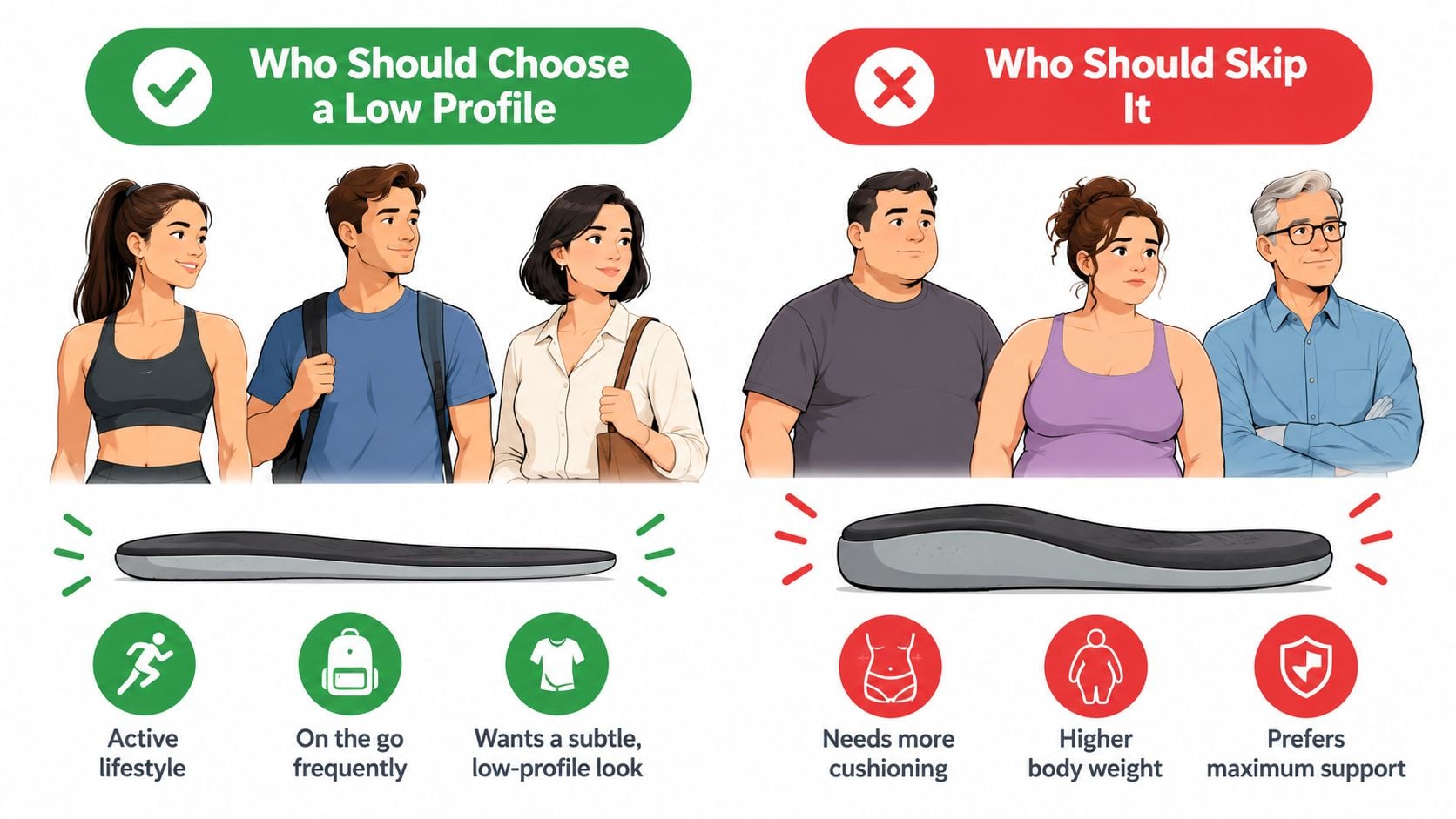
A low profile platform bed frame often suits:
- Petite adults who don't want to climb onto a taller mattress setup
- Smaller bedrooms where a lower visual line opens up the room
- Homes with sloped ceilings or strong window lines where a taller bed feels crowded
- Shoppers using thicker mattresses that can bring the final sleep height back into a comfortable range
- People who prefer a minimalist bedroom with less furniture bulk
Shoppers who should think twice
A lower frame may be less comfortable for:
- Tall sleepers who prefer a higher seated starting point when standing up
- People with joint pain or mobility limitations who don't want to lower themselves as far
- Households that depend on under-bed storage
- Owners of thin mattresses that could leave the sleep surface feeling too close to the floor
One independent design guide notes that low-profile beds are often around 6 to 18 inches from the floor and may make a room feel larger, while also acknowledging a tradeoff for people with mobility limits and for everyday tasks like making the bed (low modern bed frame ergonomics and accessibility).
A lower bed can help one person's comfort and frustrate another person every single morning.
A short in-store checklist
Before committing, a shopper should:
- Sit on the edge with shoes off and notice knee bend
- Check final sleep height with the actual mattress being considered
- Confirm center support on larger sizes
- Inspect slat spacing against the mattress warranty requirements
- Ask how much real clearance sits under the frame
That last point matters more than many expect. Some low frames barely leave room for anything underneath, which is fine if the room has enough other storage and frustrating if it doesn't. The bed frame is only one piece of the sleep system, and it needs to match the sleeper, the mattress, and the room.
Shopping Locally in the Capital Region with Confidence
Buying a bed online can look simple until the questions get specific. How high does the mattress sit once it's on the frame? Are the slats close enough for the mattress warranty? Will the side rail feel comfortable at the knees? Those answers are easier to trust when the shopper can see and touch the setup in person.
That's where a showroom visit helps Capital Region homeowners. A local store can let shoppers compare low heights side by side, check wood versus upholstered construction in person, and see whether the frame feels grounded or too low. It also helps when the home itself has quirks, like narrow stairs, unusual wall spacing, or older room proportions.
What local buying solves
For shoppers visiting Freehold from Albany, Troy, Schenectady, Greene County, or nearby areas, a local furniture store can make the process more practical by offering:
- Hands-on testing of frame height and mattress pairing
- Custom ordering when standard options don't suit the room or style
- Delivery and assembly help for larger or heavier pieces
- Flexible financing when the bed purchase is part of a bigger room project
- Access to bedroom, décor, and flooring coordination in one place
For move planning, protective handling matters too. A guide to Padded Removal Blankets for your furnitures Protection is a practical reference for keeping bed components and case goods from getting scuffed in transit.
Shoppers who want to understand setup support ahead of time can also review furniture stores that deliver and assemble, which helps clarify what to expect when the new bed arrives.
What to bring before visiting
A productive showroom visit usually starts with three things:
- Mattress measurements
- Photos of the bedroom, doorway, and stair path
- A note about whether storage under the bed is important
That preparation makes a big difference. It turns a broad style conversation into a real fit conversation. For many Upstate NY homeowners, that's the point where a low profile platform bed frame stops being a trend and starts becoming a smart, comfortable choice for the room they have.
Tip Top Furniture & Mattresses offers bedroom furniture, USA-made mattresses, Amish-crafted options, custom ordering, delivery, assembly, and flexible financing for shoppers across the Capital Region. For anyone comparing frame height, slat support, and mattress pairing in person, a visit to Tip Top Furniture & Mattresses can make the decision clearer and the final setup more comfortable.