What Is Shaker Style Furniture? Key Features Explained


Shaker style furniture is plain, functional furniture in which the form follows the job and the quality shows in proportion and joinery. For a homeowner comparing a simple wooden chest with a similarly plain cabinet, the difference often becomes clear only when a drawer opens or a joint comes into view.
What Shaker Style Furniture Is and What Sets It Apart
Imagine standing in a showroom with two simple wooden chests. One looks tidy from the front, while the other opens smoothly, sits level, and shows careful edge work. Shaker style lives in that second kind of attention. A well-made piece works like a well-cut jacket, with fit, balance, and workmanship doing the quiet work.
Defining features to recognize Shaker style
| Feature | What it looks like | What to check |
|---|---|---|
| Clean lines | Straight, uninterrupted edges and flat planes | Crisp edges with no decorative breaks |
| Restrained ornament | No carving, inlay or applied moldings | Every visible detail serves a structural purpose |
| Balanced proportions | Measured heights, widths and leg shapes | The piece feels stable and well scaled for its use |
| Built-in storage | Drawers, cupboards and cabinets built into the form | Drawers slide smoothly and fit tightly |
| Practical forms | Chairs, tables, benches, cupboards and beds | Each shape matches a daily task |
| Honest materials | Wood grain and finish left visible | Check whether surfaces are solid wood or veneer |
The San Francisco Airport Museum describes Shaker furniture through clean lines, purity of form, honesty, utility, and craftsmanship. Those qualities explain why a plain silhouette alone leaves the question open. The test comes when the drawer, leg, edge, and backing show the same care as the front.
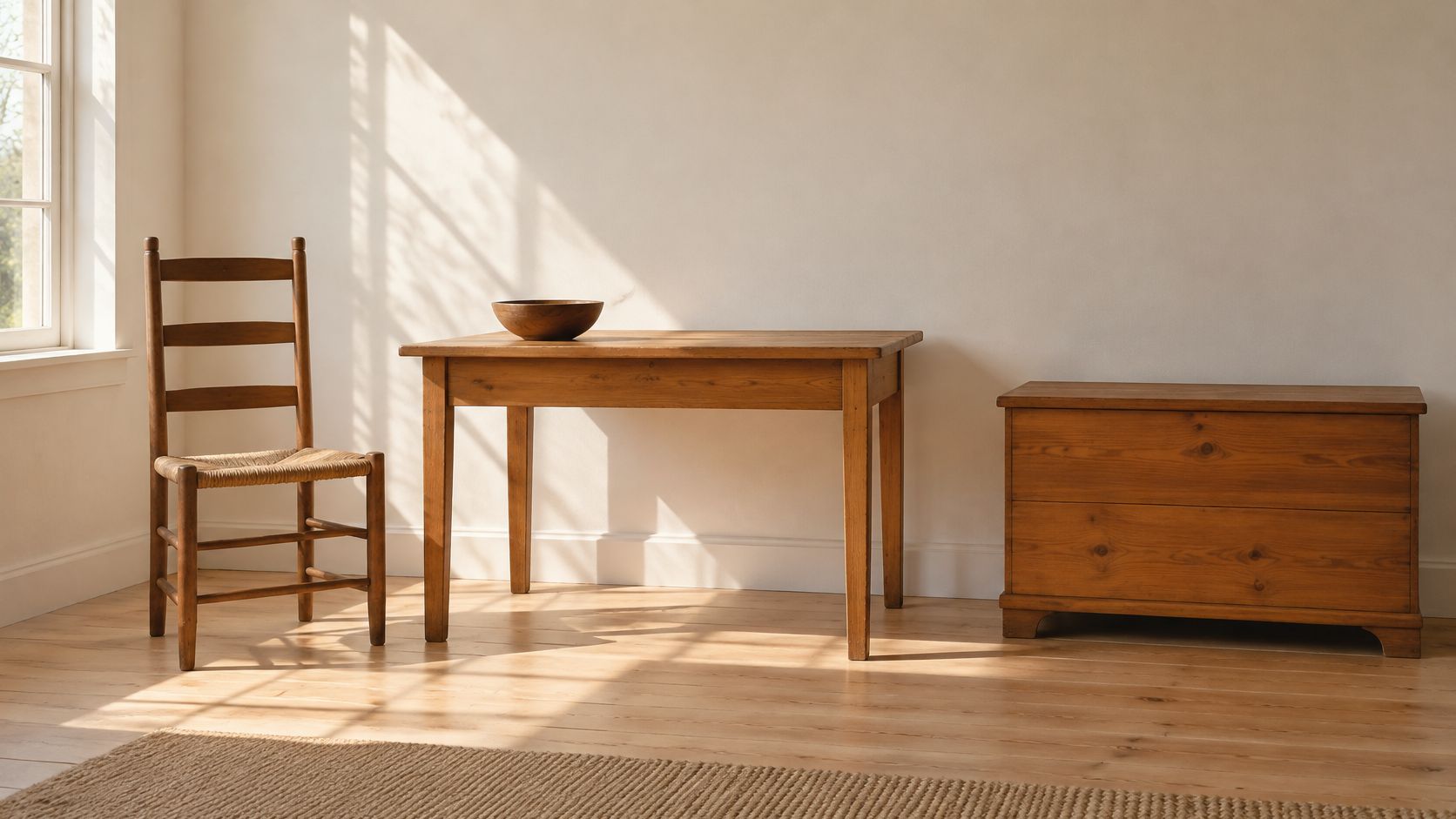
Consider a bedroom chest as a small lesson in the style. Drawer sizes should suit the clothing it holds, handles should feel comfortable in the hand, and the base should support the case without looking unnecessarily bulky. Those choices make the piece useful before they make it decorative. That order matters, because Shaker furniture starts with daily work and lets the appearance follow.
What the showroom test reveals
A patient shopper can inspect the drawer edges, open the storage compartments, and examine the back rather than judging only the front. Check that a clear finish reveals solid wood, and confirm that a tight drawer fit still slides freely. Look for edges that stay clean, joints that sit neatly, and proportions that make the piece easy to use in the room you have.
A Shaker label describes an intention. The actual piece still rewards a close look, especially when you are comparing similar pieces for a home in the Capital Region. Kenneth E. Dudley founded Tip Top Furniture in 1978. Today, the family-owned Tip Top Furniture & Mattresses showroom in Freehold, NY, serves shoppers from Freehold and across the Greater Albany Capital Region, including Greene County.
Where Shaker Style Came From and How It Grew
The people behind the furniture belonged to the United Society of Believers in Christ's Second Appearing, commonly known as the Shakers. Their furniture developed within communal life, not as a decorating collection created for fashionable homes.
The style grew through the late eighteenth and nineteenth centuries, with Mount Lebanon in New York becoming an important production and design center. Furniture making belonged to a broader communal economy that included farming, manufacturing, inventions, and household goods.
Key dates in Shaker furniture history
The National Park Service's history of Shaker style traces the following milestones, including the movement's arrival in 1774, its 1840s peak of more than 6,000 members in approximately 19 communities, and its later influence.
| Period or date | Milestone | Why it matters |
|---|---|---|
| 1774 | Shakers arrive in America from England | Start of the movement behind the style |
| 1810 | Circular saw introduced | Machines begin to shape Shaker production |
| 1840s | Peak of more than 6,000 members in about 19 communities | Furniture production develops across eastern communities |
| Late 1800s | Mount Lebanon workshops mass-produce ladder-back chairs | Shaker standards reach beyond a single workshop |
| 1876 | Shaker goods shown at Philadelphia's Centennial Exhibition | The style reaches a national audience |
| Early twentieth century | Notable revival of interest | Renewed public attention to the style |
| 1960s and 1970s | Museum collecting accelerates | Original pieces are preserved for study |
Communities stretched through New England, New York, Ohio, Kentucky, and other eastern areas. Their workshops needed repeatable methods that could produce useful objects consistently.
- Technology supported the work. Shaker makers adopted machinery rather than treating hand tools as the only legitimate route to quality.
- Production served daily needs. Chairs and cupboards had to function in shared environments, where awkward designs would quickly become inconvenient.
- Public sales broadened the audience. Furniture eventually reached people outside the communities that developed it.
For a modern buyer, this history corrects a common misunderstanding: traditional Shaker design doesn't necessarily mean exclusively handmade construction. Its enduring value lies in disciplined design and careful execution, whether a maker uses hand tools, machinery, or both.
The Design Rules Behind the Look
Shaker makers removed unnecessary decoration for a reason. Their religious principles emphasized honesty, utility, simplicity, and disciplined workmanship, while excessive ornament could suggest pride, as Britannica's account of the Shakers explains.
That background helps answer “what is Shaker style furniture?” more accurately than a description of plain doors or tapered legs. The look followed a set of convictions about useful work.
Rules that explain the appearance
- Form follows function. A sewing box needs organized compartments and convenient access. Its shape should help someone work rather than merely resemble a decorative box.
- Materials retain their character. On a wooden table, the surface and finish can provide interest without an added ornamental border.
- Proportion comes before decoration. A tall cupboard depends on the relationship between its doors, base, and overall height. Carving can't rescue an awkward balance.
- Useful details stay. A knob belongs because a hand needs a grip. An extra molding added only for display has a weaker connection to the design.
Restraint doesn't mean every piece must be perfectly symmetrical. A chest can use differently sized or asymmetrically arranged drawers to accommodate different contents, creating visual interest through organization.
Plain furniture isn't necessarily simple to make. Without ornament, uneven gaps and awkward proportions have nowhere to hide.
The Shaker vocabulary extends beyond cabinets and dining chairs. It includes tables, beds, desks, bookcases, benches, clocks, stools, trunks, and sewing boxes, reflecting an approach to furnishing an entire home.
A useful way to judge a plain piece is to identify the problem its shape solves. A narrow upper drawer might organize small items, while a deeper lower compartment holds bulkier belongings. The explanation should come from use and proportion, not from a decorative story attached to the product.
Materials and Joinery That Make It Last
Durability comes from the connections, not from bulk. A heavy-looking table can have weak joints, while a visually light chair can be carefully engineered.
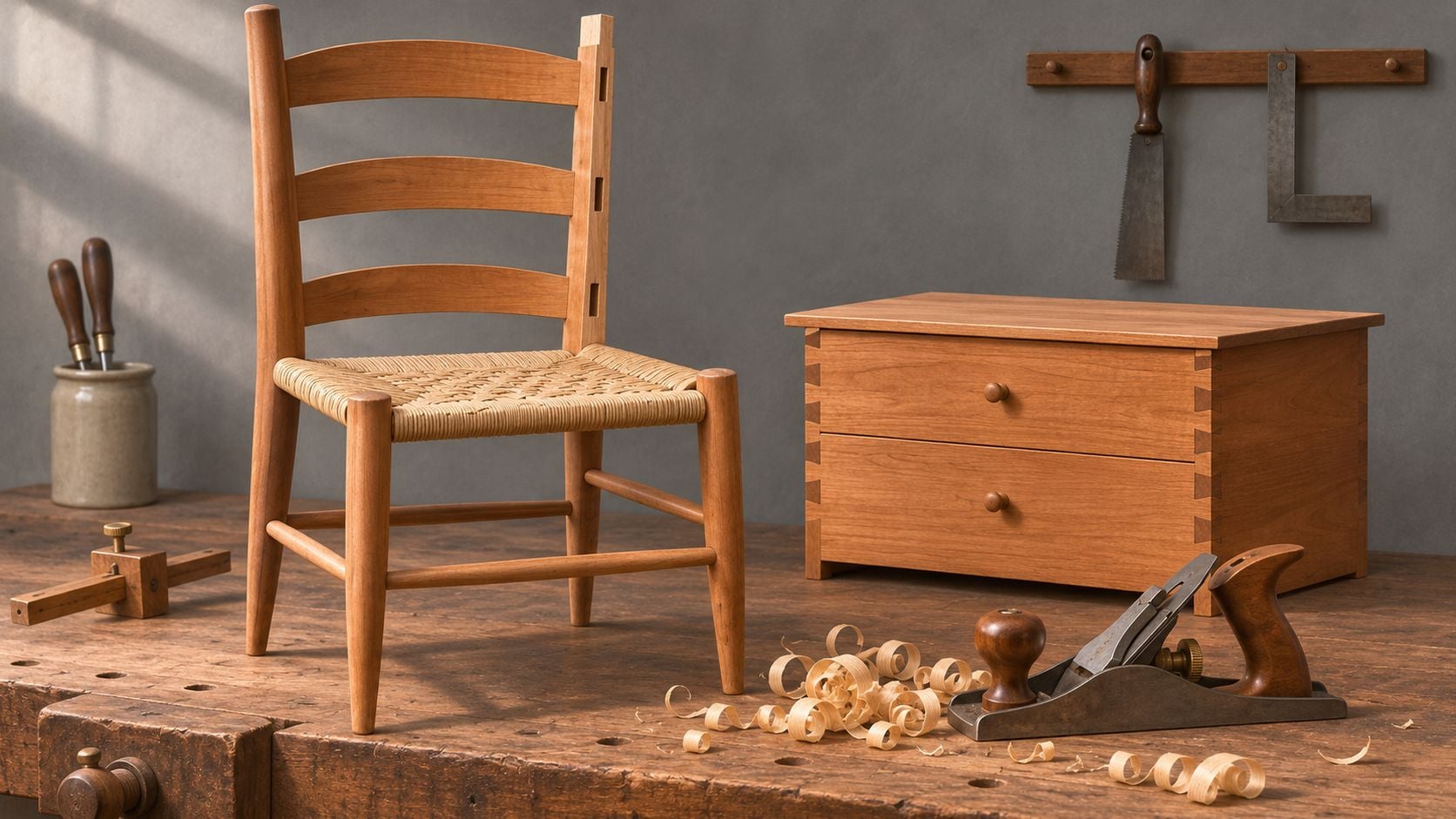
A mortise-and-tenon joint works like a shaped peg fitting into a snug socket. The fitted surfaces spread stress across a larger wood-to-wood area rather than leaving the connection dependent on a screw driven into an edge.
The Metropolitan Museum of Art's Shaker Room documentation records mortise-and-tenon and dovetail construction, along with hardwoods used for structural legs and rails. Tip Top's explanation of what a mortise-and-tenon joint is provides additional context for recognizing this connection.
Common joints and where they appear
| Joint | Where it appears | Why it matters |
|---|---|---|
| Mortise and tenon | Legs, rails and frames | Spreads load across a larger wood-to-wood area |
| Dovetail | Drawer boxes and case corners | Resists drawer-front separation under repeated pulling |
| Rabbet | Edges of cases and back panels | Gives panels a clean, stable meeting point |
| Dado | Shelves and partitions inside cases | Supports shelves along a fitted channel |
| Tongue and groove | Wide panels and boards | Aligns adjoining boards; the surrounding assembly must still accommodate movement |
Wood expands and contracts mainly across its grain. A wide solid-wood panel therefore needs construction that permits movement rather than locking every edge rigidly in place.
Tongue-and-groove construction alone doesn't guarantee that freedom. The panel's attachment to the rest of the furniture matters just as much as the joint between boards.
A practical inspection routine
- Examine drawer corners. Dovetails should fit evenly, without open gaps or broken edges. Decorative-looking joint shapes aren't a substitute for sound fitting.
- Check the frame. With permission, apply gentle pressure to a chair or table. Rocking connections, visible gaps, or movement between the legs and rails deserve an explanation.
- Look beneath wide surfaces. Slotted attachments or other movement provisions can allow a tabletop to change width without forcing the base apart.
Finish quality also deserves attention. The underside of a drawer pull, the edge of a shelf, and the inside of a door should feel appropriate for regular handling.
For a custom or Amish-made piece, the written specification should identify wood species, joinery, finish schedule, and care instructions. A photograph can communicate appearance, but it can't define how a maker should build the furniture or how its owner should maintain it.
How Shaker Pieces Fit Into a Modern Home
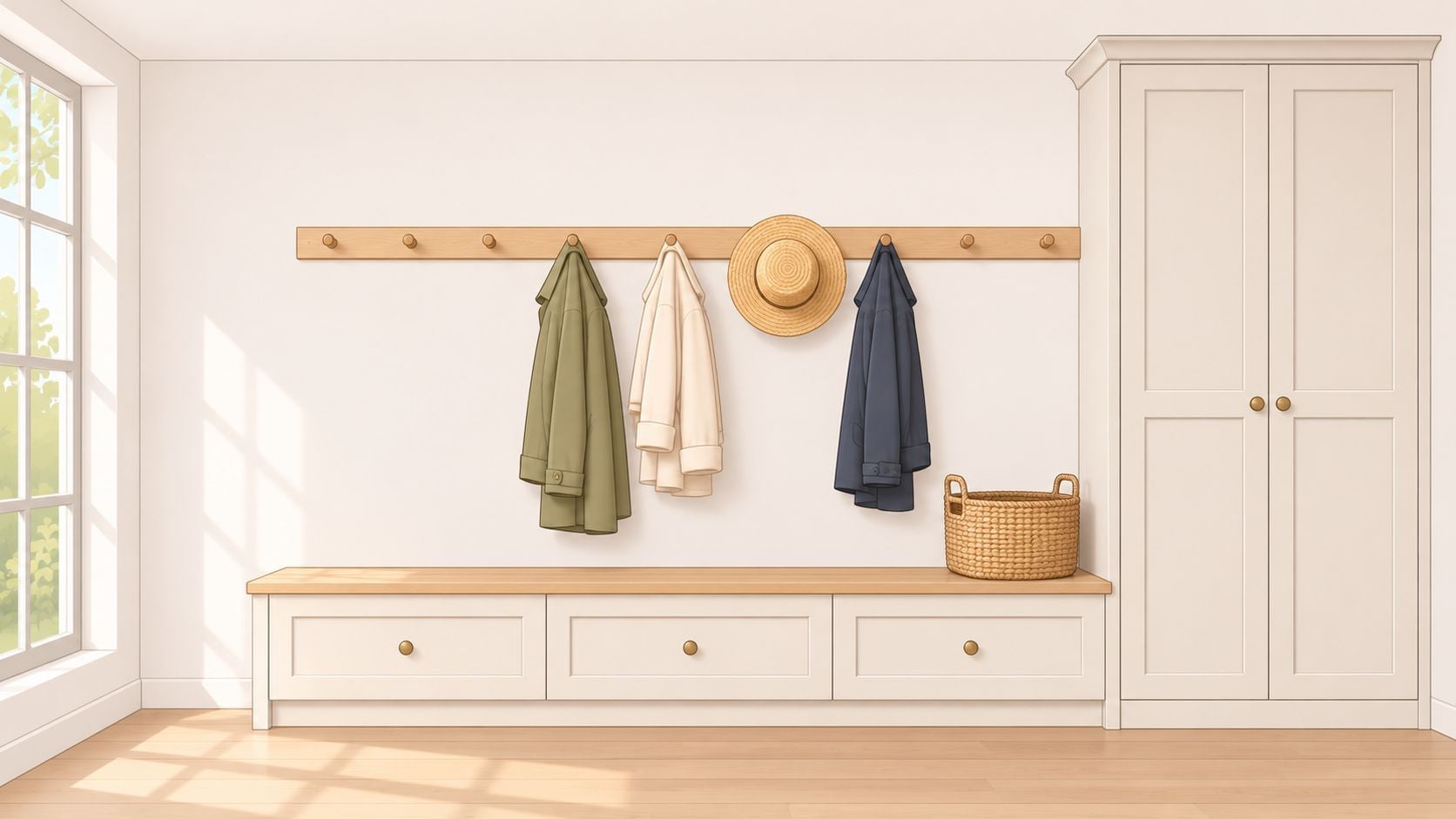
Shaker interiors weren't empty for the sake of looking minimal. Built-in cupboards, drawers, and peg rails helped residents keep shared spaces orderly, as the historic dwelling at Hancock Shaker Village demonstrates.
The modern starting point is therefore a household task, not an aesthetic label. Storage should make belongings easier to reach and easier to put away.
Room-by-room choices
- Entryway organization. A peg rail can keep coats and bags off a bench. Its mounting must suit the wall structure and expected load, especially when bags carry laptops or books.
- Bedroom storage. A slim chest can collect clothing that otherwise lands on a chair. Drawer access matters as much as cabinet depth, so the bed and doorway must remain clear when drawers open.
- Dining flexibility. A bench can accommodate a changing mix of guests without fixed chair divisions. Its usable seating length and table-leg placement still determine whether it seats more people.
- Older-home circulation. A narrow cabinet may suit a tight Capital Region hallway better than a deep sideboard. Door swing, baseboards, and nearby room entrances belong in the measurement.
- Home-office order. A desk with purposeful drawers can separate paperwork from equipment. Cable access and knee clearance should be checked before selecting the silhouette.
Finishes and future flexibility
High-use surfaces need a finish suited to their job. A dining tabletop faces spills and warm serving dishes, while an office desktop encounters abrasion from equipment and repeated hand contact.
The written care directions should explain cleaning products, moisture precautions, and repair options. A restrained profile doesn't make a surface stainproof.
A useful storage piece should make the daily routine easier, not require the household to work around it.
Shaker-inspired furniture also doesn't require an all-Shaker room. Guidance on mixing furniture styles can help connect a plain wooden cabinet with existing upholstered seating or inherited pieces.
Repairable connections and replaceable hardware help furniture adapt as household needs change. A chest that moves from a bedroom to a home office remains useful because its proportions and storage work in both settings.
Telling Shaker Style Apart From Mission, Farmhouse and Minimalist Looks
A piece can borrow Shaker styling without following Shaker construction principles. The Metropolitan Museum of Art's essay on Shaker furniture identifies honesty, utility, simplicity, and quality as central principles, including the rejection of applied ornament and deceptive construction.
The distinction is between a design system and a surface treatment. Similar-looking furniture can use very different materials and methods.
| Style | Typical visual clues | Main distinction |
|---|---|---|
| Shaker | Flat panels, square stiles and rails, restrained hardware, legible wood grain | Proportion and practical construction provide interest |
| Mission and Arts & Crafts | Vertical slats, exposed through-tenons, hammered metal hardware, often quartersawn oak | Construction is often more visibly emphasized |
| Farmhouse | Beadboard, X-bracing, distressed paint | Rustic references contribute to the appearance |
| Modern minimalist | Slab fronts, handleless doors, sometimes engineered panels | Reduced visual detail doesn't prescribe a particular construction method |
These are recognition clues, not rigid rules. A farmhouse cabinet can be well built, and an engineered-panel cabinet can suit a particular use without reproducing historical Shaker methods.
For readers comparing cabinet fronts, Trademaster Construction's guide to modern kitchen cabinet styles offers related visual context. Tip Top's comparison of contemporary and traditional design styles helps place those details within a broader room.
Questions that survive the label
- What lies beneath the finish? Identify solid wood, veneer, and engineered substrate separately.
- What does each visible detail do? Distinguish a functional rail from an applied imitation.
- Can the hardware be replaced? Obtain enough information to identify compatible parts.
- What does the finish reveal? Clear finishes expose grain; paint requires other clues to the underlying construction.
Handling drawers and joints at the Freehold showroom can reveal qualities a photograph can't. For a custom order, wood species, dimensions, finish, and joinery belong in the written specification rather than remaining assumptions.
Shaker Style in the Kitchen and What It Costs
Many homeowners first encounter the style through a flat recessed-panel cabinet door. A typical Shaker front uses a center panel surrounded by square stiles and rails, without an arch or decorative beading.
Both painted and clear finishes can suit the form. Paint covers the grain, while a clear finish leaves the wood's appearance visible, so finish choice shouldn't be confused with construction quality.
What the published kitchen estimates include
In 2024, Angi estimated installing kitchen cabinets, including Shaker cabinets, at $2,000 to $10,600, as reported by Homes & Gardens. Separately, CabinetLand estimated approximately $2,000 to $24,000 for a 10-by-10-foot kitchen with Shaker-style cabinets in 2024.
These estimates describe different scopes and shouldn't be treated as interchangeable quotes. A project estimate should distinguish cabinets, installation, hardware, finishing, and any layout changes.
- Inspect a door edge. Confirm the panel and frame materials, including whether either uses medium-density fiberboard.
- Pull a drawer. Check its box construction, joint fit, and operation under a realistic load.
- Discuss a failed hinge. Establish whether replacement hardware is identifiable and available.
For existing melamine cabinets, replacement isn't the only route worth evaluating. Painters North Shore's discussion of spray finish costs for tired melamine provides refinishing context, though a coating won't repair a failing cabinet box.
A furniture-scale starting point
A freestanding sideboard, pantry cabinet, or hutch offers a smaller project than replacing a kitchen. Tip Top lists a Shaker 4 Drawer Modular Desk at $1,185 and a Shaker Executive Desk at $1,943, useful standalone examples rather than historical kitchen-price comparisons.
Wood and finish samples deserve an in-person comparison under suitable lighting. The guide to choosing wood for tables also helps explain material considerations for adjacent dining furniture.
Plan Your First Shaker Piece for Your Capital Region Home
A hallway that needs a slim cabinet makes a good first Shaker project. The piece has a clear job, a visible footprint, and enough detail to teach you what to look for before a larger purchase.
- Measure the location. Record the wall, doorways, nearby furniture, and the space needed to operate drawers or doors. Name the task the new piece must perform.
- Shortlist by construction. Compare proportions, materials, drawer operation, and joint fit rather than relying on a style filter.
- Test the layout. Tip Top's free online room planner allows furniture arrangements to be visualized to scale before purchase.
- Choose ready-made or custom. The custom furniture design service offers a route for specifying style, size, wood type, and finish, including designs developed from a photograph or sketch.
Practical shopping routes
- Ready pieces. Living Room, Bedroom, Dining Room, Home Office, Entertainment, and Accessories categories help organize the initial search, along with mattresses.
- Value-focused choices. Compare what the piece does well against the space it will occupy and the finish you want to live with.
- Project planning. Financing options deserve discussion before the order is finalized.
Tip Top's 45-plus years of experience, professional design services available since 1984, and selection from more than 50 trusted manufacturers provide local context for those decisions. Design consultants can help coordinate furniture, décor, and flooring so the first piece works with the rest of the room instead of feeling isolated.
Tip Top Furniture & Mattresses offers Shaker-inspired furniture, solid-wood Amish furniture handcrafted in the USA, custom options, flexible financing, flooring, décor, and USA-made mattresses with sleep-matching technology. Homeowners from Freehold, Albany, and Greene County can visit Tip Top Furniture & Mattresses with room measurements and photos, or work with the design team to plan a practical first Shaker piece.