
How to Decorate a Bedroom Wall the Right Way

A bedroom wall looks easy until the furniture arrives, the art is still in its box, and the bed suddenly makes the whole room feel off-center. That's when people start guessing, hanging, re-hanging, and living with a wall that never quite settles. The better move is to treat the wall like a layout problem first, then decorate it second.
For homeowners in Freehold, NY, and across Albany, Schenectady, Troy, and the rest of the Capital Region, that mindset saves time and money. A wall that works with the bed, lighting, and furniture always feels calmer than one built on impulse. That's the standard a seasoned showroom team would use in a real bedroom, whether the project ends in a single framed piece or a fully coordinated room refresh.
Plan Before You Hang Anything
A bedroom wall goes wrong fast when the decor decision happens before the room plan. Art that is too small, too high, or too far from the bed makes the whole wall feel accidental. Start with the layout, then let the decor follow it. That is how a bedroom stays calm instead of visually busy.
A practical starting rule is to limit the design to 1 to 2 primary walls and let the others support the room, a guideline that helps bedrooms stay restful instead of crowded (room design guidance). The bed and headboard should act as the anchor. Once that anchor is set, the wall decor can support it with symmetry, texture, or one stronger statement piece.
Start with four decisions
Before anything goes up, answer these questions:
- Which wall gets the spotlight? In most rooms, that's the wall behind the bed.
- What is the focal piece? A single artwork, a mirror, paint, wallpaper, or a grouped display all work if one choice leads.
- What sits below it? The headboard, bed height, and nightstands change the scale.
- What blocks the plan? Outlets, switches, doors, windows, and traffic paths matter more than many realize.
Practical rule: If the wall has to compete with the furniture, the room loses. Pick one clear visual anchor and keep the rest quieter.
A hand sketch helps, but a room planner shows the actual proportions before any holes go in the wall. A step-by-step hanging guide is useful at this stage because it keeps the plan grounded in measurement instead of guesswork. A simple photo of the wall with rough marks for size and placement can also reveal whether the plan feels balanced or cramped.
If the layout still feels uncertain, a guide from Colorado Art Services is a solid reference for professional wall art installation planning. The point is not to buy more. The point is to place the first piece with enough confidence that everything around it makes sense.
Get the Measurements and Proportions Right
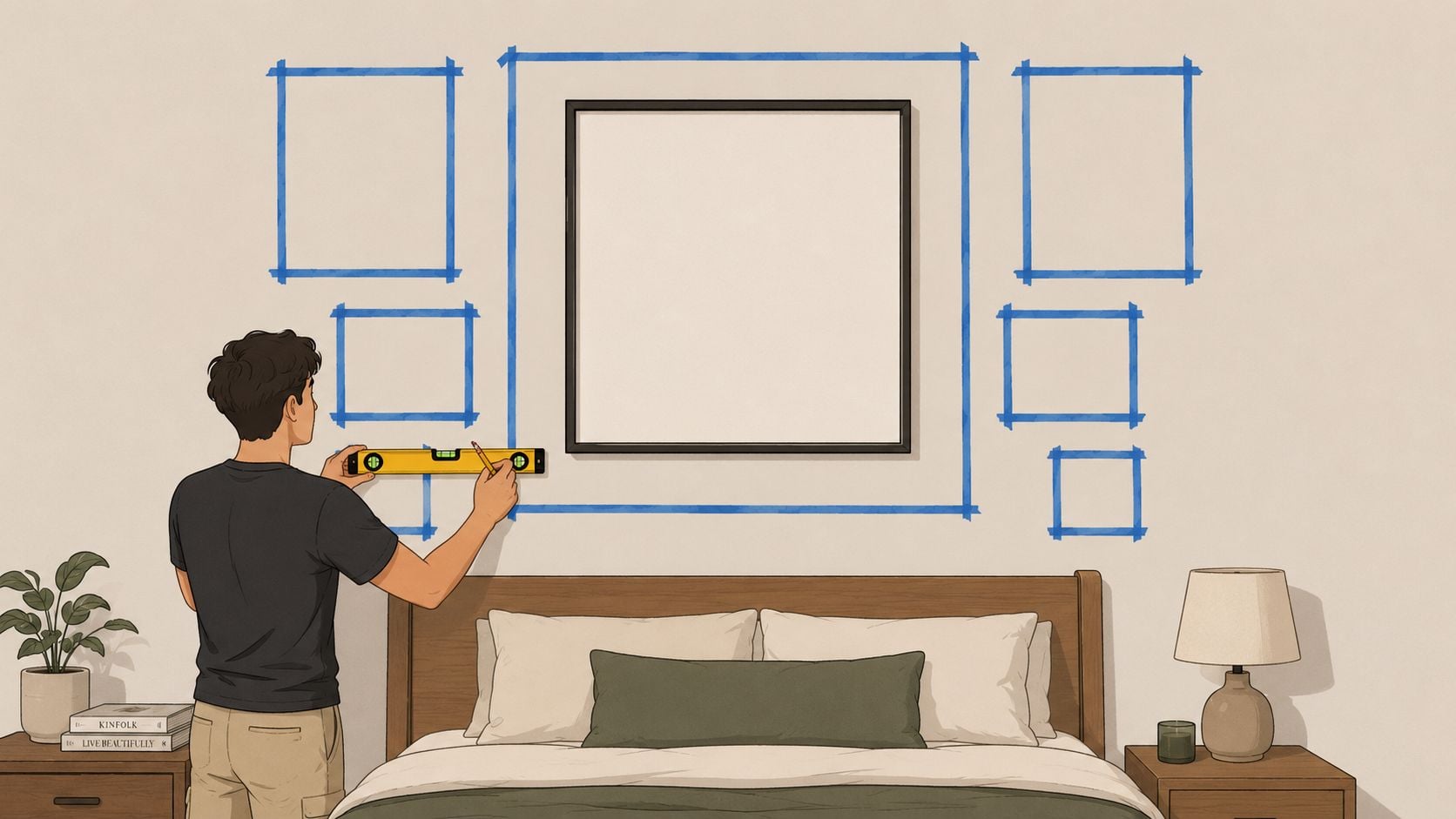
Bedroom wall decor looks professional when it respects the bed below it. The strongest common guideline is to size art or a gallery grouping to about 50 to 70% of the bed's width, keep the bottom edge roughly 6 to 10 inches above the headboard, and aim for a centerline around 57 to 60 inches from the floor (layout proportions). Those numbers keep the wall from feeling like an afterthought.
The most frequent error is hanging pieces too high. People do it because empty wall space feels bigger than it is, but the room reads better when the decor stays visually connected to the furniture beneath it. The eye wants a relationship between bed, headboard, and art, not a floating object stranded in open space.
Measure the wall like a designer would
A quick checklist keeps the plan honest:
- Measure the bed width. Use that to set the approximate art span.
- Check ceiling height. Higher ceilings can handle a larger piece, but the bed still drives the composition.
- Mark furniture clearance. Nightstands, lamps, and dressers all affect where the eye lands.
- Test the centerline. Use your own height as a guide, then compare it against the 57 to 60 inch range.
- Photograph the empty wall. A phone photo makes scale mistakes easier to spot than staring at the room in person.
Hanging decor is a furniture decision, not just a wall decision. If the dresser is tall or the headboard is low, the art size needs to adjust.
Tip Top Furniture & Mattresses has a room measurement guide that fits this kind of planning well, especially when the bedroom also needs new case goods or a mattress. The same logic applies to nightstands and dressers. If the furniture is bulky, the wall treatment should get cleaner. If the furniture is light, the wall can carry more visual weight.
Choose a Layout Style That Fits the Room
The right layout depends on what the room gives you. A wide wall behind a bed can handle a single statement piece. A more traditional room often looks better with a balanced pair. A long wall with personality can take a curated gallery. Renters usually get the most flexibility from ledges or shelves because the layout can change without a full rehang.
A bedroom with a narrow footprint or a crowded floor plan usually does not need more visual noise. In those cases, a gallery wall can become clutter instead of character. A simpler structure, like one large image or a shelf with fewer objects, keeps the room from feeling busy.
Matching layout style to room conditions
| Layout Style | Best Wall Width | Ceiling Height | Renter-Friendly |
|---|---|---|---|
| Single statement piece | Medium to wide | Any, if scaled correctly | Yes, with damage-free hanging |
| Symmetrical pair | Medium | Standard to tall | Yes |
| Curated gallery wall | Wide | Best with balanced proportions | Sometimes |
| Shelf or ledge display | Narrow to medium | Any | Yes |
A small branch of design logic applies here too. If a room already has a lot of vertical drama, a horizontal ledge can calm it down. If the room is plain and square, symmetry adds order fast. A single strong piece is the cleanest answer when the bed wall already has enough presence on its own.
The wrong layout usually fails because it ignores the room's shape, not because the decor itself is unattractive.
For readers who like to test ideas before buying, a free online room planner makes sense because it lets a wall plan be previewed at scale. A thoughtful example of using small, sculptural decor to soften a layout is incorporating bonsai into your home, which shows how a single living element can work like a visual punctuation mark in a room. Tip Top's layout planning page also fits this stage, since the bedroom wall should work with the bed, not fight the bed.
Materials, Tools, and Hanging Techniques
A wall that looks finished usually comes down to the hardware behind it. Drywall takes standard hooks, anchors, and light supports. Plaster needs a lighter touch because it can crack if you force it. Paneling calls for careful placement that respects seams and trim lines. Concrete or cement walls need masonry-rated anchors, not ordinary wall hardware, and their condition should be checked as part of concrete wall care and maintenance.
Start with the right kit: a stud finder, level, drill, picture hanging hooks, and painter's tape. For renters, damage-free adhesive strips and peel-and-stick wallpaper are the cleanest options because they change the room without leaving a permanent mark. Heavy pieces need more support, so anchors or a French cleat make more sense than a single nail.
Use the hardware that matches the weight
- Light frames: Picture hooks or small nails usually handle them.
- Medium pieces: Anchors spread the load better than a bare nail.
- Heavy mirrors or art: A French cleat gives the most secure hold when installed correctly.
- Gallery walls: Paper templates on the floor make spacing easier before the first hole goes in.
Large mirrors need even more care. Their weight changes the whole equation, so the fastening point has to be chosen with the wall material, the mirror size, and the surrounding furniture in mind. A clear guide for that kind of job is how to hang a large mirror, because a mirror that is even slightly off can throw off the entire wall.
Check for wiring and plumbing before you drill. That is prudent practice. The wall does not care how expensive the frame was if the bit lands where it should not.
Concrete walls also need maintenance. Wipe them with a damp cloth monthly, reseal them every few years, and watch for cracks or moisture because those surfaces expand and contract with temperature changes. For a framed look with a polished edge, a dedicated display frame matters too, and a sturdy example is a movie poster frame from Famous Movie Posters.

Coordinate the Wall With Furniture and Bedding
A bedroom wall should repeat the room's materials, not fight them. If the bed has a warm wood finish, the frame, shelf, or ledge should echo that tone instead of introducing a random contrast. If the lamps, hardware, or curtain rods are brushed metal, the wall accents should respect that finish so the room feels deliberate.
Color matters too, but only when it gets repeated. Pull one color from the art or wall treatment and bring it into pillows, a throw, or a chair cushion. That repetition is what makes the room read as one design instead of a pile of separate purchases.
Use the bed as the bridge
Hard surfaces need softness nearby. A quilt, tapestry, or upholstered headboard can handle that job while also acting as wall decor, especially in a room with concrete, brick, or another visually cool surface. A large woven rug can also define the bed zone on the floor and balance the wall above it, which is a smart move when the room needs warmth at both eye level and underfoot (concrete bedroom styling guidance).
Tip Top Furniture & Mattresses in Freehold, NY carries bedroom furniture, mattresses, décor, flooring, and custom ordering options under one roof, which makes finish-matching easier for homeowners from Albany to Troy. The design team can compare wood tones, fabric swatches, and bedding choices in person, which matters more than any screen preview when a room needs to feel cohesive. Their interior design consultation services are a practical next step when the wall needs to coordinate with new furniture, not just a new frame.
The fastest way to make a bedroom feel finished is to repeat one material, one finish, and one color across the bed wall, the bedding, and the lighting.
For shoppers considering a larger refresh, the same logic applies to mattresses and case goods. A new bed, nightstand, or dresser should not be chosen separately from the wall plan. They should look like they belong in the same room from the start.
Tricky Walls That Need a Different Approach
Slanted walls punish bad assumptions. An angled surface should usually be treated more like a ceiling than a standard wall, which means heavy decor does not belong there. Paint, paneling, or lighting often works better than trying to hang something awkwardly on the slope, and tall furniture should be anchored where the ceiling is highest for safety (slanted wall guidance).
Narrow or awkward walls need structure, not clutter. Horizontal ledges, picture rails, mirrors, and layered lighting do more good than a crowded gallery wall in a tight room. The goal is to create a clear visual line that helps the room breathe.
Use material and light to solve the room
Bare concrete needs warmth. Wood, rattan, and linen soften the cold surface, and a neutral palette keeps the texture from becoming harsh (concrete wall styling). A small room can also benefit from a warm ambient light source near the bed wall so the texture feels intentional instead of industrial.
If the room's geometry feels stubborn, a complimentary design consultation is the right move. A trained eye can tell the difference between a wall that needs a larger frame, a different finish, or a full rethink of the furniture placement. That kind of judgment saves more frustration than trial and error ever will.
Bring the Plan to the Freehold Showroom
A bedroom wall project gets easier once measurements and photos are in hand. Bring the wall width, ceiling height, bed size, and a few pictures of the room to the Freehold, NY showroom so the design team can work with real numbers instead of guesses. That's especially useful for homeowners across the Greater Albany Capital Region who want a bedroom that feels pulled together on the first pass.
The advantage of an in-person visit is simple. Fabric swatches, wood finishes, and mattress choices can be compared against the actual room plan, and custom ordering makes it possible to match a specific wood type or finish when the bedroom already has pieces worth keeping. For budget-minded projects, the Clearance Corner can make a single-room refresh more manageable without sacrificing quality.
Tip Top Furniture & Mattresses also offers flexible financing through the Synchrony Home Card, which helps when a wall update turns into a bigger bedroom project. New movers can also take advantage of the mattress matching system, so the sleep setup and the room style work together from the start. If the wall plan is still in the idea stage, the free online room planner is a smart next stop before the showroom visit.
Tip Top Furniture & Mattresses helps homeowners turn a blank bedroom wall into a finished room with bedroom furniture, mattresses, décor, custom ordering, design help, and financing under one roof. Visit Tip Top Furniture & Mattresses to start a room plan, bring in your measurements, and get practical help from a Freehold showroom team that knows how to make the layout, lighting, and furniture work together.