Best Amish Furniture Brands: A Local Buyer’s Guide

Cheap furniture usually looks fine on delivery day. Then the drawer starts sticking, a chair loosens, and the finish shows every scratch after one busy season. That cycle gets old fast for homeowners in Albany, Schenectady, Troy, and across the Capital Region who want a home to feel settled, not temporary.
That's why Amish furniture keeps coming up in serious buying conversations. It isn't bought for a trend. It's bought because solid wood, hand-built joinery, and honest construction solve the exact problems that fast furniture creates.
Families shopping in Greene County and the Greater Albany area often don't need more choices. They need better judgment. Since 1978, a long-running family showroom in Freehold has helped local homeowners sort through what lasts and what only photographs well. That matters with Amish furniture, because the biggest mistake buyers make isn't choosing the wrong stain. It's trusting a label without knowing how to verify the work behind it.
Your Guide to Heirloom Quality Furniture in the Capital Region
A common story plays out in Upstate New York homes. A family buys a dining set for a first house, a bedroom suite for a guest room, or a coffee table to finish the living room. It looks good online, the price feels manageable, and the delivery is quick. A few years later, the table wobbles, the finish chips, and replacing it costs more than buying well the first time.
Amish furniture appeals to a different kind of buyer. This buyer wants weight in the wood, clean lines that don't date quickly, and craftsmanship that holds up to daily use. That's why the search for the best Amish furniture brands usually starts after disappointment with disposable furniture.
In the Capital Region, the smarter move is to stop shopping by marketing language and start shopping by construction. That means looking for real hardwood, proven joinery, and a retailer that knows how to separate authentic Amish-made furniture from lookalikes. Homeowners who want a local starting point can review Amish furniture near Albany and Freehold before visiting in person.
Why this matters for Albany area homes
Older homes in Albany and Troy, newer builds outside Schenectady, and renovated farmhouses in Greene County all benefit from furniture with staying power. A solid wood dining table doesn't just fill a room. It becomes part of how the room works for holidays, weeknight meals, and everything in between.
Practical rule: If a piece is supposed to stay in the home for decades, it should be built like it means it.
That's where heirloom quality earns its name. Good Amish furniture doesn't depend on veneers, shortcuts, or throwaway hardware to create the impression of quality. It earns confidence through visible details and long-term performance.
A local guide beats an anonymous checkout cart
Online listings often flatten every product into the same sales pitch. “Handcrafted.” “Solid wood look.” “Traditional style.” That language hides more than it reveals.
A showroom serving the Albany Capital Region has a different job. It should help buyers compare wood species, understand how a finish will look under real lighting, and decide whether a custom size makes sense for the room. It should also make the rest of the project easier, from mattresses and flooring to design help and financing, because most real homes aren't furnished one piece at a time in isolation.
That's the practical value of buying with local expertise. The goal isn't to chase a trend. It's to make one good decision and then keep benefiting from it for years.
What Truly Defines a Top Amish Furniture Brand
Brand names matter less than build standards. That's the truth buyers need first. The best Amish furniture brands earn their reputation by doing the hard parts right, not by printing “Amish” on a tag.
According to Snyder's Furniture's guide to Amish furniture, authentic Amish furniture is defined by traditional joinery methods, specifically dovetail and mortise-and-tenon connections, that eliminate the need for nails or screws. The same source notes that oak is the most affordable wood while walnut is the most expensive, and dining tables range from $1,000–$10,000.
Start with the wood
Wood choice changes the whole purchase. It affects cost, appearance, and how formal or casual the piece feels in the room.
- Oak offers durability and value. It's the practical entry point for buyers who want authentic solid wood without climbing to the highest price tier.
- Cherry brings warmth and a more refined look. It suits traditional and transitional homes especially well.
- Maple has a cleaner appearance that works nicely in updated spaces.
- Walnut is the premium end of the spectrum. Buyers choose it for its rich character and elevated look.
Some homeowners also like reclaimed materials for their texture and story. For anyone weighing that option, this overview of the benefits of using reclaimed wood gives useful context on why aged lumber appeals to so many people.
Joinery tells the truth
A dovetail joint looks like interlocking puzzle pieces at the corners of a drawer. A mortise-and-tenon joint fits one shaped wood section into another like a peg locked into a socket. Both methods are old for a reason. They work.
Mass production often hides weak construction behind glue, staples, or fast assembly methods. Traditional joinery does the opposite. It puts strength into the bones of the piece.
Buyers should open drawers, check corners, and look underneath the piece. The hidden parts usually reveal more than the showroom pose.
Finish and surface quality separate good from mediocre
The finish should feel even, not plastic-heavy or rushed. Hand-planed surfaces and natural grain variation are good signs because they show the piece wasn't flattened into machine sameness.
A strong finish also protects the investment. Dining tables, bedroom sets, chairs, and cabinets all take daily abuse. If the finish looks thin in the store, it won't improve at home.
Amish Furniture Quality Checklist
| Quality Marker | What to Look For | Why It Matters |
|---|---|---|
| Solid hardwood | Consistent grain, real wood edges, substantial weight | Solid wood lasts longer and can age with character |
| Traditional joinery | Dovetail drawers, mortise-and-tenon construction | Strong joints resist wobbling and failure |
| Surface quality | Hand-planed feel, visible grain variation, smooth touch | Craftsmanship is visible and affects durability |
| Finish | Even application, depth of color, no plasticky feel | Better protection from wear and everyday use |
| Honest materials | No veneers or particle board in key structural areas | Better long-term value and repair potential |
Homeowners who want a closer look at these standards can review how Amish furniture quality is evaluated.
Recognized Amish Brands and USA-Made Excellence
Some names come up again and again because they represent what buyers want from this category. Not hype. Consistency.
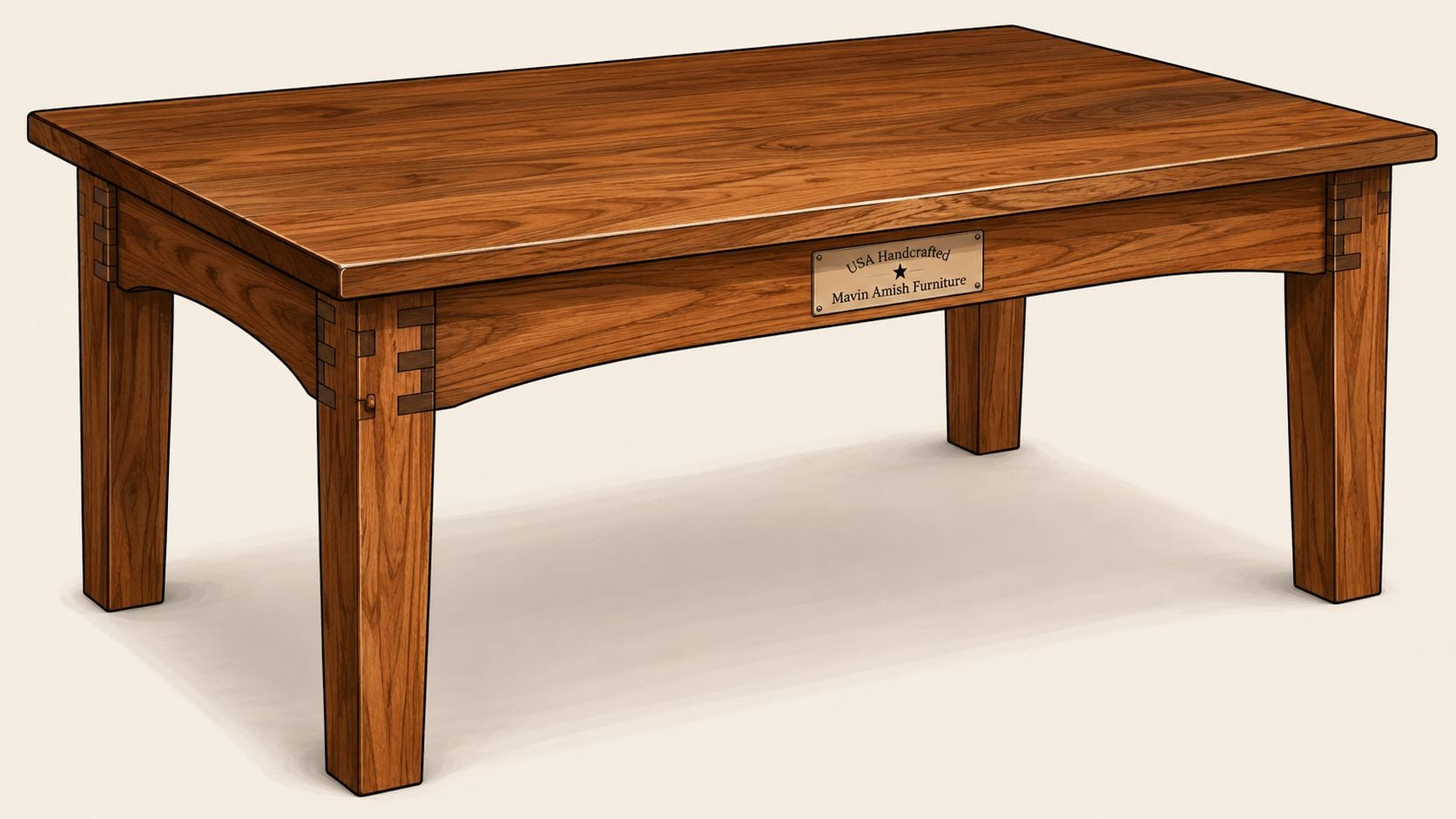
A useful benchmark comes from Mission Motif's guide to top Amish furniture makers, which states that makers such as Mavin, Simply Amish, and Daniel's Amish craft heirloom-quality pieces in Pennsylvania, Ohio, and Indiana, the heart of Amish communities. The same source says Daniel's Amish is ranked #2 among top USA furniture brands for 2026 and is known for durability and finish quality.
Why respected names matter
Recognized makers matter because they usually reflect a serious production culture. Buyers aren't just paying for a logo. They're buying into standards around wood selection, domestic craftsmanship, fit, and finish.
That doesn't mean a shopper should buy by brand alone. It means these names can serve as useful markers of what a reputable Amish-made collection should feel like in person.
The USA-made connection
Pennsylvania, Ohio, and Indiana remain central because that's where strong Amish furniture traditions continue. That domestic concentration gives buyers a clearer line between workshop craftsmanship and mass-market imitation.
There's also a practical reason local shoppers care about USA-made construction. It aligns with the values many Capital Region homeowners already bring to the purchase: durability, accountability, and the ability to custom order rather than settle for generic sizing.
A respected Amish maker should show discipline in the details. Tight joints. Smooth finishes. Balanced proportions. No shortcuts pretending to be character.
For buyers in Freehold and the wider Albany area, a curated showroom matters because it narrows the field. Tip Top Furniture & Mattresses works with over 50 trusted manufacturers, which gives shoppers access to a pre-screened mix of furniture styles, custom options, and American-made quality without asking them to sort through endless online noise on their own.
That kind of curation is valuable because the furniture business has no shortage of attractive photos. The hard part is knowing which products still look and feel right years later.
How to Verify Authenticity and Avoid Amish Style Fakes
A lot of shoppers assume the word “Amish” in a product title means the furniture is authentic. That assumption causes expensive mistakes.
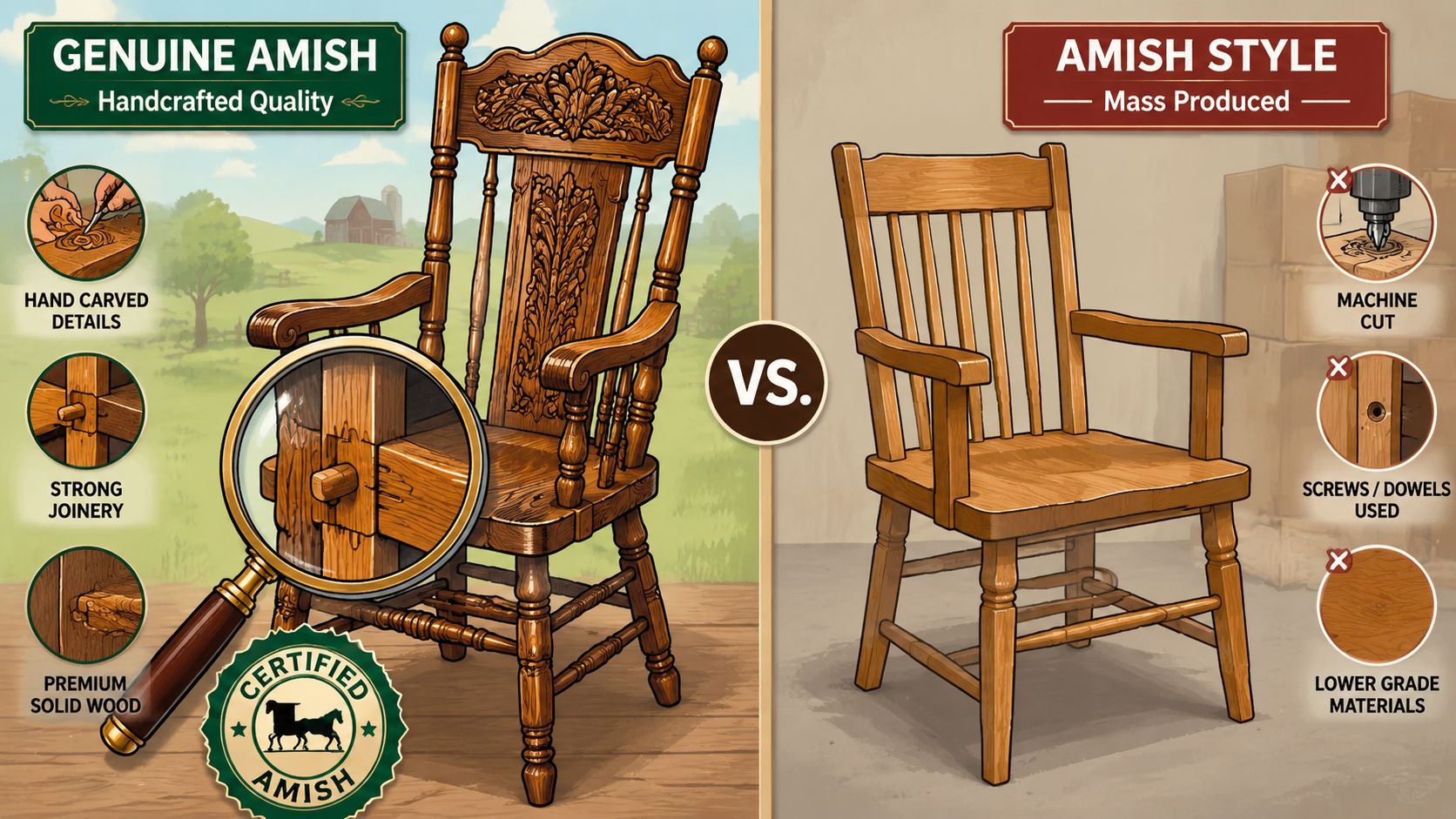
The problem has a name. In Simon Pure Amish's discussion of authentic Amish brands, the “Online Authenticity Gap” describes how many buyers end up with mass-produced furniture marketed as “Amish-style.” That same guide emphasizes that true Amish artisans in Ohio still primarily use hand tools, a distinction often missing from online descriptions.
Why brand names alone don't protect buyers
A polished website can sell almost anything. Smooth product copy, rustic photos, and words like “crafted” or “heritage” don't prove a thing.
Buyers in Albany, Troy, and Schenectady need to ask direct questions. Who built it. What wood was used. Whether the construction is solid hardwood throughout. Whether the piece uses traditional joinery. Whether the retailer can explain the build process without dancing around it.
If a seller can't answer clearly, that's the answer.
A practical authenticity checklist
This is the checklist serious buyers should use before placing an order.
- Ask for construction details. A trustworthy seller should explain the joinery and materials without hiding behind vague phrases.
- Check for solid wood. Veneers and particle board don't belong in a piece sold as heirloom-quality Amish furniture.
- Look at the surface carefully. Hand-planed character and natural variation are signs of real workmanship. Dead-uniform repetition can signal machine-heavy production.
- Inspect drawers and hidden areas. Drawer corners, undersides, and back panels reveal whether the builder cared about strength or only appearances.
- Request authenticity documentation. Reputable sellers should be able to provide proof of artisan work and traditional methods.
- Read the description skeptically. “Amish-style” means style, not origin.
A deeper look at mortise-and-tenon joints and why they matter helps buyers understand one of the clearest construction signs to verify in person.
What authentic work tends to look like
Authentic Amish furniture usually has a calm confidence to it. The wood grain does the talking. The joinery is tight. The finish is smooth, not flashy. The design doesn't need gimmicks to justify the price.
By contrast, fake “Amish-style” furniture often leans hard on rustic marketing while cutting corners where buyers won't notice until later. Thin materials. Generic hardware. Machine-perfect sameness. Lightweight construction that feels wrong the moment someone lifts a chair.
Buyer warning: If the price seems low for solid hardwood, handcrafted joinery, and domestic production, the label deserves extra scrutiny.
A local retailer builds trust. A good showroom does the vetting before the piece reaches the floor. That matters far more than a dramatic product title on a screen.
Customizing Your Amish Furniture for Your Upstate NY Home
Customization is where Amish furniture pulls away from ordinary retail. A buyer doesn't have to accept the wrong width, the almost-right stain, or a hardware choice that clashes with the rest of the house. That's a major reason custom Amish furniture makes sense for homes across the Capital Region.
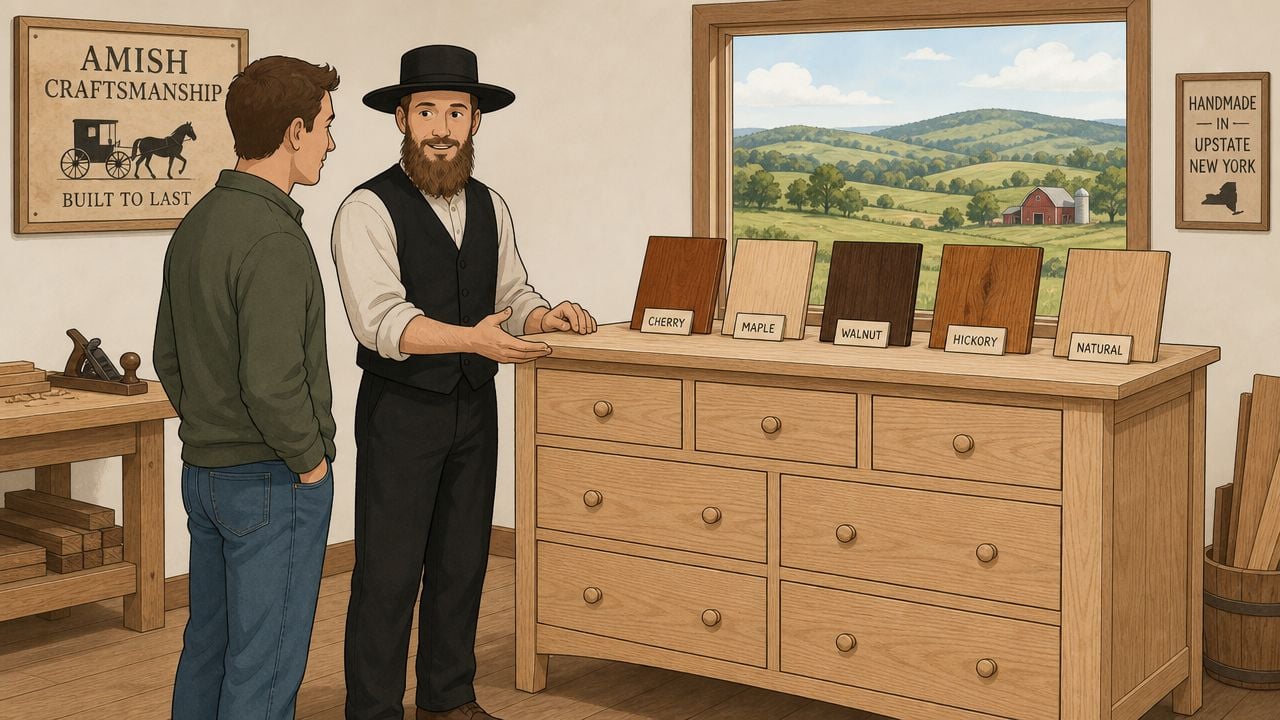
Customization isn't a fringe benefit. It's part of the category. According to ReAmish, the organization has represented over 70 Amish furniture builders since 1999 and allows customers to customize size, wood type, and finish, while also offering daily discounts of 40% or more.
The smartest custom choices
Not every custom decision matters equally. Some choices affect appearance. Others affect whether the piece works in the room.
The most useful options usually include:
- Size adjustments for narrow dining rooms, shallow entry spaces, or bedrooms with tricky wall layouts
- Wood species selection to match the home's style and the buyer's budget
- Finish choice so a new piece complements existing floors, trim, or cabinetry
- Hardware selection for a cleaner modern look or a more traditional feel
A homeowner in Albany might need a dining table sized for entertaining without overwhelming the room. A family in Troy may want a bedroom set that relates better to older woodwork in the house. A buyer in Schenectady may need a bookcase built to fit a precise wall.
That's where custom ordering stops being a luxury and starts being common sense.
Better fit creates better value
Furniture that fits the room correctly gets kept. Furniture that almost fits gets replaced, moved to the basement, or resold with regret.
Professional guidance helps here. Tip Top's custom ordering process gives shoppers a way to choose style, size, wood type, and finish with more precision than a standard retail order. Buyers can explore how to get started with a custom furniture order before visiting the Freehold showroom.
The right custom piece doesn't look “special order.” It looks like it belonged in the room from the start.
There's another advantage for local homeowners. Since design services have been available through the showroom since 1984, buyers can coordinate furniture with flooring, décor, and room flow instead of making isolated decisions. The free room planner also helps people test layouts before committing, which is especially useful when ordering a dining set, bedroom collection, or large entertainment piece for an Albany-area home.
Buying and Caring for Your Heirloom Investment in Albany NY
Buying Amish furniture online without seeing it first is a gamble. Buying it locally is a decision.
A showroom visit gives buyers the things a product page can't. Real color under real light. Actual wood grain. The weight of a chair when it's lifted. The feel of a drawer when it opens. Those details matter because heirloom furniture is supposed to be lived with for a long time, not admired for a week.
What to do before buying
Shoppers in the Capital Region should keep the final buying process simple.
- Measure the room carefully. Include wall space, traffic flow, and door clearance.
- Bring photos of the home. Flooring, trim, wall color, and nearby furniture all matter.
- Sit, open, lift, and inspect. Comfort and construction should be checked in person whenever possible.
- Ask about delivery and setup. Reliable local delivery protects the piece and the home.
- Review financing and clearance options. A better piece may be more accessible than expected.
For long-term upkeep, buyers can follow these wood furniture care basics.
How to protect solid wood for the long haul
Care doesn't need to be complicated. It needs to be consistent.
- Dust gently with a soft cloth so grit doesn't scratch the finish.
- Keep it out of prolonged direct sunlight when possible to reduce uneven aging.
- Use pads and protection under hot dishes, lamps, and decorative objects.
- Clean spills promptly instead of letting moisture sit on the surface.
- Avoid harsh household cleaners that can damage the finish.
Solid wood furniture often becomes more meaningful over time because families attach memories to it. For readers who appreciate that emotional side of ownership, this short piece on the sentimental value of heirlooms explains why certain tables, dressers, and cabinets stay in families long after trends change.
Good Amish furniture should get older with dignity. A few signs of use can add character. Structural weakness never does.
The local advantage matters at the end just as much as at the beginning. Buyers in Freehold, Albany, Schenectady, and Troy benefit from one-stop shopping that goes beyond dining sets and bedroom furniture. A full project might include flooring, design guidance, a better mattress for the guest room, a custom order for the dining area, flexible financing, and even a clearance find for another space in the home. That kind of coordination makes the purchase easier and the result more cohesive.
Shoppers ready to invest in solid wood furniture for the long term can explore Tip Top Furniture & Mattresses for Amish furniture, custom ordering, flexible financing, design help, and clearance options, then visit the Freehold, NY showroom to compare materials and finishes in person for a home anywhere in the Greater Albany Capital Region.