All Season Down Alternative Comforter: Upstate NY Guide


A cold January night in Greene County can expose a bedding mistake quickly. The comforter feels perfect when the bedroom is chilly, then becomes too warm once the heat runs. By morning, one sleeper may be shivering while the other has pushed the covers to the foot of the bed. An all-season down-alternative comforter can help, but only when its fill, shell, construction, and moisture performance match the room and the sleeper.
The label alone isn't enough. In the United States, “all-season” has no single industry-standard warmth scale, so buyers need to compare actual fill information, quilting, shell fabric, care instructions, and the realities of an Upstate New York bedroom. The right choice should provide moderate insulation, manageable care, and enough flexibility for the transition from humid summer nights to cold winter mornings.
Why Your Current Bedding Falls Short in Upstate Weather
A homeowner in Freehold might go to bed beneath a heavy winter duvet during a cold snap. The room feels comfortable at bedtime, but several hours later, the heating cycle changes the temperature. The sleeper wakes overheated, folds the comforter down, and then feels the chill return before morning.
That pattern is common across the Capital Region, including Albany, Schenectady, Troy, and Greene County. Bedding designed only for deep winter can trap too much heat in a heated bedroom, while a thin blanket may leave cold spots when outside temperatures fall. A single “medium” label doesn't account for humidity, mattress insulation, sleepwear, body temperature, or whether two people share the bed.
Practical rule: Choose bedding for the bedroom and sleeper, not for the product label alone.
The useful shift is from single-purpose bedding toward moderate insulation with practical layering. Synthetic fills can create loft without animal-derived down, and a well-made comforter can be washed according to its care label. But washable doesn't automatically mean breathable, and lightweight doesn't automatically mean cool.
The Upstate compromise
The strongest all-season setup usually combines:
- Moderate loft: Enough insulation for ordinary winter nights without excessive bulk.
- Even quilting: Consistent fill distribution helps limit thin areas and uneven warmth.
- A vapor-permeable shell: The outer fabric needs to release moisture instead of creating a damp microclimate.
- Flexible layers: A breathable blanket can supplement warmth during colder periods without forcing a heavy comforter through summer.
A practical guide to adjusting bedding as temperatures change appears in this seasonal sleep setup guide. The central lesson is simple. An all-season comforter works best as part of a sleep system, not as a promise that one fixed layer will feel identical every month.
For Freehold households, the purchase should begin with the bedroom's normal conditions. Consider whether the room runs warm, whether the sleeper wakes sweaty, whether the bed sits near a draft, and whether a partner prefers more or less insulation. Those answers matter more than a plush product photograph.
Understanding Synthetic Materials and Allergy Protection
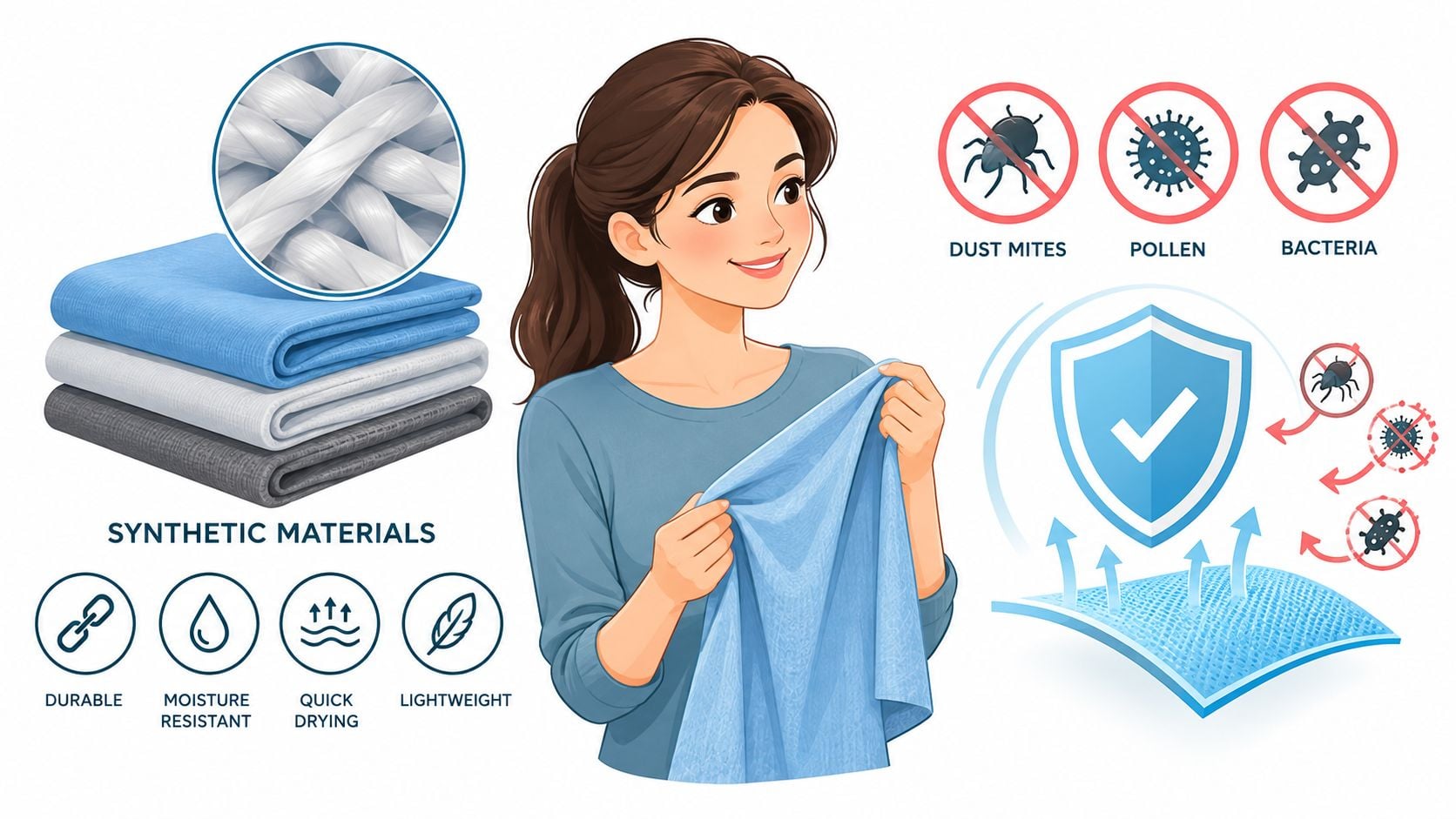
For an all-season comforter in Upstate New York, synthetic fill is a practical starting point because it manages changing bedroom conditions without animal-derived down. Polyester is most common, while some products use regenerated cellulose fibers such as Lyocell. Recycled polyester is also available. These materials create loft and hold still air, and many comforters can be machine-washed and tumble-dried when the care label permits it. Choose construction and maintenance based on the room's moisture and temperature, not the word “all-season” alone.
The wider textile market helps explain the steady availability of these materials. Global fiber production rose from approximately 125 million metric tonnes in 2023 to 132 million metric tonnes in 2024, while polyester production increased from roughly 71 million tonnes to 78 million tonnes over the same period, according to the Materials Market Report 2025. These figures cover the entire fiber sector, not comforter sales, but they show the manufacturing base behind consistent synthetic bedding.
Fill material isn't the whole allergy story
Synthetic fill can simplify laundering. It does not make a comforter allergy-proof. Research summarized by the National Institutes of Health found that allergen-impermeable covers reduced exposure when they completely enclosed the mattress, blanket, and pillow. In one randomized study, 279 people with allergic rhinitis received impermeable or ordinary covers, and mite-proof bedding reduced allergen exposure.
The shell, seams, zipper, piping, and coverage all affect protection. Laboratory testing found that tightly woven fabrics with average pore sizes below 10 micrometers blocked the dust-mite allergens Der f 1 and Der p 1 below detectable limits. Fabrics at 6 micrometers or less blocked cat allergen Fel d 1, according to the same review.
That evidence does not support calling every polyester comforter hypoallergenic. Clinical results remain mixed. Some trials found major allergen reductions, while others found no meaningful improvement in asthma symptoms or quality of life from bedding encasements alone.
What allergy-sensitive households should check
- Named fill: Choose listings that identify polyester, microfiber, Lyocell, recycled polyester, or another specific material.
- Complete-item care: Confirm that the entire comforter can be washed and dried thoroughly.
- Shell construction: Look for tightly woven fabric and secure stitching, rather than relying on a “hypoallergenic” label.
- Certifications: Check whether the manufacturer identifies limits for harmful substances.
- Bedroom air: Bedding care can work alongside whole-home air purifiers when indoor dust and allergens remain a concern.
Use these bedroom maintenance tips to build a routine beyond washing the comforter. Synthetic doesn't mean allergen-proof. The shell, seams, coverage, and care instructions must support any allergy-related claim.
Measuring Real Warmth Beyond Simple Fill Weight
A heavy comforter can still sleep cold in one spot and clammy in another. Fill weight helps, but it cannot rate warmth by itself. Loft, quilting geometry, shell fabric, and compression determine how much still air the comforter retains, so two products with similar fill amounts can perform differently.
The EN 17667 guarded-hotplate method measures thermal resistance for nonuniform insulated constructions up to 0.5 m²·K/W, equivalent to 5.0 tog. Measured thermal resistance gives you a sounder comparison than thickness or weight alone.
Loft and quilting decide whether warmth stays even
Higher loft generally improves insulation because the fill holds more still air. Overstuffing can compress that structure and reduce its benefit. Tight quilting can also create flatter zones, leaving your shoulders warm while your feet feel colder.
For an Upstate bedroom, choose balanced construction:
- Check the stated fill information. The listing should identify the material and provide useful specifications.
- Inspect the quilting. Box or channel construction helps keep fill distributed across the bed.
- Look for recovery. The comforter should regain loft after storage or gentle compression.
- Favor measured performance. Thermal-resistance or tog data gives you more useful evidence than “cozy” or “extra warm.”
A heavier comforter is not automatically warmer or better for year-round use.
According to the standard's thermal guidance discussed above, down provides stronger insulation performance than polyester in comparative testing, while polyester ranks above cotton. Polyester therefore works well as a moderate-insulation material, but it cannot reproduce every performance characteristic of premium down.
Use this complete bedding and mattress protector guide to assess the comforter as part of the whole bed. Mattress material, protector fabric, sheets, and bedroom temperature all affect how the top layer feels. In Upstate New York, moisture control matters as much as loft when temperatures swing from humid summer nights to dry winter cold.
Navigating Year-Round Sleep Comfort in an Upstate Bedroom
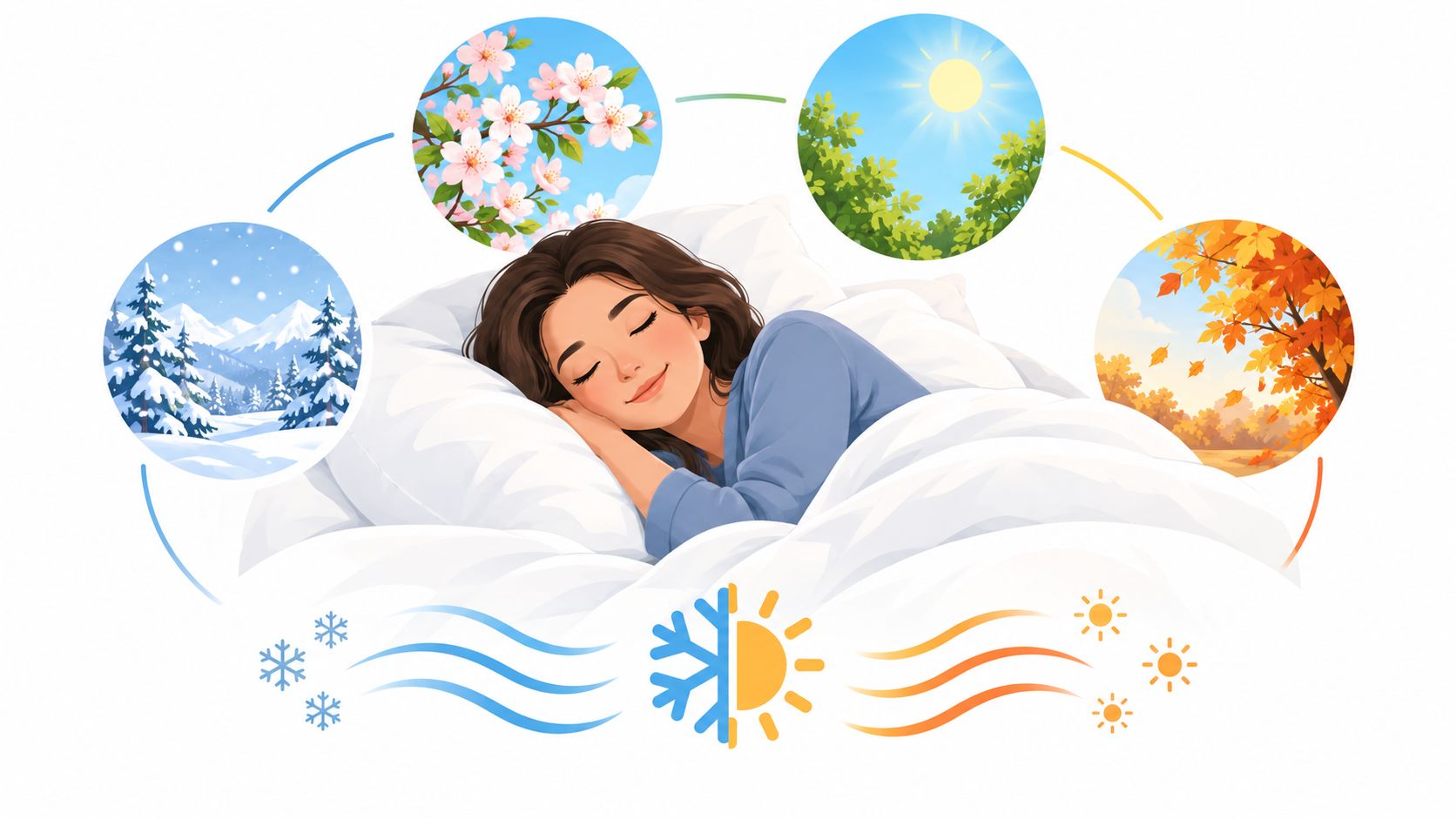
A comforter that feels right in April can become clammy during a humid July night or fall short during a drafty January morning. “All-season” describes convenience, not one fixed warmth level. Bedding research reports the lowest thermal-resistance needs in July and August, the highest from December through March, and intermediate needs during the transition seasons, according to seasonal bedding research.
That seasonal range makes a fixed medium-weight comforter a compromise. It may work in spring and fall, feel too warm in summer, and seem slightly light in winter. A dynamic indoor temperature profile of 21–18–21°C improved deep-sleep duration compared with a constant 21°C environment in a related 2025 study reported in the same source. The point is practical: year-round comfort depends on bedroom temperature and moisture, not weight alone.
Match the comforter to the room
Start with the bedroom, then assess the “all-season” label.
- Warm, humid bedroom: Choose lighter construction, a vapor-permeable shell, and breathable sheets to help manage moisture.
- Moderate bedroom: A medium all-season comforter can work well, especially with a separate blanket available.
- Cold or drafty bedroom: Choose more loft or add a blanket on the coldest nights.
- Shared bed: Prioritize flexibility, since one warmth level may not suit both sleepers.
Your own heat production matters too. A hot sleeper or someone who experiences night sweats may need less insulation, even in winter. A cold sleeper may get better results from removable layers than from a comforter so heavy it becomes uncomfortable when the heat runs.
Use layering instead of forcing one product to do everything
A moderate comforter paired with a removable layer usually handles Capital Region weather better than one fixed layer. One optimization model found that combining quilts with different thermal resistances provided broader annual comfort, according to the seasonal bedding research cited above.
The sleep sanctuary guide explains how temperature, lighting, mattress support, sheets, and the top comforter work together. Choose the all-season comforter that gives you room to adjust.
Comparing Down Alternatives to Natural Feathers
Natural down remains highly efficient at trapping air relative to its weight, but it also brings different care, sourcing, and allergy considerations. A down alternative uses synthetic fibers, most often polyester, and generally offers a more straightforward household routine.
The phrase “all-season” still needs scrutiny. In the United States, it isn't governed by a single industry-standard warmth scale, so shoppers should compare construction, actual fill information, shell material, and care instructions rather than assuming that similarly labeled products have the same warmth. The Wirecutter comforter guide explains that broad categories such as lightweight, medium, and heavyweight don't create a universal rating system.
Down vs. Down-Alternative Comparison
| Feature | Natural Down | Down-Alternative |
|---|---|---|
| Fill source | Goose or duck down | Usually polyester or another synthetic fiber |
| Warmth efficiency | Strong insulation relative to weight | Useful moderate insulation, generally with more weight for comparable warmth |
| Animal-derived material | Yes | No |
| Routine care | Often requires more specialized cleaning | Many products are machine-washable and tumble-dryable according to the care label |
| Allergy considerations | May not suit households avoiding feather or down materials | Often chosen for easier cleaning, but the shell and finished construction still matter |
| Construction priorities | Loft and compartment design | Loft, quilting, shell breathability, and wash recovery |
For shoppers weighing the materials in greater detail, this guide to choosing the best comforter fill provides another perspective. The practical choice usually comes down to priorities.
Choose natural down when low weight, high loft, and traditional insulation matter most and specialized care is acceptable. Choose a down alternative when machine washability, animal-free materials, simpler upkeep, or predictable everyday use matter more. Neither material removes the need to evaluate shell construction and thermal fit.
Essential Care Tips for Long-Lasting Loft
A washable comforter only delivers its full value when the household follows the care label carefully. Excess detergent, crowded machines, high heat, and incomplete drying can leave synthetic fill clumped, flattened, or damp inside.
A dependable maintenance routine
- Read the label first. Care instructions vary by product, and the manufacturer's directions control.
- Use enough machine space. A comforter needs room to move through the wash. A cramped drum can prevent thorough cleaning and rinsing.
- Choose mild detergent. Heavy residue can coat fibers and reduce the fresh, lofty feel.
- Use the approved wash setting. A gentle cycle is appropriate when the care label permits machine washing.
- Dry completely. Low heat is generally safer for synthetic fill when allowed, and the comforter should be fully dry before returning to the bed.
- Break up clumps during drying. Periodic redistribution can help the fill recover evenly.
- Store it loose and dry. Long compression can reduce loft and encourage moisture retention.
A duvet cover can reduce direct wear on the shell, but it doesn't replace washing the comforter when the care label calls for it. Households should also allow bedding to air out after use, especially in warm bedrooms.
Care priority: Complete drying matters as much as washing. Damp fill won't maintain a healthy, comfortable loft.
For broader bedding replacement and upkeep considerations, SleepHabits' guidance on restoring better sleep offers useful household context. Mattress care also affects the full sleep setup, and these mattress maintenance tips can help coordinate care across the bed.
Finding Expert Guidance at Our Freehold Showroom
Bedding decisions become easier when shoppers can discuss the entire bedroom instead of judging a comforter in isolation. A showroom visit can connect comforter size with mattress depth, sheet selection, room temperature, bedroom furniture, and the way the room is used.
Tip Top Furniture & Mattresses is a family-owned showroom in Freehold, NY, serving Albany, Schenectady, Troy, Greene County, and the wider Greater Albany Capital Region since 1978. Its professional design services have been available since 1984, giving local homeowners a place to coordinate furniture, decor, flooring, and sleep products through one conversation.

What local guidance can clarify
- Fit: A comforter should cover the mattress appropriately, especially with deeper mattresses or shared beds.
- Sleep matching: USA-made mattresses and sleep accessories can be evaluated alongside bedding, with a high-tech bed matching system available for personalized support and comfort recommendations.
- Room coordination: Professional design consultants can coordinate bedroom furniture, window treatments, decor, flooring, and bedding.
- Personalization: Custom ordering allows shoppers to select style, size, wood type, and finish for furniture, with craftsmen able to work from a picture or sketch.
- Budget: Flexible financing options and a clearance section can make a larger bedroom project easier to plan.
The showroom also offers Amish furniture handcrafted in the USA, furniture from 50+ trusted manufacturers, home decor, flooring, and a free online room planner. That one-stop format matters when the comforter purchase is part of a broader bedroom refresh rather than a replacement made in isolation.
A shopper may need a comforter that suits a new mattress, a bedroom that runs warm, or a design scheme built around solid wood furniture. Local advice helps turn those separate requirements into one workable plan.
Frequently Asked Questions About Synthetic Bedding
Is an all-season down-alternative comforter suitable for every month?
“All-season” means moderate warmth, not identical comfort in every room and month. Upstate New York brings humid summer nights, cold winter air, and changing bedroom temperatures. Lower thermal resistance suits July and August, while December through March usually calls for more insulation. Humidity, sleepwear, personal heat production, and added layers matter as much as the comforter's weight.
A moderate comforter with a removable blanket gives sleepers better control than relying on one layer year-round.
Does synthetic fill make a comforter hypoallergenic?
Synthetic fill avoids animal-derived down, and many options can be washed more easily. The fill alone does not make the finished comforter allergy-proof. Shell weave, seams, stitching, zippers, coverage, laundering, and thorough drying all affect allergen control.
As noted in the clinical review of dust-mite avoidance, complete impermeable covers can reduce allergen exposure, while clinical outcomes for asthma and quality of life remain mixed. Check the full construction and any stated certification instead of treating “hypoallergenic” as proof.
What should shoppers inspect before buying?
Check the fill material, quilting pattern, shell fabric, care label, and available information on thermal and vapor resistance. Even distribution prevents cold spots and compressed areas. Breathability is separate from warmth, and ISO 11092 guidance addresses both properties in quilted and multilayer textile assemblies.
Ask these practical questions:
- Can the complete comforter be washed and dried?
- Does the shell release moisture while retaining insulation?
- Is the fill secured evenly across the bed?
- Will the size cover the mattress without constant tugging?
- Can an extra layer be added for the coldest nights?
Tip Top Furniture & Mattresses helps Capital Region homeowners compare bedroom furniture, USA-made mattresses, sleep accessories, and bedding needs at its Freehold, NY showroom. Visit Tip Top Furniture & Mattresses to discuss a comfort-focused bedroom plan, custom options, flexible financing, and Clearance selections.