Black Floral Curtains: A Complete Buying and Styling Guide


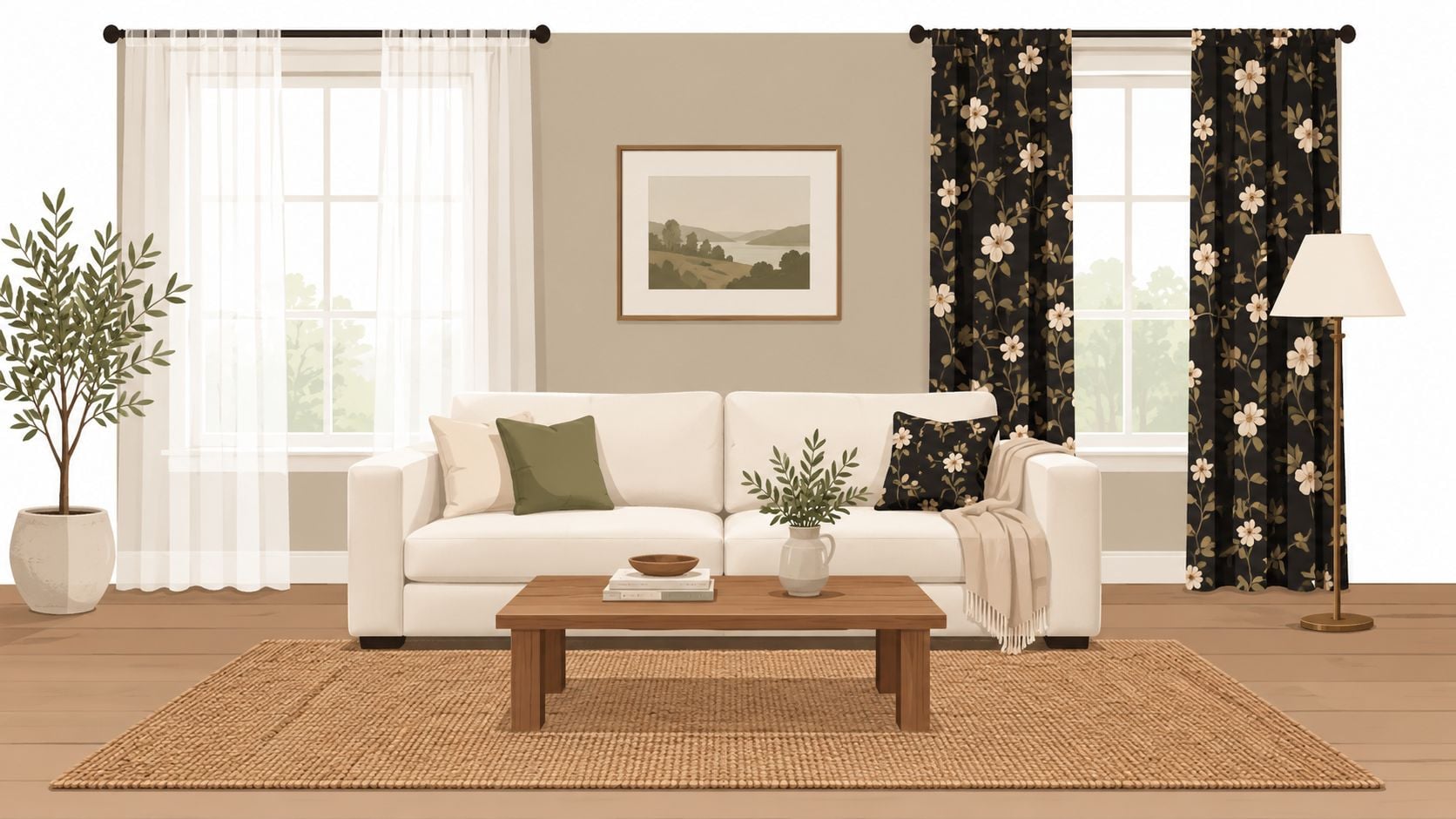
A room can have the right sofa, rug, and wall color yet still feel unfinished. This often happens in a north-facing living room with an ivory sofa, a jute rug, and warm greige walls, where plain white sheers soften the windows but contribute little visual structure. Black floral curtains can change that balance immediately, adding a dark anchor while keeping the room approachable through botanical shapes.
The decision deserves more thought than choosing a dramatic print. Sunny exposures can make dark fabric absorb more radiant heat, small rooms can feel enclosed with the wrong pattern scale, and an attractive floral face fabric won't automatically provide privacy or blackout performance. The right choice depends on window measurements, lining, openness, fabric weight, hardware, and room function.
Why Black Floral Curtains Are Worth a Second Look
Black floral curtains work because they combine two opposing visual effects. The black ground gives furniture and pale walls definition, while the floral motif introduces softness, movement, and a natural reference. In a neutral room, that contrast can do the work of artwork and architectural trim at the same time.
That doesn't make every black floral panel a good choice. Dark fabric can absorb more heat under radiation than lighter fabric, and a closely fitted curtain can make a compact room feel cave-like if the walls, flooring, and upholstery are also dark. Testing on the actual window matters, especially in a south- or west-facing room. Research on window coverings found that lighter colors reflect more radiant heat and darker colors absorb more, while gaps around the covering also affect performance (independent testing on window-covering color and heat).
The design payoff
A black background can visually anchor a room, but the flowers prevent the treatment from looking severe. Warm-toned botanicals, such as dusty rose, ochre, or terracotta, create a more relaxed and collected appearance. Crisp white flowers create a graphic, modern effect, while jewel-tone blooms lean traditional.
The curtain also changes how nearby pieces read:
- Ivory upholstery looks brighter against the dark ground.
- Natural wood and jute feel warmer beside botanical pattern.
- Brass hardware adds lift where the fabric feels visually heavy.
- Greige walls provide breathing room without competing with the print.
Practical rule: A black floral panel should either support the room's existing pattern language or become the room's clear focal point. It shouldn't compete equally with bold wallpaper, a highly patterned rug, and busy upholstery.
Before selecting a fabric, homeowners should decide whether the curtains are mainly decorative, privacy-oriented, light-controlling, or expected to support seasonal comfort. The broader window-coverings industry was valued at approximately $48.4 billion in 2025, with curtains representing 39.8% of worldwide revenue, according to industry market context for window coverings. Black floral curtains are not separately tracked as a category, but they sit within an established furnishing market rather than an obscure textile niche.
A useful color-palette reference can help homeowners coordinate the floral tones with flooring, upholstery, and wall paint. The guidance in this expert guide to the perfect color palette is particularly useful before a custom fabric is ordered.
Measure Your Windows the Right Way
A tape measure should come out before a fabric swatch or shopping cart. Poor measurements produce short hems, insufficient coverage, visible side gaps, and panels that can't stack away from the glass. Builders also leave small differences from one window to another, so every opening deserves its own measurement record.
Start with the window opening, then measure the intended rod position down to the finished hem. If the window isn't floor-length, record the sill depth and decide whether the panel should stop at the sill, below the sill, or at another deliberate point. A rod commonly looks more polished when it sits three to four inches above the frame, although the final position should account for trim, crown molding, and the selected hardware.
A simple measuring sequence
Record the opening width. Measure across the frame, then measure again at a second point. Note the smaller measurement if the opening isn't perfectly square.
Plan the finished rod width. Add twelve to sixteen inches on each side of the frame when wall space allows. That extra width lets the panels stack clear of the glass and preserves daylight when the curtains are open.
Set the finished length. Measure from the top of the rod or track to the intended hem. A floor-length panel can kiss the floor, hover about half an inch above it, or pool for a relaxed effect. A clean, nearly touching finish is usually easiest to maintain.
Check the return. Measure how far the rod projects from the wall. A deeper return helps the panel wrap toward the wall and reduces side light.
Photograph every window. Include the floor, trim, nearby furniture, outlets, and ceiling line. Those images help a design consultant catch obstructions that numbers alone won't reveal.
Homeowners comparing this process with a replacement-window project can also review this practical resource on measuring windows for replacement, then keep curtain measurements separate from the window unit's ordering dimensions.
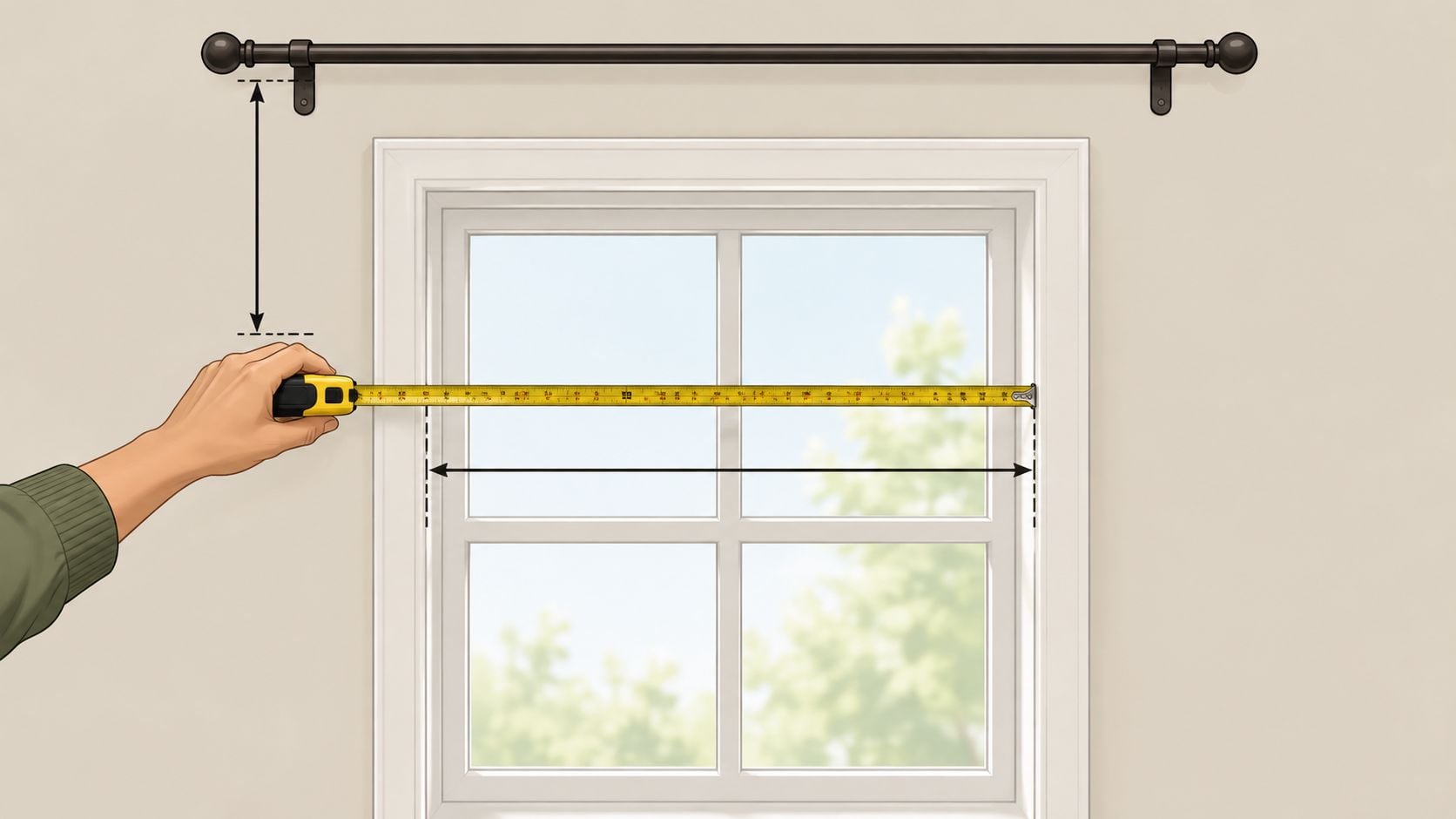
For a quick reference, a homeowner's worksheet should include the opening width, planned rod width, rod-to-floor height, sill depth, desired fullness, return, and mounting surface. The curtain panel sizes guide can help translate those measurements into a panel configuration before fabric is purchased.
Choosing Pattern Scale, Fabric, and Color Contrast
Pattern scale is the biggest visual decision after the black ground. A large botanical print reads like art and needs enough wall, ceiling height, and visual quiet around it. A small repeat behaves more like texture, making it easier to coordinate with bookshelves, patterned upholstery, or a rug.
Fabric weight changes the mood and the practical result. Lightweight cotton or lawn drapes softly and filters more daylight. Linen has more body and a relaxed surface, but it can show natural variation and may not provide the darkness expected in a bedroom. Velvet and heavy jacquard create greater visual presence, reduce some daylight, and generally hang with more authority.
Openness factor matters more than the color name. A sheer or voile ground allows the floral design to glow when daylight passes through it, but it won't guarantee nighttime privacy. An opaque ground gives the print a flatter, more saturated appearance and offers greater visual separation from the outdoors. The fabric's openness, weave density, and lining should be evaluated together rather than inferred from a product photograph.
A useful pattern comparison looks like this:
| Choice | Best For | Light and Heat Effect |
|---|---|---|
| Large-scale botanical | A room with restrained furniture and minimal wall décor | Can reduce the sense of glare through visual weight, but a dark face may absorb more radiant heat in strong sun |
| Small-scale botanical | A compact room, layered patterns, or a home office | Feels lighter visually and is easier to coordinate, but the fabric's weave still determines light control |
| Lightweight cotton or lawn | Soft daytime filtering and relaxed rooms | Allows more daylight and usually offers limited privacy after dark |
| Mid-weight linen | Casual living rooms and natural furnishings | Provides body without stiffness, with performance determined by openness and lining |
| Velvet or heavy jacquard | Bedrooms, formal rooms, and dramatic interiors | Reduces daylight and can improve the sense of enclosure, while dark fabric may retain more solar heat |
| Black with warm florals | Romantic, collected interiors | Creates strong contrast without a stark graphic effect |
| Black with white florals | Modern, tailored rooms | Produces the highest visual contrast and makes the pattern more dominant |
| Black with jewel tones | Traditional or layered rooms | Supports richer furniture finishes and a more decorative atmosphere |
The fabric geometric pattern guide offers useful pattern-scale principles that also apply to botanicals. The central point is simple: large patterns need room to breathe, and contrasting patterns need differences in scale or visual weight.
A room with a bold rug usually benefits from a smaller floral repeat or a lower-contrast print. A quiet room with solid upholstery can handle a larger botanical that becomes the focal point. Homeowners coordinating several patterns can use the guidance in this guide to mixing and matching patterns before committing to a custom panel.
Lining, Hardware, and Performance Details
Lining should be selected by function, not by the label alone. An unlined black floral curtain may look beautiful in a dining room with controlled daylight, but it won't reliably provide nighttime privacy or bedroom darkness. Privacy lining softens the view from outside, dimout lining reduces incoming light, and blackout construction blocks substantially more light when the fabric, seams, and edges are properly fitted.
A blackout label doesn't settle the heat question. A dark face fabric can absorb radiant energy, while a light-colored thermal lining may reflect some of that energy back toward the glass. The final result depends on the window orientation, glazing, fabric weight, lining, distance from the glass, and gaps at the sides, top, and bottom.
Independent retrofit research found that closely spaced threads can reduce solar heat-gain coefficient by nearly 90%, and laboratory comparisons measured an SHGC of approximately 0.69 for jacquard with an openness factor of 0.05, compared with 0.82 for organza at 0.45. Jacquard and gabardine reduced U-values by about 13% relative to single glazing, while organza achieved about 7%, according to window energy retrofit research.
Match the hardware to the job
A rod pocket suits a relaxed decorative panel but makes frequent opening less convenient. Pinch pleats create a formal line and work well with rings or a traverse system. Grommets give a contemporary appearance, while traverse and ripplefold systems make wide or heavy panels easier to operate.
Hardware should extend far enough beyond the frame for the panels to stack clear of the glass. A return toward the wall limits side light, and a center bracket prevents sag across a broad span. Heavier lined panels need a substantial pole and secure brackets fastened to appropriate wall support. A double rod makes sense when a sheer, liner, or light-filtering layer needs to sit behind the black floral panel.
| Option | Light Block | Heat and Noise | Best Use |
|---|---|---|---|
| Unlined panel | Low | Minimal change | Decorative dining rooms and low-privacy windows |
| Privacy lining | Moderate visual privacy | Softens the panel and limits some daylight | Living rooms and street-facing spaces |
| Dimout lining | Stronger light reduction | Adds body and some sound-softening effect | Media rooms and bedrooms needing flexible darkness |
| Blackout lining | Highest light control when edges are covered | Adds weight and can improve the sense of enclosure | Bedrooms and rooms requiring reliable darkness |
| Double rod | Depends on the two layers | Allows separate control of light and privacy | Living spaces with sheers behind floral panels |
| Traverse or ripplefold track | Depends on the curtain construction | Useful for smooth movement across wide windows | Large windows and frequently used openings |
| Motorized track | Depends on lining and fit | Useful for difficult or high windows | Hard-to-reach openings and scheduled light control |
Motorization pays for itself in convenience when panels are tall, wide, or difficult to reach. Decorative finials only change appearance. They don't improve privacy, thermal performance, or stack-back clearance.
Installation Tips for a Clean, Professional Finish
A polished installation begins with a level rod, not with the curtain panels. Mark the bracket height, check the full wall with a laser level, and confirm that the rod clears trim, handles, and nearby furniture. A tape measure can establish distances, but it can't show whether the line runs evenly across a wall that isn't perfectly level.
Install in the correct order
Mark the brackets. Use the planned rod height and side extension, then check both marks against the window, ceiling, and trim.
Choose the anchors. Drywall, plaster, and masonry need different fasteners. A bracket mounted only into weak surface material can pull away once lined panels are added.
Drill pilot holes. Size the hole for the selected anchor and avoid forcing a screw through a bracket without support.
Mount the brackets. Install the center support on a wide span before placing the rod. Check the level again after tightening.
Place the rod and panels. Hang the panels before final tightening when the hardware allows it. This exposes clearance problems while adjustments remain easy.
Train the folds. Arrange pleats by hand, loosely tie the panels in their intended folds, and leave them in position so the fabric learns a consistent fall.

Three mistakes spoil otherwise attractive black floral curtains:
- Mounting the rod too low. The window loses height and the room can look compressed.
- Spacing brackets too far apart. The rod bows in the center, especially with blackout lining or heavy jacquard.
- Hemming before hanging. Floors and rods rarely sit exactly as expected, so the finished length can be wrong.
Pinch pleats often need gentle hand shaping after installation. Grommet panels should be spaced evenly rather than pushed into tight accordion folds. Steaming can relax packing wrinkles, but the steamer should stay moving and avoid pressing directly against a printed face fabric.
The Roman shade installation resource is also useful when a layered treatment includes a shade behind the floral panels. The shade and curtain hardware need enough clearance to operate independently.
Styling Black Floral Curtains Room by Room
The same black floral curtain can feel intimate in a bedroom, theatrical in a living room, elegant in a dining room, and practical in a home office. The surrounding materials decide whether the pattern feels restful or loud.
Bedroom
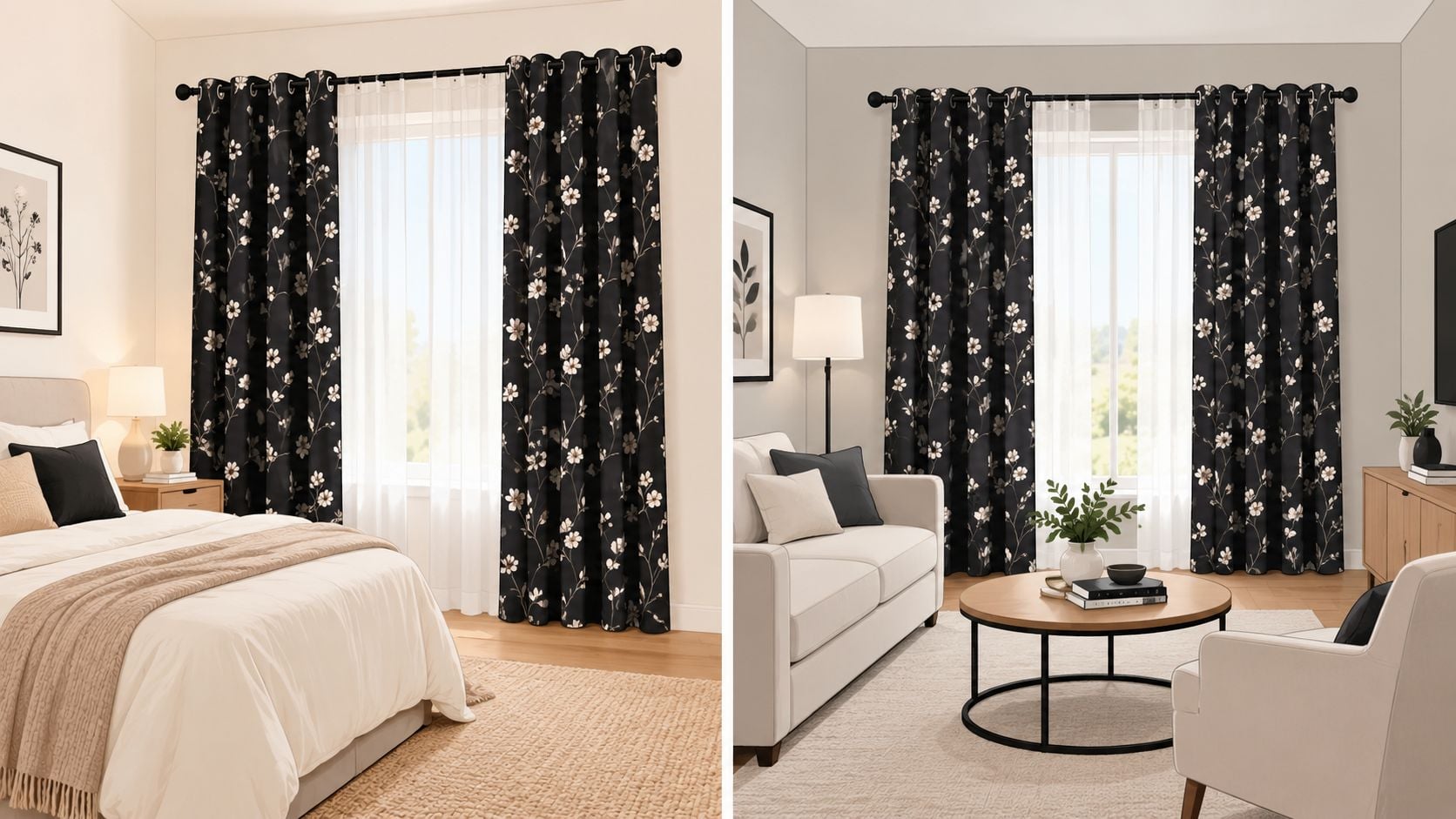
Warm white walls keep the black ground from becoming oppressive. Layering the floral panels over sheers gives the room daytime privacy without forcing the heavy panels open or closed every time daylight changes. Matte black hardware reinforces the pattern, while pale bedding and a textured rug keep the composition from turning overly dark.
For a bedroom, the floral face should be paired with lining selected for the actual sleep requirement. A light-filtering curtain can look substantial while still allowing silhouettes to appear after interior lights come on.
Living room
A living room benefits from width. Panels that extend beyond the frame can stack away from the glass, preserve the view, and make the window feel more generous. A leather tieback, cream rug, and brass accent table create a deliberate contrast between the dark botanical fabric and lighter furnishings.
Large florals work here when the rest of the room has visual restraint. If the sofa, rug, and wall art already carry strong patterns, a small repeat will look more composed.
Dining room
Floor-length pinch pleats give a dining room a finished, polished edge. The panels should remain untied so the floral stays present at the table rather than bunching at the sides. Oatmeal roman shades can provide a quiet secondary layer while keeping the curtains as the main decorative statement.
Home office
A smaller-scale floral is usually the safer choice near a desk, shelving, and screens. Mounting the panel higher than the frame can preserve useful desk light, while the print softens a technology-heavy corner. A lighter lining keeps the room functional during working hours.
Three broader style directions also work well:
- Maximalist: Pair large florals with a second pattern in a different scale and repeat one floral color in a lamp, cushion, or art piece.
- Modern farmhouse: Use a restrained botanical, natural wood, warm white walls, and simple black hardware.
- Moody traditional: Choose velvet or jacquard, deeper floral tones, custom pleats, and brass or aged metal accents.
Care, Maintenance, and When to Call a Pro
Black floral curtains stay attractive when dust and handling are addressed before they become permanent wear. A soft brush attachment removes surface dust without dragging the print, while a mild detergent spot treatment should be tested on an inconspicuous area first.
A practical care routine includes:
- Vacuum gently. Support the fabric behind the brush when the panel is lightweight.
- Follow the label. Lined or silk-blend curtains may require dry cleaning, while cotton and polyester may tolerate a cool machine cycle.
- Steam carefully. Use gentle steam to release wrinkles without scorching the print or flattening the weave.
- Rotate panels seasonally. This distributes sunlight exposure so one side doesn't fade faster.
- Inspect the construction. Check rod pockets, grommets, lining seams, and hems every six months.
Homeowners who need specialist handling for substantial or lined treatments can review a professional curtain dry cleaning service before placing panels in a household washer. Washing the printed face fabric alone doesn't reveal how the lining and interlining will behave together.
Custom curtains need a stability check
Custom-made panels should be tested before full fabrication whenever the care method is uncertain. AATCC 135 measures marked fabric dimensions before and after controlled home-laundering cycles, with dimensional change calculated separately in the length and width directions. The face fabric, blackout lining, and interlining can shrink at different rates, creating puckering, pattern misalignment, or a wavy hem. The standardized method is described in the AATCC dimensional-stability document.
A professional should be called when blackout lining develops persistent odor or yellowing, the fabric stretches or sags and no longer hangs true, or the hardware pulls away from its bracket. Tip Top's local measuring, design consultation, and custom-order services in Freehold can also help with re-lining, reupholstering related furnishings, or replacing a treatment that no longer suits the room.
Tip Top Furniture & Mattresses is a family-owned Freehold showroom with a 1978 legacy, more than 45 years of furnishing experience, and professional design services available since 1984 for homeowners across Albany, Schenectady, Troy, Greene County, and the Greater Albany Capital Region. Its one-stop service covers custom window-treatment planning, furniture, flooring, décor, USA-made mattresses, Amish furniture, delivery, clearance selections, and flexible financing. Homeowners ready to test floral samples, review lining options, or plan a coordinated room should visit Tip Top Furniture & Mattresses.