
USA Made Mattress Protector Guide


A glass of water tips over during the night. A child has an accident. A summer allergy flare-up leaves the bedroom dusty and uncomfortable. These moments can turn a comfortable bed into a costly cleaning problem, especially when the mattress has no reliable protection between the sleeper and the surface below.
A quality USA-made mattress protector gives that mattress a fitted layer of defense without changing the feel of the bed. For homeowners in Freehold, Albany, Schenectady, Troy, and the wider Capital Region, the right choice should go beyond a country-of-origin label. Material transparency, safe construction, quiet performance, correct sizing, and easy care all matter.
Why Your Mattress Needs a Reliable Defense
A mattress is built for nightly use, but its inner materials aren't designed to absorb repeated spills, perspiration, body oils, pet dander, or household dust. Once moisture reaches the upholstery and comfort layers, drying becomes difficult. Odors and stains can follow, and cleaning a large mattress at home is rarely simple.
A protector acts as a thin, fitted shield between the sleeper and the mattress. It can preserve the bed's original feel while helping block liquid and common irritants. As explained in this guide to mattress protectors, the accessory works best when it fits securely and becomes part of the regular bedding routine rather than an emergency purchase after damage occurs.
Small accidents can create large problems
Consider a guest bedroom in a Freehold home. A visitor spills a drink, the liquid reaches the mattress, and the owner removes the sheets several hours later. The surface may look dry after cleaning, but moisture can remain inside the mattress layers. A protector would have created a washable barrier and made the cleanup far more manageable.
The same principle applies to families with young children, households with pets, and anyone who eats or drinks near the bed. A waterproof layer doesn't make a mattress indestructible, but it gives the household more time to respond before a spill spreads into the bed.
Practical rule: A protector should be installed when the mattress is new, not after the first accident.
Mattress care and warranty concerns
Many mattress warranty terms exclude damage caused by stains or contamination. That means a household can follow every recommended support and rotation instruction yet still face a warranty problem after an avoidable spill. A protector doesn't replace careful mattress maintenance, but it helps keep the surface in the condition manufacturers generally expect.
A protector also supports better long-term hygiene. It can be removed, washed, inspected, and replaced without turning the entire mattress into a cleaning project. For anyone investing in a USA-made mattress, a domestic protector is a practical companion that helps preserve the feel and condition of that investment.
The strongest options should feel quiet under the sheets, stay in place through normal movement, and provide a clear explanation of their waterproof layer. That combination matters more than a flag printed on the package.
The Evolution of Modern Bedding Protection
A shopper at our Freehold showroom may start with a simple question: when did a mattress protector become more than a washable cover? A bedding-industry account commonly credits the first waterproof mattress protector to the mid-1980s, a shift described in this history of waterproof mattress protection. Earlier covers focused mainly on keeping the surface clean. Modern designs must balance liquid resistance with comfort, airflow, allergy considerations, fit, and repeated use.
The change reflects decades of development, from straw mats to memory foam, as traced in this history of mattresses from straw mats to memory foam.
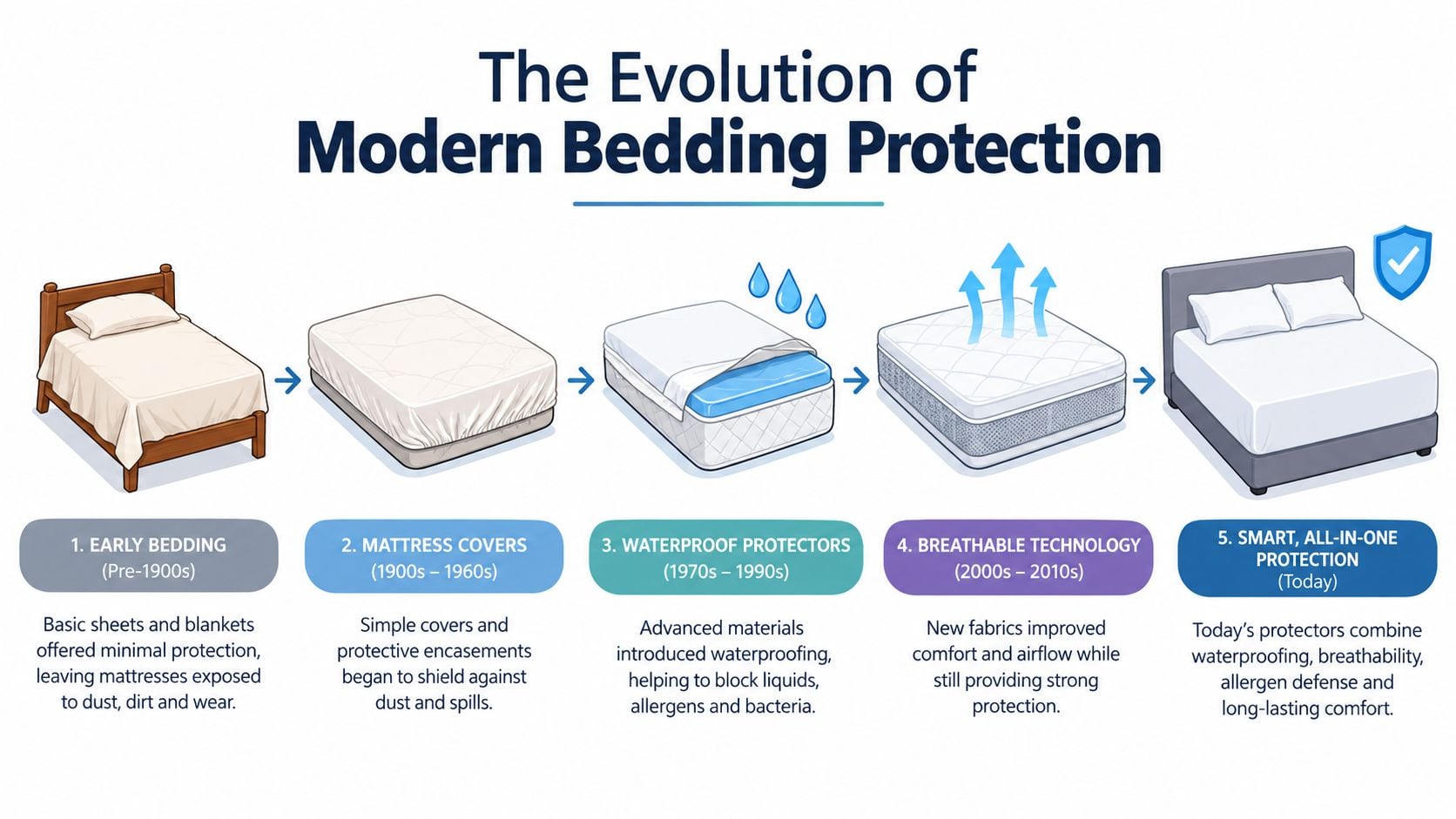
A plastic-feeling cover may stop moisture while making the bed warmer or noisier. Engineered protectors address that trade-off with thinner barrier films, stretch fabrics, fitted skirts, and softer surface textiles. The goal is protection that stays quiet and unobtrusive beneath the sheet.
A mainstream bedding purchase
The U.S. bedding protector market was valued at about USD 1.5 billion in 2024 and is projected to reach about USD 2.2 billion by 2033, representing roughly 46.7% total growth and a projected CAGR of about 4.9%, according to market data on bedding protectors. The same source estimates that around 65% of U.S. households use mattress protectors and that roughly 28 million protectors are sold annually across residential and hospitality segments.
These figures show how protectors moved from niche bedding accessories into a common household purchase. Hygiene concerns, children, pets, replacement needs, and mattress longevity all support demand. Shoppers in the Capital Region deserve careful guidance here, just as they do when selecting a mattress.
Why domestic construction attracts attention
The linked category analysis reports that North America holds 35.2% of global mattress protector revenue, while waterproof and hypoallergenic variants account for an estimated 44% of the regional market. Those figures help explain the attention given to domestic construction and product information.
A USA-made mattress protector can appeal to buyers seeking clearer details about its fabric, barrier, safety certifications, testing, manufacturing process, and measured breathability. Country of origin is a useful starting point, not a complete quality test. A transparent specification sheet gives shoppers a better basis for judging comfort and construction than a label alone.
The category has progressed from crude plastic covers to engineered bedding. Quality now depends on how openly the maker explains the materials and performance behind that progress.
Understanding Waterproof Barriers and Safety Certifications
Waterproofing can come from two very different approaches. A protector may use a physical laminated polyurethane barrier, often described as PU or TPU, or it may rely on a chemical finish applied to the surface of the textile. The first approach creates a thin film that blocks liquid. The second changes the surface chemistry so water resists the fabric.
Independent guidance identifies laminated polyurethane as the stronger construction for a mattress protector because it blocks liquid without depending on fluorinated water-repellent coatings. The PFAS guidance on waterproof mattress protectors explains why shoppers should examine the barrier material instead of assuming that every waterproof finish works the same way.
Step one is identifying the barrier
A product description should state what sits between the fabric layers. Useful wording may include:
- Laminated polyurethane: A physical membrane designed to stop liquid from passing through.
- TPU barrier: A form of thermoplastic polyurethane used in some waterproof bedding constructions.
- Chemical water-repellent finish: A surface treatment that should prompt questions about the substances used.
- Unclear waterproof layer: A reason to request more material information before buying.
The barrier should also be thin enough to preserve the mattress feel. A thick or stiff layer may protect against liquid but make the bed feel less comfortable. The label should explain the surface fabric, the waterproof layer, and the care instructions in plain language.
Step two is reading certifications carefully
Certification names don't all prove the same thing. GOTS prohibits PFAS in processing, while OEKO-TEX Standard 100 screens textiles for many harmful substances, including PFAS within its newer testing scope. OEKO-TEX is a harmful-substance threshold test, however, and it shouldn't automatically be presented as a dedicated PFAS test.
That distinction matters for sensitive households. A shopper may reasonably ask:
- What material forms the waterproof barrier?
- Does the manufacturer state that the product is PFAS-free?
- Was the finished product independently tested?
- Does the certification apply to the entire product or only a component?
- Can the manufacturer provide testing details?
One product test described in the safety guidance screened 679 PFAS substances and found none above laboratory limits. That example shows why specific test information can be more useful than a vague safety phrase.
A domestic label may communicate where a protector was made. It doesn't answer every question about chemistry or performance. USA-made plus transparent materials and relevant testing gives shoppers a more meaningful standard.
Balancing Moisture Protection with Nighttime Breathability
A waterproof protector can fail as a sleep accessory if it makes the bed hot, clammy, or noisy. Liquid protection and breathability aren't opposites, but they require careful construction. The membrane needs to resist liquid while allowing some moisture vapor to move away from the sleeper.
The most useful question for a hot sleeper isn't just, “Is it waterproof?” It's, “How does the manufacturer measure vapor and air movement?” Industry references commonly use ASTM E96 for water-vapor transmission, ASTM D737 for air permeability, and ASTM D751 for hydrostatic resistance.
What the performance figures mean
Reported target ranges associated with breathable, waterproof sleep surfaces include roughly 1,500 to 3,000 g/m²/24 h MVTR, 40 to 100 L/m²/s air permeability, and 2,000 to 3,000 mm hydrostatic resistance. Some U.S.-manufactured products publish moisture-vapor transfer values above 7,500 g/m²/24 h in third-party laboratory reports. These benchmark figures and test references appear in this technical guide to breathable mattress covers.
MVTR measures how much water vapor can pass through a material over a set period. A higher result generally indicates greater vapor movement, but the number shouldn't be viewed in isolation. The fabric surface, membrane thickness, mattress underneath, room humidity, and bedding layers all influence the final experience.
Choosing between protection priorities
A protector for a child who frequently wets the bed may prioritize stronger liquid resistance and a secure fit. A protector for a hot sleeper may place greater emphasis on vapor transfer, air permeability, a low-profile surface, and reduced noise. A sensitive sleeper may need both a clear material disclosure and a soft, smooth top fabric.
| Sleep concern | Features to prioritize | Potential tradeoff |
|---|---|---|
| Heat and humidity | Published MVTR, air-permeable fabric, thin barrier | Maximum liquid resistance may require a denser construction |
| Accidents and spills | Physical waterproof membrane, full mattress coverage, secure skirt | Some highly protective designs may feel more noticeable |
| Quiet comfort | Soft textile surface, flexible membrane, low-profile fit | A textured surface may change the feel beneath the sheet |
| Sensitive skin | Clear fiber disclosure, PFAS information, relevant certification | More documentation may be needed before purchase |
A protector that feels thick or textured under a fitted sheet may bother sleepers even when it performs well against moisture. That is why the final decision should account for the person using the bed, not just the strongest waterproof claim.
For bedding layers that influence feel and airflow, shoppers can also review this guide to bedding fabric types. The practical goal is simple: keep the mattress dry without turning the sleeping surface into a sealed plastic shell.
Getting the Right Fit for Your Mattress Depth
A protector can have an excellent membrane and still fail if it doesn't fit the mattress. Corners may pull free, the skirt may ride up, or excess fabric may bunch beneath the sleeper. Correct sizing starts with mattress depth, not just the familiar label of twin, full, queen, or king.
Measure before selecting a pocket size
The measurement should include the mattress itself and any permanent pillow-top or plush layer that remains on the bed. A removable topper should be measured separately, because placing it under or over the protector changes the required depth.
Use this process:
- Remove the sheets and existing loose bedding.
- Measure from the bottom edge of the mattress to the highest point of the sleep surface.
- Include a built-in pillow-top or attached comfort layer.
- Compare the result with the protector's stated pocket range.
- Allow enough stretch for the skirt to grip without forcing it over the corners.
Manufacturers commonly list a standard fit from 8 to 15.5 inches and a deep-pocket fit from 15.5 to 20 inches, as shown in this mattress protector sizing guide. Some retail listings use different limits, so the product's own measurement should control the decision.
| Mattress profile | Common pocket depth | Best for |
|---|---|---|
| Standard profile | 8 to 15.5 inches | Traditional mattresses without unusually tall comfort layers |
| Deep profile | 15.5 to 20 inches | Tall mattresses, attached pillow-tops, and substantial comfort systems |
| Unusual or layered profile | Manufacturer-specific | Beds with added toppers or nonstandard construction |
A shopper comparing sheets and protectors can use this bed sheet measurement guide to understand how depth affects fitted bedding more broadly. The protector should lie flat across the top, reach fully around the sides, and remain anchored when the sleeper turns.
Fit check: After installation, run a hand across the surface. If the protector feels tight at the corners or loose beneath the sheet, the pocket depth may be wrong even if the bed-size label is correct.
Building a Healthier Bedroom Environment
A protector can help keep a bedroom cleaner, but it cannot carry the whole job. Its surface may reduce exposure to dust mites, bacteria, bed bugs, pollen, and pet dander, according to guidance on mattress protectors and allergy control. The result depends on full coverage, sound construction, its condition, and regular washing.
Country of origin is only one part of the evaluation. A USA-made protector deserves closer review of its disclosed fibers, waterproof barrier, safety certifications, and published breathability information. Those details work like a product map. They show what touches your skin, what blocks moisture, and how the material is designed to handle airflow and heat.
Different households will value different details. A family with pets may prioritize a washable surface and clear information about dander protection. Someone with seasonal allergies may prefer secure coverage or an encasement-style design. A sleeper with sensitive skin may look for fiber disclosure and chemical testing rather than relying on a country-of-origin label alone.
Connect sleep protection with the whole room
A healthy bedroom also needs clean sheets, controlled dust, reasonable humidity, and furniture that leaves room to move around the bed. Follow these dust- and allergen-free bedroom maintenance tips to support that routine. Clear access beneath and around the bed makes cleaning easier, while crowded layouts create more surfaces and corners to manage.
Bedroom comfort also depends on the surrounding furniture. A family-owned Freehold showroom serving Albany, Schenectady, Troy, Greene County, and the surrounding Capital Region can coordinate bedroom furniture, mattresses, décor, window treatments, and flooring in one place. Its professional design services have been available since 1984, and its broader furniture business has a legacy reaching back to 1978.
Sleep habits matter alongside bedding choices. This practical nighttime wellness guide offers ideas for a calmer evening routine. A protector cannot solve every sleep concern, but a clean, comfortable, organized room removes several common distractions.
Domestic sourcing is part of a larger decision
A USA-made mattress protector may suit a household that values domestic manufacturing, traceable materials, and durable construction. Before buying, confirm that those qualities are supported by clear product information, relevant safety certifications, and breathability details. The same priorities can guide choices about American-made mattresses, solid-wood Amish furniture, custom finishes, and long-lasting flooring.
Use this checklist:
- Material clarity: The surface fabric and waterproof barrier are identified.
- Safety evidence: Certifications or testing information are clearly stated.
- Comfort evidence: The design addresses heat, noise, and texture concerns.
- Maintenance fit: The household can follow the washing and drying instructions.
- Room coordination: The bed, mattress, protector, and furniture work together.
- Service access: Delivery, financing, custom ordering, and design support are available when needed.
A protector is a small purchase beside a full bedroom, yet it influences how comfortably and reliably that room performs each night.
Proper Care and Washing Routines
A waterproof protector needs regular cleaning, but harsh laundry habits can damage the very barrier that makes it useful. Most care guidance recommends machine washing in cool-to-warm water on a gentle cycle with mild detergent, followed by tumble drying on low heat. The detailed mattress protector care guide also advises avoiding bleach and harsh chemicals.
A simple washing routine
Start by checking the sewn-in care label. If the protector has a removable component, separate it as directed. Then use the following approach:
- Wash gently: Choose a gentle cycle with cool-to-warm water.
- Use mild detergent: Avoid bleach, fabric treatments, and harsh chemicals unless the manufacturer specifically allows them.
- Protect the membrane: Keep the cycle moderate and avoid practices that can stress the laminated layer.
- Dry carefully: Use low heat or air-dry the protector when the care label permits.
- Inspect before reinstalling: Look for torn seams, worn elastic, punctures, or changes in the waterproof layer.
- Replace when compromised: A protector with visible damage can't provide dependable coverage.
High heat can weaken elastic and place unnecessary stress on waterproof materials. Bleach may also affect the textile or barrier. A protector should be washed often enough to remain fresh, but the care schedule should reflect the household's use and the manufacturer's directions.
Keep the bed ready for everyday life
A second protector can make laundry day easier for families, guest rooms, and children's bedrooms. While one protector is washing, the mattress can remain covered instead of waiting uncovered for the next accident.
Proper care also supports the broader value of a domestic sleep purchase. In the Freehold area, shoppers can discuss USA-made mattresses and protectors, delivery, flexible financing, custom bedroom options, and furniture from more than 50 trusted manufacturers with Tip Top Furniture & Mattresses. A visit can help households match the protector's fit, feel, and care requirements to the mattress already in the home.