How Custom Furniture Works from Design to Delivery


A dining table can look perfect online and still fail in the room. The depth may block a walkway, the length may crowd a doorway, or the finish may fight with the flooring. After weeks of measuring and browsing, many homeowners in Albany, Troy, Schenectady, and Greene County reach the same conclusion: the room shouldn't have to bend around the furniture.
That's where custom furniture works differently. Instead of choosing the closest standard size, the homeowner helps define the dimensions, materials, finish, storage, and function before production begins. The process takes more thought than buying from a showroom floor, but it can solve awkward layouts, support daily routines, and create a piece worth maintaining for years.
Why Homeowners Choose Custom Furniture
A homeowner with an unusually shaped dining room may need a table that leaves room around a corner, keeps chairs clear of a passage, and still seats the household comfortably. Standard tables often force a compromise. A custom design can adjust the length, depth, leg placement, edge profile, and finish around the actual room.
That practical advantage explains why the category has moved well beyond a luxury niche. The global custom furniture market is projected to grow from $23.51 billion in 2021 to $74.60 billion by 2033, with a stated 10.1% CAGR, according to Cognitive Market Research's custom furniture market analysis. The same analysis projects North American sales revenue rising from $6.75 billion to $19.99 billion, while United States revenue is forecast to increase from $5.13 billion to $15.03 billion over the same period.
Fit matters more than novelty
Most homeowners aren't ordering custom furniture to own something unusual. They're trying to solve a specific problem:
- Awkward dimensions: A narrow entry, sloped ceiling, shallow wall, or oversized room needs more precise proportions.
- Daily-use demands: A home office may require cable management, a dining area may need extension capability, and a bedroom may need storage that standard pieces don't provide.
- Consistent design: Matching wood, stain, hardware, and upholstery can make separate rooms feel intentional.
- Long-term ownership: Solid wood Amish furniture, handcrafted in the USA, can be selected as an heirloom-quality piece rather than a temporary purchase.
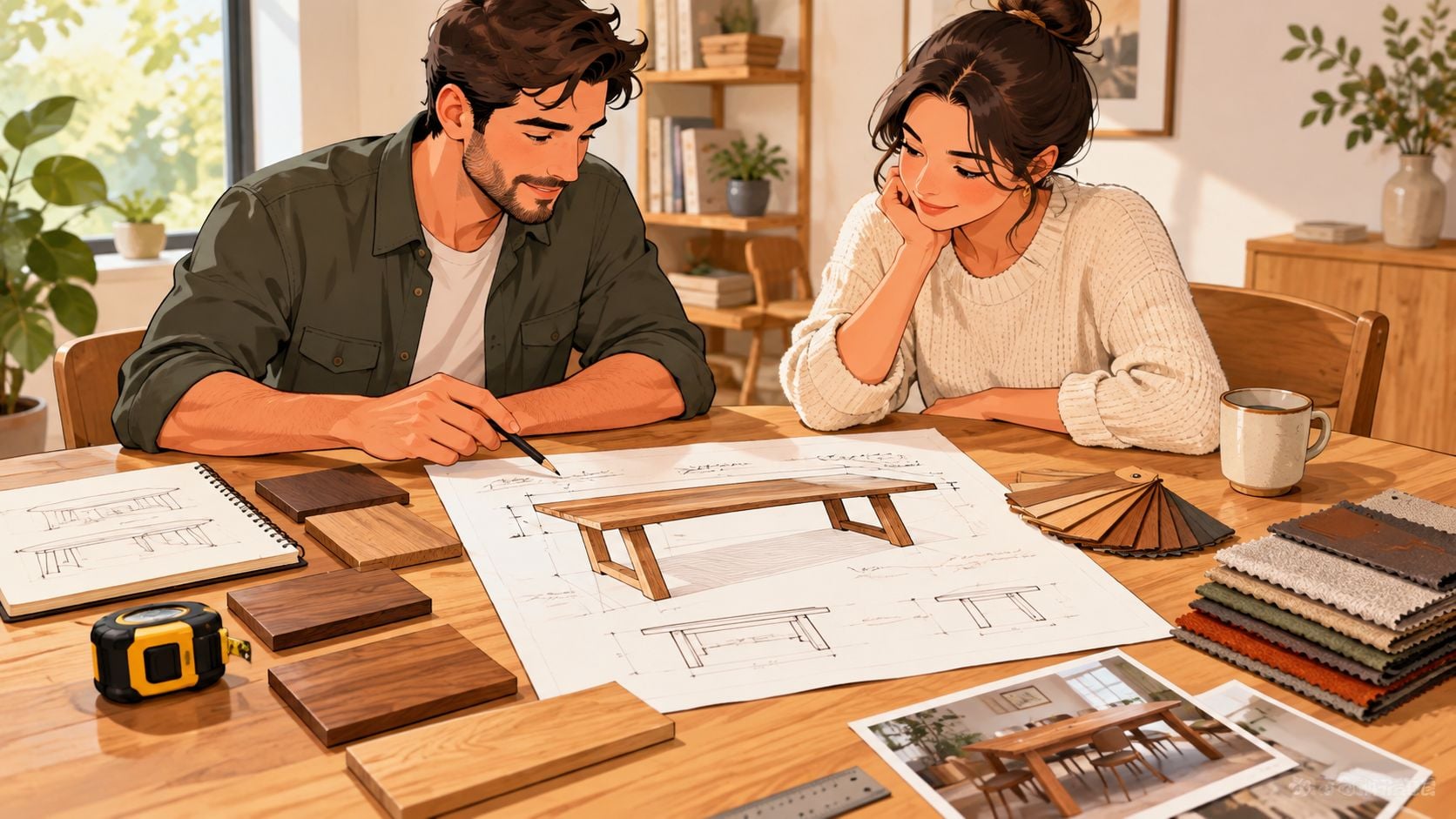
Custom ordering also gives shoppers more control over the details that change a piece's character. A homeowner might start with a photograph, a magazine image, or a hand-drawn sketch, then work with a designer to turn that idea into a buildable specification.
Practical rule: Custom furniture earns its premium when it solves a real fit or function problem. If the only goal is a different color, a ready-made or semi-custom option may be more sensible.
The market outlook supports continued demand. A separate forecast values the global customized furniture market at $39.55 billion in 2025 and projects $110.12 billion by 2034, representing a 12.05% CAGR, as reported by Straits Research. The report identifies Asia Pacific as the largest regional market in 2025, with a 38.4% share. For homeowners near the Freehold showroom and throughout the Greater Albany Capital Region, the takeaway is simple: personalization has become a mainstream buying expectation, not an odd exception. A clear starting point is Tip Top's custom furniture process.
The Consultation and Design Phase
A successful custom order starts before anyone discusses stain colors. The homeowner needs to bring accurate information about the room, the household, and the way the furniture will be used.
Prepare the room before the appointment
The first task is measurement. Record the available wall length, ceiling height, doorway width, stair turns, window locations, outlets, vents, trim, and radiator positions. A piece can fit its final location and still fail at delivery if it can't pass through the entry or turn inside a hallway.
Photos help, especially when they show the full room from several angles. A rough floor plan is useful too, but the measurements should be labeled clearly and checked twice. Homeowners should also note which paths must remain open, where people sit, and whether doors, drawers, recliners, or cabinet doors need clearance.
Explain how the household lives
A designer needs more than a style label such as farmhouse, traditional, or modern. The useful questions are practical:
- Who uses the piece every day?
- What gets stored inside or on it?
- Does the household host guests?
- Are pets, children, mobility needs, or frequent moves part of the decision?
- Will the room also include new flooring, window treatments, mattresses, or décor?
- Does the piece need to support remote work, charging, display, or concealed storage?
The answer affects proportions and construction. A media console for occasional use can be designed differently from one that carries daily equipment and hides multiple cords. A bedroom dresser should reflect the clothing it will hold, while a dining table should account for chair placement, circulation, and cleaning habits.
Turn preferences into specifications
A professional design consultation translates broad preferences into decisions that a maker can follow. The discussion should produce a written outline covering dimensions, wood type, finish, hardware, upholstery, functional features, delivery access, and approval points.
Tip Top's professional design services have been available since 1984, and the firm's own history page reports more than 300 completed projects through its design work GEMACO Interiors. That kind of long-running design experience illustrates why consultation is more than decoration. It's risk control.
Homeowners can use Tip Top's interior design consultation services to coordinate furniture, décor, and flooring decisions rather than treating each purchase as an isolated choice. A scaled room plan can expose a cramped walkway before the order is placed, when changes are still manageable.
Selecting Materials and Finishes
Material selection determines how a custom piece looks, ages, and behaves in a home. Wood species affects grain, color, hardness, and visual weight. Finish affects sheen, maintenance, and how strongly the grain appears. Hardware adds both function and style.
Custom Amish furniture makes those decisions visible instead of hiding them behind a single product name. One Amish furniture source offers 50 finishes, 5 North American wood species, and 70 hardware selections, demonstrating how detailed a made-to-order catalog can become Daniel's Amish.
Choose the wood for the room and the routine
A dining table that sees daily meals needs a finish and construction approach suited to regular cleaning. A bedroom case may prioritize a calmer grain and coordinated hardware. A home office may need a surface that tolerates writing, equipment, and repeated contact.
The choice isn't only about appearance. Homeowners comparing solid timber with engineered alternatives can review this explanation of solid timber or engineered for cladding for broader material context. Furniture decisions still need to account for the intended load, environment, repair expectations, and the maker's construction method.
Treat moisture content as a construction requirement
Wood moves as indoor conditions change. Furniture-grade wood is typically dried to about 6–8% moisture content so it can equilibrate with conditioned interior spaces and reduce the risk of warp, gaps, and joint stress, according to Sensora Home's woodworking moisture guidance.
That doesn't mean wood movement disappears. Experienced builders allow for seasonal expansion with techniques such as:
- Floating panels: Panels can move within a frame instead of splitting the surrounding structure.
- Elongated screw holes: Fasteners hold components securely while allowing controlled movement.
- Frame-and-panel construction: Cross-grain parts are designed to move without binding.
This is one reason an experienced maker matters. A beautiful wood sample can't compensate for a design that ignores how the material behaves.
Specify the finish and hardware clearly
Finish samples should be viewed in the room's actual light, near the flooring and nearby upholstery. A stain can look different beside warm carpet than it does beneath showroom lighting. The order should identify the selected finish, sheen, edge treatment, hardware style, and any acceptable variation in grain or color.
Tip Top's custom wood finishes help homeowners compare those choices before approval. A neutral American-made furniture directory also describes the “create your own” model, where shoppers select style, wood, stain, and hardware Still Made in USA. Clear choices at this stage prevent disputes later.
When Custom Beats Ready-Made Furniture
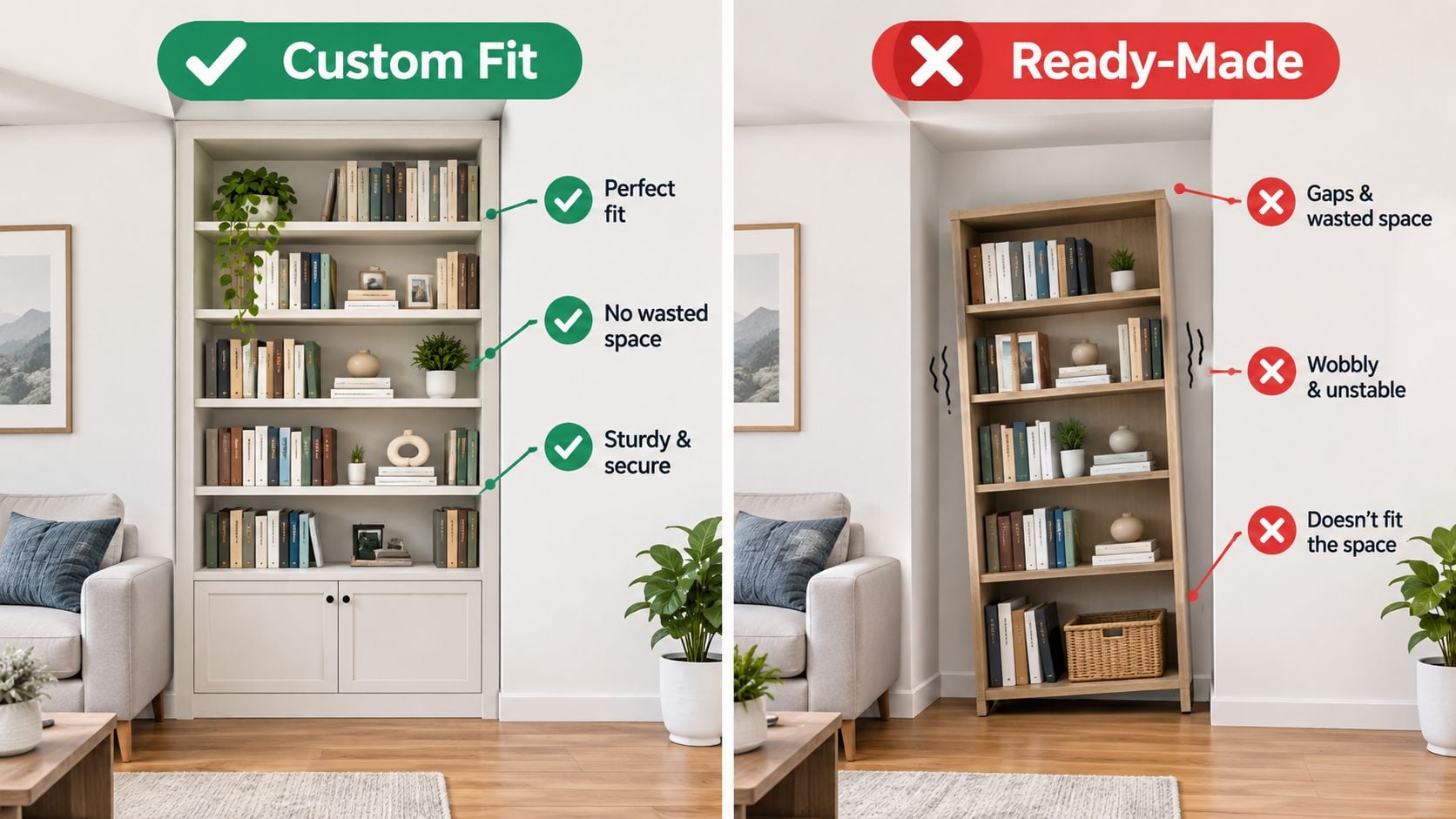
Custom furniture isn't automatically the best value. It wins when the cost of a poor fit, awkward function, or short ownership cycle outweighs the premium for a custom build.
A built-in bookshelf is a strong custom candidate when the room has an unusual ceiling, a narrow alcove, or a wall that needs every inch of usable storage. A standard bookcase may cost less at checkout, but it can leave dead space, look undersized, or require later modifications.
Use this value test
| Choose fully custom when | Consider ready-made, semi-custom, or modular when |
|---|---|
| Exact dimensions determine whether the piece works | Standard dimensions already fit the room |
| The design must combine storage and specialized functions | The need is temporary or likely to change |
| Matching wood, finish, and hardware across rooms matters | Budget and immediate availability lead the decision |
| The piece is intended for long ownership | Flexibility and easy replacement matter more than permanence |
| A complex room makes rework expensive | A designer can solve the problem with layout changes |
Custom also makes sense when the homeowner wants a specific combination that standard inventory doesn't offer, such as a particular height, drawer arrangement, wood species, and finish. The value comes from getting the whole solution right, not from adding options for their own sake.
Know when less customization is smarter
Small-space homeowners and budget-conscious buyers often get better results from semi-custom or modular furniture. A standard frame with selected upholstery, finish, or hardware may deliver the desired look without the cost and waiting period of a fully bespoke build. A modular storage system can also adapt as a household changes.
The most economical move may be design assistance rather than a custom build. Better room planning, a targeted size adjustment, or a carefully chosen ready-made piece can solve the central problem. Recent market coverage also describes modular, upgradeable, quick-ship semi-custom, and circular refurbishment approaches as part of the evolving category Coherent Market Insights.
Custom is not a virtue by itself. The right purchase is the one that solves the room's problem with the least unnecessary complexity.
Production Timelines and Pricing Factors
A custom order is a sequence of approvals, material decisions, fabrication, finishing, inspection, and delivery. The calendar depends on the build, the maker's workload, material availability, and the time required to resolve questions.
Homeowners should expect the schedule to move more slowly when a design contains unusual dimensions, multiple finishes, specialized hardware, integrated storage, or complex joinery. Seasonal demand can also affect production capacity. A quote that doesn't explain approval points and delivery conditions deserves careful questioning.
Ask what the price includes
The price reflects more than the wood. Request a written breakdown covering:
- Dimensions: Unusual height, depth, length, curves, or built-in elements can add labor.
- Material: Species, grade, thickness, and availability affect the build.
- Finish: A custom stain, paint, distressing, or multi-step finish requires defined work.
- Hardware: Pulls, hinges, slides, soft-close components, and specialty mechanisms change the specification.
- Design work: Drawings, revisions, room planning, and coordination should be stated clearly.
- Delivery: Confirm whether transport, placement, assembly, and installation are included.
The most important question isn't “How much?” It's “What would cause this price or schedule to change?” A responsible order process identifies substitutions, revision limits, damage procedures, and the point at which the customer gives final approval.
Plan around approvals
Homeowners can prevent avoidable delays by making decisions in a deliberate order:
- Approve the room plan and dimensions.
- Confirm access through doors, halls, and stairs.
- Select the wood and finish.
- Approve hardware and functional features.
- Review the final drawing or specification.
- Confirm the delivery and installation plan.
Digital planning and emerging furniture design and manufacturing AI can support visualization and production coordination, but technology doesn't replace accurate measurements or a clear approval process. The customer still needs to verify the details before fabrication begins.
For a practical starting point, homeowners can review Tip Top's custom order guide. Flexible financing may also help spread the cost of a larger room project, but the terms, eligibility, and applicable promotions should be confirmed directly before purchase.
Delivery and Installation in the Capital Region
The final stage is where a well-planned order proves its value. A custom piece may be heavy, delicate, or too large for ordinary handling, so delivery needs to account for protection, access, placement, and assembly.
For a homeowner in Albany, Schenectady, or Troy, the process can begin at Tip Top Furniture & Mattresses' family-owned Freehold showroom. The store has served the area since 1978, offering furniture, mattresses, décor, and flooring through one local destination. Its delivery coverage extends across the Greater Albany Capital Region, including Greene County and surrounding communities.
What happens on delivery day
Before delivery, the customer should clear the route, protect fragile décor, and make sure the agreed room is ready. The delivery team should confirm the destination, protect the furniture during transport and handling, and position the piece according to the approved layout.
Installation matters most with large cases, built-in-style storage, adjustable components, and pieces that need leveling. Doors and drawers should open fully, shelves should sit correctly, and the furniture should remain stable on the floor. Homeowners should inspect visible surfaces and function before accepting the completed placement.
A local provider can also coordinate the practical details that national shipments often leave to the homeowner. Furniture delivery and assembly service should be discussed early, especially when the project includes multiple rooms or flooring and décor coordination.
Tip Top's selection includes furniture from more than 50 trusted manufacturers, along with Amish furniture handcrafted in the USA, USA-made mattresses, flooring, and clearance inventory. That one-stop approach can simplify a broader home project, while local delivery support keeps the final stage connected to the showroom where the order began.
Your Custom Furniture Decision Checklist
Before placing an order, a homeowner should be able to answer these questions:
- Room: What are the exact wall, ceiling, doorway, hallway, and stair measurements?
- Use: Who will use the piece, and what must it store or support?
- Access: Can the finished dimensions pass through every entry and turn?
- Design: Which style, wood species, finish, sheen, hardware, and fabric fit the room?
- Alternatives: Would semi-custom or modular furniture solve the problem with less cost or waiting?
- Quote: Does the written price identify design work, materials, hardware, delivery, and installation?
- Approvals: When must the customer approve drawings, samples, and final specifications?
- Care: What cleaning, repair, refinishing, and seasonal maintenance will the piece require?
- Project scope: Should furniture, mattresses, décor, window treatments, or flooring be coordinated together?
The right time to book a consultation is before shopping narrows to a single product. Bring photos, measurements, sketches, finish preferences, and a realistic budget. A complimentary design consultation at the Freehold showroom can help determine whether the room calls for fully custom furniture, a semi-custom adjustment, or a ready-made solution from clearance inventory.
Tip Top Furniture & Mattresses offers custom ordering, Amish furniture, USA-made mattresses, flooring, décor, delivery, flexible financing, and professional design guidance from its family-owned Freehold showroom. Homeowners across Albany, Schenectady, Troy, Greene County, and the wider Capital Region can visit Tip Top Furniture & Mattresses to review options and book a complimentary design consultation before placing an order.