12 Drawer Rolling Cart: Expert Buying Guide for 2026

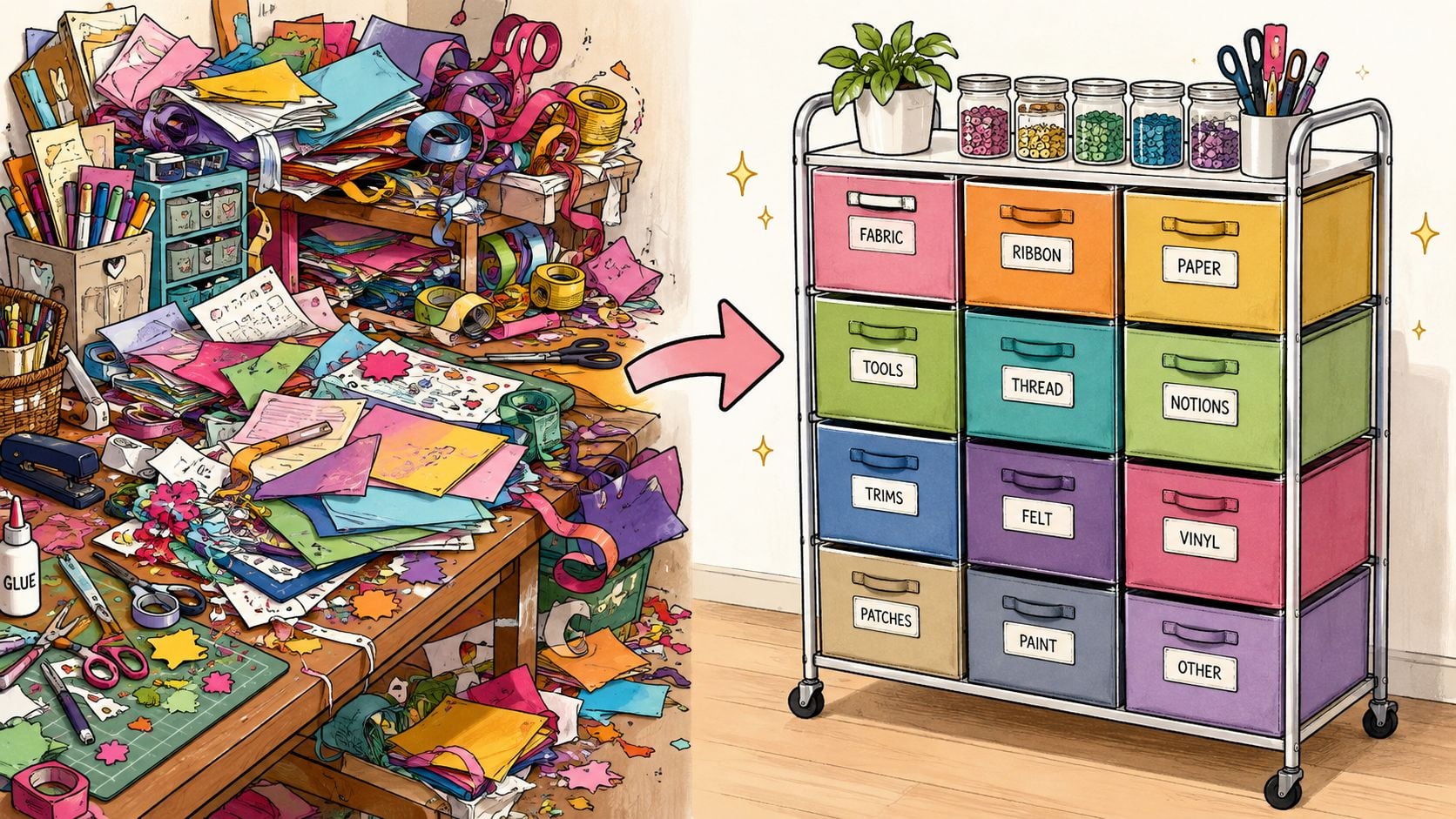
A corner of the craft room has disappeared beneath paper, tools, ribbon, and half-finished projects. In the home office, small accessories keep sliding into one another, while the desk remains crowded with items that need to stay within reach. A 12 drawer rolling cart can bring order to that kind of clutter without committing the room to another large cabinet.
The right choice depends on more than drawer count. Frame material, drawer capacity, caster quality, room clearance, and long-term repairability all affect whether the cart becomes a useful daily organizer or an unstable piece of temporary storage. The following guide walks through those decisions in practical terms, including how a compact cart fits into a broader furniture plan for homes in Freehold, NY, Albany, Schenectady, Troy, and the surrounding Capital Region.
What a 12 Drawer Rolling Cart Actually Is
A 12 drawer rolling cart is a compact storage unit built around twelve drawers, a usable top surface, and a wheeled base. It appears across major retail markets for home, office, classroom, craft, and beauty organization. One major marketplace search returned 371 product listings for the category, showing that the format is a widely merchandised storage subcategory rather than a niche product (marketplace listings for 12 drawer rolling carts).
The most familiar layout uses eight small drawers and four larger drawers. That split gives the cart two jobs at once. Small drawers can hold beads, pens, cables, cosmetics, or fasteners, while larger drawers accommodate paper, fabric, notebooks, tools, or other supplies with more volume.
The basic format
A typical model is designed to move between work areas rather than remain fixed like a dresser. Product examples include lockable or fixed wheels, lightweight construction, and a tabletop footprint of about 23 by 14.5 inches, with one widely sold model listing a net weight of 13 pounds (12 drawer rolling cart marketplace examples).
Pricing spans a wide range, from roughly $23 to more than $1,850, depending on materials, branding, finish, and features (12 drawer rolling cart marketplace examples). That spread matters because two carts can share the same drawer count while serving very different purposes.
A lightweight plastic cart may be suitable for craft supplies that move occasionally. A sturdier wood or metal-framed unit may make more sense for a home office or workshop where drawers open repeatedly throughout the day.
Practical rule: Drawer count tells shoppers how much sorting is available. It doesn't tell them how much weight the frame, slides, or casters can safely handle.
The format has remained popular because it combines mobility, compact storage, and immediate access. It was already established in online retail by September 9, 2010, and later appeared across major retailers and best-seller rankings by 2024 through 2026 (12 drawer rolling storage cart listing). For readers comparing formats, a discussion of the perfect trolley for hobbyists from Display Guru offers additional context on compact rolling drawer organization.
Materials and Build Quality Explained
A cart's appearance can hide its most important differences. Two products may both show twelve drawers in a photograph, yet one may be intended for occasional light storage while the other is built for more demanding daily use. The frame, drawer material, slides, and casters determine how the unit behaves after it has been filled.
Frame materials
Lightweight plastic shells keep the cart easy to lift and inexpensive to produce. They're practical for paper, accessories, classroom materials, and other dense but relatively small items. Their weaknesses usually appear under uneven loading, repeated movement, or rough handling.
Powder-coated steel frames generally provide more rigidity and a firmer foundation for the drawer tracks. They can still be lightweight, but the frame is less dependent on thin plastic panels for structural support. Buyers should inspect welded joints, fasteners, caster attachments, and any areas where the frame flexes during drawer use.
Solid wood and wood-composite construction brings a different ownership experience. Wood can coordinate with bedroom, office, or living-room furniture, and a well-made piece may be easier to refinish or repair than a molded plastic shell. The tradeoff is greater weight and often a higher purchase price. Guidance on choosing the right hardwood for longevity and style can help shoppers evaluate wood storage with the same care used for other furniture.
Drawer construction and hardware
Plastic drawers are often injection-molded or made from semi-transparent polypropylene. They offer visibility and easy cleaning, but the drawer bottom and front can flex when overloaded. Wooden drawers may use dowel or dovetail joinery, depending on the construction, and can provide a more furniture-like appearance.
The cart's weight offers a useful clue. One independent listing specifies 4.4 pounds maximum per drawer and 53 pounds total, with overall dimensions of about 25 by 15.2 by 32.6 inches and four wheels, including two locking casters (clear 12 drawer rolling cart specifications). Other listings specify 2.2 pounds per drawer and 33 pounds total, or 3.3 pounds per drawer with a 16.5-pound top shelf (12 drawer rolling storage cart specifications).
A plastic cart is similar to a rental car. It handles ordinary use, but it isn't a sensible choice for every load or environment. A solid wood or reinforced metal cart is closer to a family sedan, heavier and more durable, with more potential for service and repair.
Five Buyer Checkpoints Before You Choose
A first-time buyer can avoid most disappointments by checking the cart as a working object rather than judging it from a product photo. The following checklist applies whether the cart is being purchased online or examined at the Freehold showroom.
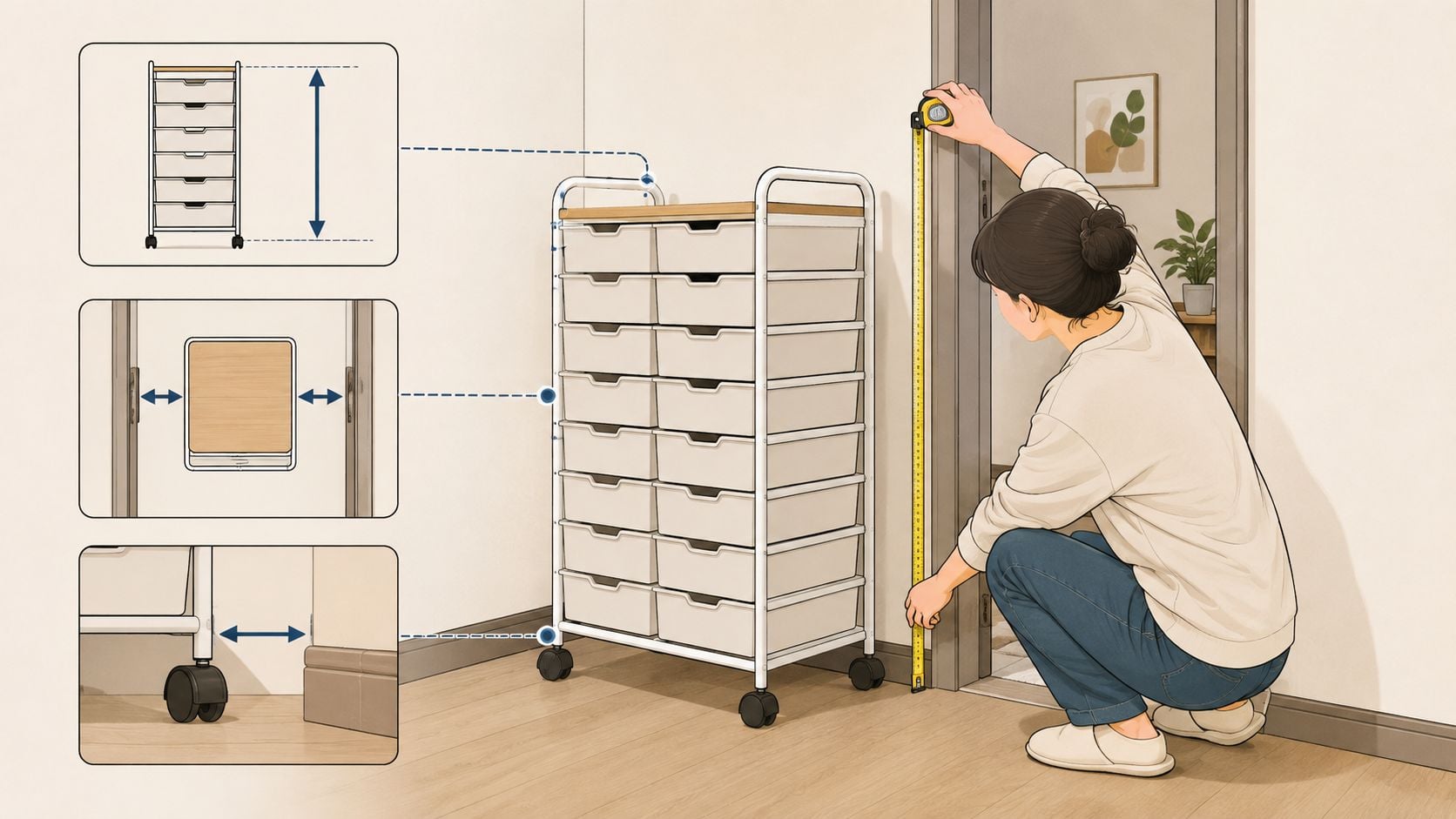
Check the footprint and access path
Measure the proposed location, then measure the route to reach it.
- Overall width and depth: Include the casters and any handle or overhanging top.
- Drawer clearance: Leave room for the deepest drawer to open fully.
- Doorways and turns: Measure the narrowest passage, not only the final corner.
- Baseboards and outlets: Check whether the cart will scrape trim or cover a needed plug.
A model can fit against a wall and still fail in daily use if its drawers collide with a desk, bed, or doorway.
Test the casters
Casters should roll without excessive wobble, and locking wheels should hold the cart in place on the intended floor surface. In a showroom, the buyer should push the cart slowly, stop it, engage the locks, and pull a drawer open.
Small casters can struggle over thresholds, cords, thick rugs, and uneven flooring. A cart that moves well on a smooth showroom floor may need a fixed parking location at home.
Open every drawer
Drawer type matters less than drawer behavior. Each drawer should open smoothly, remain aligned, and close without scraping the frame.
Check whether the drawers can be removed, whether the slides are replaceable, and whether the front remains secure when the drawer is full. Semi-transparent bins improve visibility, while opaque or wooden drawers can hide visual clutter and coordinate more naturally with furniture.
Read both capacity ratings
The total capacity isn't enough. A cart might support a stated total load while each individual drawer has a much lower limit. Exceeding the per-drawer rating can deform rails, make drawers drag, and accelerate wear on the base.
Use the lower of the two practical limits, the drawer rating and the cart rating. Heavy items belong in the lower drawers, not in the top shelf or upper compartments.
Match the finish to the room
Color and finish affect whether the cart looks intentional. A bright plastic organizer may suit a craft room or classroom, while a wood-finished cabinet may sit more comfortably beside a desk, dresser, or entertainment unit.
The broader guidance in what to look for when buying chests, dressers, and cabinets applies here too. Finish quality, hardware alignment, and proportion matter when storage remains visible every day.
Real-World Uses and Organization Setups
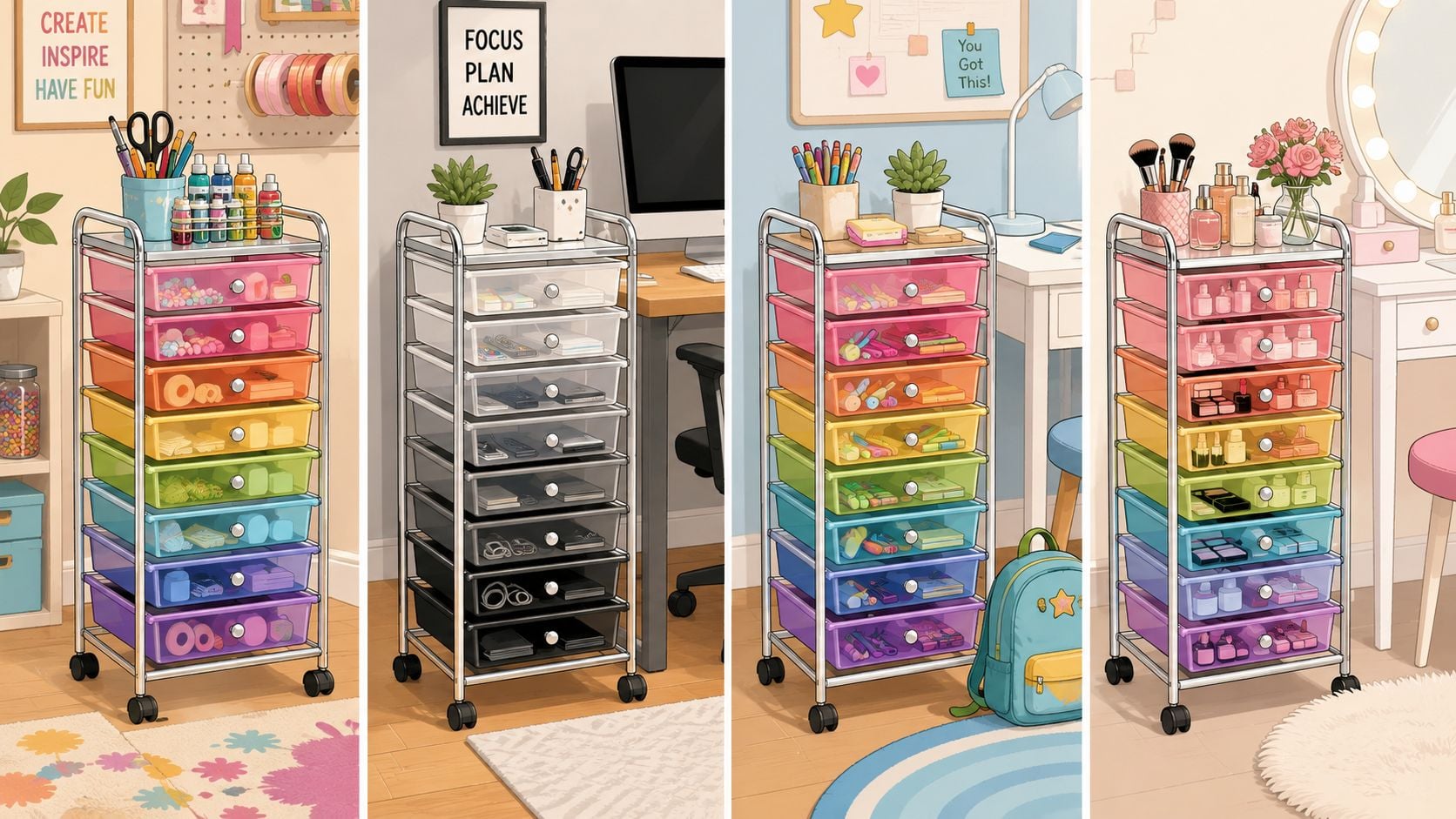
The same cart can serve very different purposes, but the organization works best when every drawer has a defined job. Labels should describe the contents at a glance, and small bins or drawer liners can stop loose items from shifting during movement.
Craft room
In a craft room, the eight small drawers can sort scissors, adhesives, markers, beads, thread, and fasteners. The four larger drawers can hold scrapbook paper, fabric, cutting mats, or project folders. The cart belongs beside the primary work surface, not across the room, so the top can act as a staging area.
A label on every drawer prevents the unit from becoming a new miscellaneous pile. A liner can also reduce noise and protect the drawer bottom from sharp tools.
Home office
An office setup may use the small drawers for pens, charging accessories, clips, labels, and memory devices. Larger drawers can hold notebooks, printer paper, project files, and envelopes.
The cart can sit under or beside a desk, provided the drawer fronts have enough clearance to open. For an office that also needs a more permanent workstation, a coordinated desk and drawer arrangement may be more practical than asking a lightweight cart to carry every supply.
Classroom or homework station
A classroom cart can separate writing tools, art materials, math manipulatives, and lesson accessories. A homework station might dedicate the small drawers to pencils, erasers, flash cards, and calculators, while larger drawers hold folders and paper.
Because several people may use the cart, labels should use plain words or pictures. Locking casters become particularly useful when the cart is parked near a walkway.
Beauty area or workshop bench
Beauty supplies can be separated by category, with small drawers for clips, applicators, accessories, and samples, and larger drawers for towels, bottles, or boxed supplies. A workshop setup can use the small drawers for screws, bits, measuring accessories, and fasteners, while the larger drawers hold hand tools and protective equipment.
The category's longevity reflects this broad usefulness. Product descriptions have positioned the format for tools, sewing supplies, school and office items, art materials, beauty products, scrapbook paper, and studio organization (12 drawer rolling cart product examples). A room-by-room planning mindset, similar to the principles behind smart kitchen innovations, helps the cart support a larger workflow instead of becoming an isolated storage object.
Budget Cart vs Premium Cart Compared
A budget cart usually prioritizes low weight, simple assembly, and accessible pricing. A premium cart generally charges for rigidity, smoother hardware, more durable finishes, improved casters, and a stronger relationship to the surrounding furniture.
Observed marketplace pricing ranges from roughly $23 to more than $1,850, while broader category coverage indicates that most rolling storage carts are priced below $100 (12 drawer rolling cart marketplace listings; rolling storage cart market overview). The correct question isn't whether the premium cart costs more. It's whether the cart will be used lightly, moved often, and expected to last.
Budget vs Premium 12 Drawer Rolling Cart
| Feature | Budget Cart | Premium Cart |
|---|---|---|
| Frame | Lightweight plastic or thin metal | Reinforced metal, solid wood, or stronger composite |
| Drawer action | Basic slides or molded guides | Smoother hardware with more consistent alignment |
| Casters | Small, basic wheels | More stable casters, often with firmer locks |
| Finish | Functional, with limited repair options | More durable finish and stronger visual coordination |
| Replacement parts | May be difficult to obtain | More likely to have serviceable hardware or replacement components |
| Best use | Light craft, school, or accessory storage | Frequent daily use and visible room furniture |
What the price difference should accomplish
A higher price should produce a noticeable improvement in daily handling. Drawers should remain aligned when loaded, the frame shouldn't twist when one drawer is opened, and the casters should hold the unit securely when parked.
Review complaints in this category often focus on flimsy structures and assembly problems. That doesn't make every inexpensive cart a poor purchase. It means shoppers should match the budget model to light, organized contents rather than expecting furniture-level endurance.
A premium model makes more sense when the cart will remain visible in a home office, coordinate with wood furniture, or receive repeated use from several people. If the cart is temporary storage for a craft project, the lower-cost option may be more sensible.
Measuring and Placing the Cart in Your Room
A cart can meet every specification and still create frustration if it blocks a doorway, catches on a baseboard, or leaves no room for the drawers to open. Room geometry should be checked before the product is ordered.
A simple measurement routine
Use painter's tape to mark the cart's full footprint on the floor. Mark the drawer-opening zone as well, because the cart occupies more usable space when a drawer is extended.
Then check the route:
- Measure the narrowest doorway.
- Measure hallway width at turns.
- Check thresholds, rugs, and floor transitions.
- Confirm that the cart won't cover outlets or vents.
- Open nearby doors and drawers to test conflicts.
The same planning logic used for larger furniture applies to a compact organizer. A deeper or taller unit needs more clearance around it, especially where people walk or turn.
Use a scaled room plan
A free online room planner available through the Tip Top showroom can help shoppers place furniture on a scaled floor plan before purchase. That makes it easier to test whether the cart belongs beside a desk, within a craft zone, or near a storage wall without disrupting circulation.
The Freehold, NY showroom has served homeowners across the Greater Albany area as a one-stop shop since 1978 (Greater Albany area showroom information). The same planning conversation can include a desk, bedroom storage, flooring, window treatments, or other room elements when a small cart is part of a larger furnishing project.
For additional measurement guidance, the furniture measuring guide provides a useful routine for confirming fit before delivery. Accurate measurements protect the buyer from a cart that technically fits the room but doesn't function comfortably in it.
Custom Orders Financing and Local Sourcing
A ready-made cart solves a standard storage problem. A custom storage piece can solve the awkward problem, such as a narrow alcove, an unusual desk height, or a need to match existing wood furniture. Local sourcing becomes valuable when dimensions, finish, delivery, and follow-up support matter as much as drawer count.
A custom-order discussion can begin with four choices:
- Style: traditional, transitional, contemporary, or another room direction.
- Size: width, depth, height, and drawer proportions.
- Wood type: selected for appearance, durability, and coordination.
- Finish: chosen to match existing furniture or create a deliberate contrast.
A sketch or photograph can help a design consultant understand a difficult space. The result may not be a rolling cart in the strict mass-market sense. It may be a more durable drawer cabinet, bureau, desk component, or other storage solution that performs better for the room.
Tip Top Furniture & Mattresses is a family-owned and operated showroom founded by Kenneth E. Dudley in Freehold, NY, and has been in business since 1978 (Tip Top Furniture & Mattresses). Its official furniture selection covers every room, along with mattresses and flooring, supporting a one-stop approach for a broader home project (Tip Top furniture categories).
Financing the upgrade thoughtfully
Some shoppers hesitate to move from a low-cost plastic cart to a solid-wood or reinforced storage piece. Promotional financing through the Synchrony HOME Credit Card includes six months on purchases from $299 to $1,998.99 and twelve months on purchases of $1,999 or more. Select participating retailers may offer promotional financing of up to 60 months on qualifying purchases, subject to the card and retailer terms (Synchrony HOME financing terms).
A clearance corner offers another route for buyers who want a higher-quality piece at a tighter budget. The custom-order starting guide can help a Capital Region shopper begin with a room problem, rather than defaulting to an anonymous listing based only on drawer count.
Safety Stability and Long-Term Maintenance
The most overlooked question isn't whether a 12 drawer rolling cart can hold supplies today. It's whether the cart will remain stable and useful after repeated loading, movement, and drawer opening.
Many models are narrow, about 25 inches wide and 15 inches deep, and rely on small casters and a lightweight frame (12 drawer rolling cart safety and product information). A partially open upper drawer can shift the center of gravity, especially if heavier items sit near the top. Children, pets, narrow hallways, cords, and thresholds increase the need for cautious placement and movement.
Safer daily habits
- Load from the bottom up: Put heavier supplies in the lowest drawers.
- Lock the cart when parked: Engage both front locking casters when the model provides them.
- Move slowly: Close drawers before rolling and avoid cords, thresholds, and uneven surfaces.
- Keep paths clear: Don't place the cart where people must squeeze past it.
- Watch uneven loading: Pulling several drawers open on one side can make a lightweight frame less stable.
Safety guidance for mobile shelving emphasizes hazard controls, awareness of obstructions, and safe operating procedures because moving storage units can create risks in compact environments (mobile shelving safety guidance).
Maintenance also affects ownership cost. Caster stems may need tightening, drawer slides benefit from regular cleaning, and a cracked plastic bin may be replaceable without discarding the entire frame. Buyers choosing wood storage can follow practical wood furniture care guidance to protect the finish and extend service life.
A 12 drawer rolling cart works well when its load, traffic level, and room placement match its construction. For families and Capital Region homeowners seeking a longer-term storage plan, a conversation with a local furniture team can prevent a short-life purchase and identify whether a cart, bureau, desk, or custom cabinet makes more sense.
Tip Top Furniture & Mattresses offers room furniture, home office storage, Amish furniture, USA-made mattresses, flooring, custom ordering, delivery, design services available since 1984, and clearance options for homeowners in Freehold, Albany, Schenectady, Troy, and the broader Capital Region. Visit Tip Top Furniture & Mattresses to discuss the right storage solution, explore coordinated room furnishings, or plan a custom piece for the space.