How to Build a Closet Organizer for Your Home

Before you even think about picking up a drill, the real work begins with a simple plan. A truly great closet organizer isn’t just about measurements; it’s about understanding your wardrobe, your daily routines, and designing a system that makes your life easier. This upfront planning is what separates a generic set of shelves from a personalized space that brings a sense of calm to your day, and it's a principle our family-owned business has championed since 1978.
Start with a Smart Closet Plan
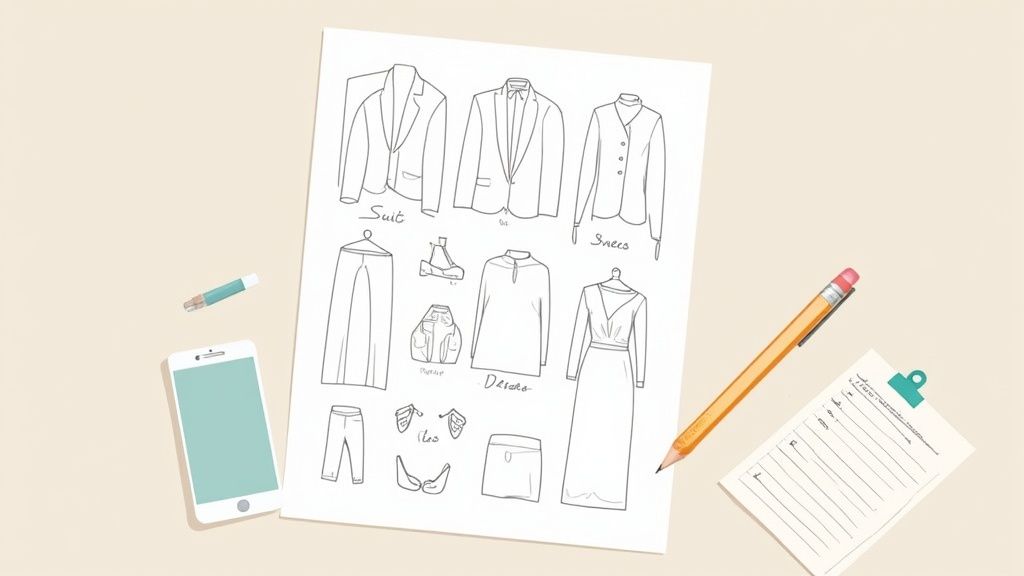
The most important work happens with a pen and paper—or maybe a planning app. A well-organized closet is a direct reflection of a well-thought-out design. Jumping straight into construction is like building a house without a blueprint. Sure, you might end up with something, but it probably won’t work for you in the long run.
For homeowners from Albany to Schenectady, taking a moment to plan first means creating a space that cuts down on the daily chaos, rather than adding to it. The journey starts with an honest look at what you actually own and wear.
Assess Your Wardrobe and Habits
First things first: pull everything out. We know it sounds like a massive chore, but it's the only way to get a real inventory. As you sort through it all, you’ll start to see patterns and realize what your storage needs truly are—and they’re often different from what you’d guess.
If you need a little help getting started with the purge, you can learn more about cleaning out your closet effectively in our detailed guide.
Try sorting your clothes into these practical groups:
- Long-Hang Items: This is for your dresses, long coats, and suits. They need uninterrupted vertical space so they don't end up crumpled at the bottom.
- Short-Hang Items: Think blouses, shirts, and jackets. You can often install a second rod below the first to instantly double your hanging space for these.
- Folded Clothing: Sweaters, jeans, and t-shirts are best stored flat on shelves or in drawers to keep them from stretching out on hangers.
- Shoes: Break them down by type. Heels, boots, flats, and sneakers all have different shapes and storage needs.
- Accessories: This is the catch-all for belts, scarves, ties, handbags, and jewelry. These small items are usually the biggest source of clutter, so giving them a dedicated home is a game-changer.
Set Realistic and Functional Goals
Once you know what you're working with, you can set some practical goals for your new closet. The design should be a direct extension of your lifestyle.
For instance, if you get up for work before your partner, maybe your work clothes should be in the most accessible spot to keep things quiet. If you have an impressive shoe collection, then adjustable shoe shelving should probably be your top priority.
At Tip Top Furniture, we’ve found that the most successful closet designs are those built around daily routines. Since starting our Professional Design Services in 1984, our focus has always been on creating spaces that work for the people living in them, not just filling a space with shelves.
Think about the flow of your morning. What do you reach for first? Where are the current bottlenecks and frustrations? Answering these questions will guide your layout. Maybe a pull-out valet rod for staging the next day's outfit is what you need, or perhaps some simple drawer dividers will finally bring order to your socks.
This is your chance to solve all those little daily annoyances. It’s where a generic, one-size-fits-all kit falls short and a thoughtful, personalized plan truly shines.
Choosing Your Closet Build Path in the Albany Capital Region
Once you have a solid plan in your hands, it's time to decide how you're going to make this closet a reality. This is where the rubber meets the road, and your decision will come down to your budget, your timeline, and just how comfortable you are with a tape measure and a saw.
There’s no single right answer here. For homeowners in the Greater Albany Capital Region, understanding the three main paths will help you make a choice you’ll be happy with for years to come: building it from scratch (the full DIY), using a modular kit, or investing in a completely custom solution from a local expert.
The Do-It-Yourself Approach
For the truly hands-on homeowner, nothing beats the satisfaction of a well-done DIY project. You get total control. Every material, every shelf height, every design choice is yours. It’s the best way to get a closet that’s perfectly tailored to your space without being boxed in by pre-set dimensions.
But let’s be realistic. This path demands a serious time commitment and a good bit of carpentry skill. Projects almost always take longer than you think, and a wrong cut can be a costly mistake. You absolutely need the right tools and a detailed plan before you even think about buying lumber.
Modular Closet Systems
Modular kits are a popular middle-of-the-road option, and you can find them at pretty much any big-box store. They come with all the pre-cut shelves, rods, and hardware you need, giving you a structured framework that's much simpler to assemble than building from scratch.
The big trade-off here is flexibility. You're stuck with the manufacturer's components, which might not be the perfect fit for your closet's quirks or your unique storage needs. While they seem more affordable upfront, they’re often made from less-than-sturdy materials like particleboard that can sag or chip over time.
The Custom-Built Solution
For a truly seamless, high-quality result that lasts a lifetime, nothing compares to a custom-built organizer. This approach is all about precision, quality, and making the closet work perfectly for you. A custom solution is designed to the exact millimeter of your room, easily working around sloped ceilings or awkward corners to maximize every last inch.
At Tip Top Furniture, our family has been helping homeowners in the Albany area create custom spaces since 1978. We believe furniture should be as functional as it is beautiful—a principle we apply to every single closet we help design.
Going custom means you get to choose materials that will stand the test of time. While melamine and wire are common, for true, lasting durability, you just can't beat solid wood. This is where you can explore options like our handcrafted Amish furniture, selecting the exact wood, finish, and hardware to create a system that becomes a permanent, valuable feature in your home. This is an investment in quality that pays off every single day, and the difference is obvious when you know what to look for in quality furniture, like the heirloom pieces you'll find at our Freehold showroom.
It's clear homeowners are tired of clutter. As noted by Forbes, a well-organized closet can completely transform your daily routine, which is why so many people are investing in quality solutions.
Closet Organizer Options Compared
To help you visualize the trade-offs, here’s a straightforward comparison of the three paths. Think about what matters most to you—cost, time, or the final result.
| Factor | DIY (Build from Scratch) | Modular Kits (Box Store) | Custom Built (Tip Top Furniture) |
|---|---|---|---|
| Budget | Lowest upfront material cost, but can increase with mistakes. | Moderate, fixed cost for the kit. | Highest initial investment for superior quality and service. |
| Skill Level | Requires advanced carpentry skills and a full set of tools. | Basic to intermediate DIY skills are usually sufficient. | No skills needed; our professional design and installation are key. |
| Customization | Unlimited. You have complete control over design and materials. | Limited to the manufacturer's available sizes and components. | Fully personalized to your exact space, style, and storage needs. |
| Durability | Varies based on material choice and construction quality. | Often lower, using materials like particleboard or wire. | Heirloom quality, typically using solid wood for maximum longevity. |
| Time | Highest time commitment, from planning to finishing touches. | Moderate time for assembly and installation. | Minimal time required from you; we handle the design and setup. |
Ultimately, the best path forward really depends on your priorities. If you love having complete creative control and have the skills to back it up, DIY is incredibly rewarding. If you just need a quick, structured fix, a modular kit can get the job done.
But for a truly effortless, durable, and perfectly tailored space, a Custom Order from our Freehold showroom provides unmatched quality and peace of mind.
Measuring and Designing Your Layout
Now that you have a clear idea of what you need to store, it's time to figure out the exact dimensions of your closet. Honestly, this is where a project succeeds or fails. So many DIY frustrations—think weird gaps, crooked shelves, or organizers that just don't fit—start with rushed or inaccurate measurements.
Getting this right is a huge deal, especially in the charming, older homes we see all over the Albany Capital Region. Those walls are rarely perfectly plumb and square! Taking your time here is the single best thing you can do to ensure everything you plan will fit like a glove.
Master the Measurements
Before you can even think about building, you need a blueprint of your space. Grab a good tape measure (the flimsy ones can be misleading), a notepad, and a pencil. Our expert tip? Measure everything at least twice to be absolutely sure of your numbers.
Start with these three core measurements:
- Width: Measure the back wall from side to side. Do this near the top, again in the middle, and once more near the floor. It's crucial to use the smallest number of the three—this accounts for any bowing or imperfections in the walls.
- Height: Measure the distance from the floor straight up to the ceiling. Just like with the width, take this measurement in a few different spots (left, middle, right) and go with the smallest number.
- Depth: Measure from the back wall out to the front of the closet opening. Do this on both the left and right sides to catch any variations.
Beyond these basics, you'll need to play detective. Note the exact location and dimensions of any obstacles that will get in your way. This means light fixtures, electrical outlets, light switches, heating vents, and even the trim around the door. The same principles apply here as they do for larger rooms; for more tips, check out our guide on how to measure a room for furniture.
Designing a Functional Layout
With your measurements in hand, the fun part begins. The goal isn’t just to cram stuff in; it’s to create a system that works for you. A great way to start is by "zoning" your closet based on the wardrobe inventory you took earlier.
This is where you decide your path forward—whether you're building from scratch, using a kit, or going fully custom.
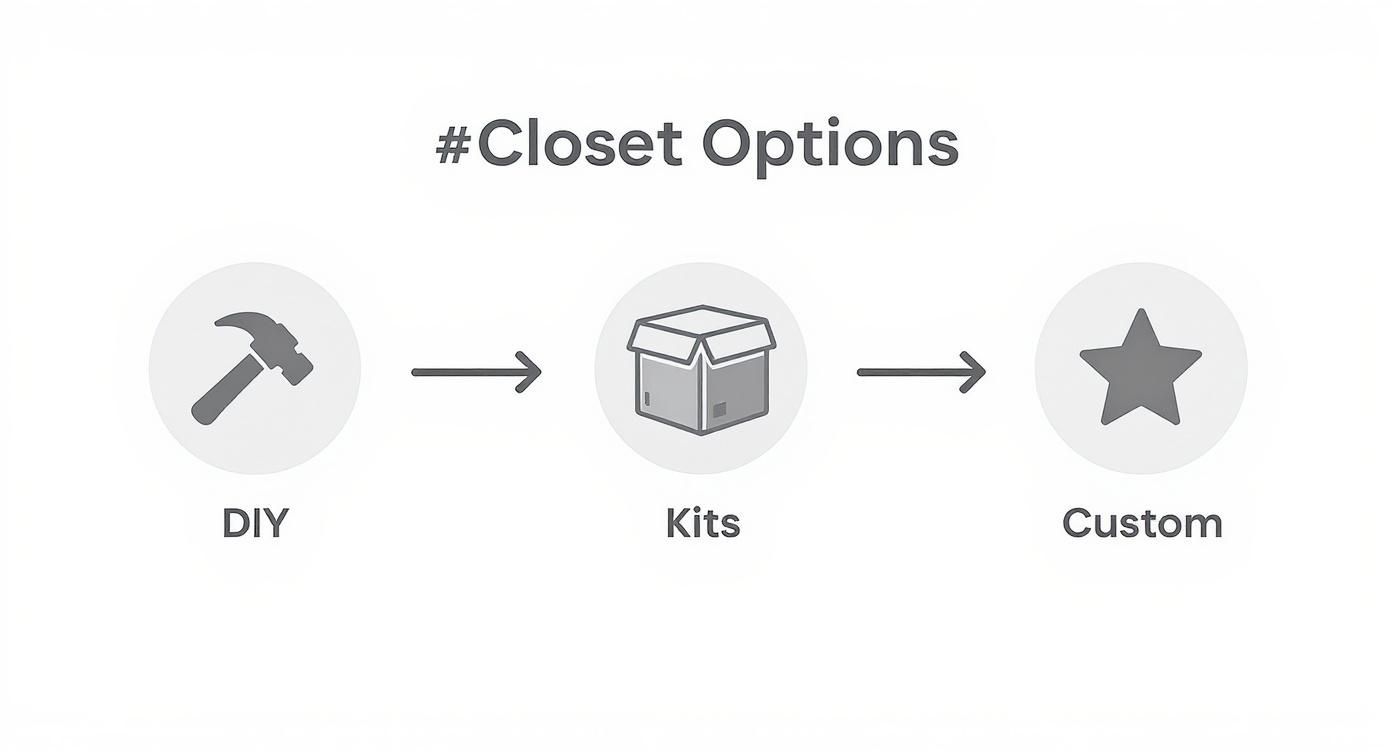
No matter which route you choose, a thoughtful layout is what will make it all work seamlessly.
A well-designed layout should have a few key zones:
- Double-Hang Sections: This is the most efficient way to use vertical space. Think shirts, blouses, and folded pants. A typical setup has one rod around 42 inches from the floor and a second one up around 84 inches.
- Long-Hang Section: You'll need to dedicate a portion of the closet for dresses, long coats, and suits. This area needs uninterrupted vertical space, usually about 65-70 inches.
- Shelving Tower: A central or side tower of shelves is perfect for folded items like sweaters and jeans. We always recommend adjustable shelves—they give you so much more flexibility down the road.
- Drawer Space: Drawers are a lifesaver for small things that tend to create clutter, like socks, underwear, and accessories. They keep everything tidy and easy to find.
Since 1984, our Professional Design Services team has helped countless homeowners in Freehold and beyond turn tricky spaces into beautiful, functional closets. We always advise clients to think in zones—it’s the secret to making a closet feel intuitive and easy to keep organized.
It really helps to visualize your ideas. To make this process even easier, you can play around with different configurations using our Free Online Room Planner. This tool lets you plug in your dimensions and experiment with layouts before you commit. Once you have a concept you love, bring it into our Freehold showroom, and our experts can help you nail down all the details.
Bringing Your Organizer to Life
Alright, you've got a solid plan in hand. Now comes the exciting part: moving from the drawing board to the actual build. This is where your vision really starts to take shape, whether you’re assembling a slick modular kit or tackling a full DIY project from scratch.
Honestly, the success of this phase boils down to three things: patience, precision, and having the right tools ready to go. Before you even think about starting, gather your gear. Nothing is more frustrating than getting halfway through installing a shelf only to realize you can’t find your level. A little prep work here will save you a massive headache later.
Essential Tools for a Secure Installation
Having the right tools makes all the difference between a frustrating afternoon and a successful, sturdy build. The good news is that most homeowners already have some of these lying around. It's still a smart move to do a quick inventory check before you begin.
Here’s a look at the basic toolkit that will get you through most installations:
- A Good Quality Level: This is absolutely non-negotiable. Eyeballing shelves is a recipe for a lopsided disaster. A 24-inch or 48-inch level is your best bet to ensure everything is perfectly horizontal and plumb.
- Stud Finder: Drywall alone can’t support the weight of a fully loaded closet organizer—not even close. A reliable stud finder is critical for locating the solid wood studs you need to anchor into for a safe, secure installation.
- Drill and Assorted Bits: Your cordless drill will be your best friend for driving screws and pre-drilling holes. Make sure you have a good set of bits, including Phillips head drivers and various drill bit sizes.
- Tape Measure: You already used this for planning, but keep it handy. You'll be double-checking placements constantly as you install each component.
- Pencil: For marking stud locations and shelf heights right on the wall. Simple, but essential.
Key Stages of the Build Process
The installation process follows a pretty logical sequence. If you rush ahead or skip steps, you’ll likely make mistakes that are a real pain to fix later on. Our advice? Take your time and focus on getting one step right before moving to the next.
First things first: use your stud finder to locate and mark every single wall stud in the closet. This is your foundation. Lightly mark each one with your pencil so you know exactly where your secure anchor points are. This step alone is the most important thing you can do to make sure your organizer won’t sag or, even worse, pull away from the wall.
Next, you'll start installing the main structural components. For most systems, this means mounting a top horizontal track or individual vertical panels to the wall. This is where your level becomes crucial again. Make sure this first piece is perfectly straight, because every other component will align with it.
One of the most common mistakes we see is people relying solely on drywall anchors. For a system that’s going to hold dozens of pounds of clothing, anchoring directly into studs is a critical safety measure. It’s the difference between a temporary fix and a permanent, reliable solution.
With the main supports in place, you can start adding the fun stuff: shelves, closet rods, and drawers. If you're using a modular kit, follow the manufacturer’s instructions closely. If you’re building from scratch, just remember to check for level at each step. Install shelves with sturdy brackets and make sure your closet rods are secured firmly at both ends to prevent them from bowing under the weight of your clothes.
The Hassle-Free Custom Amish Solution
For many homeowners in the Greater Albany Capital Region, the thought of tackling this kind of installation is, well, daunting. Finding the time, gathering the tools, and ensuring a perfect finish is a pretty significant undertaking. This is exactly where a custom-built solution from Tip Top Furniture offers complete peace of mind.
When you choose a handcrafted Amish organizer, you're not just investing in superior solid wood construction; you're also getting a completely seamless experience. Our professional delivery and setup service handles everything. You won’t need a stud finder, a level, or a drill—our experienced team takes care of the entire installation from start to finish.
Our installers ensure every component is perfectly level, securely anchored, and functions flawlessly. This white-glove service transforms what could be a weekend of work into an effortless upgrade for your home. It's the same professional approach we take with other custom projects, like the one detailed in our guide on adding doors to a bookcase, where expertise ensures a perfect fit and finish.
With over 45 years of experience, we bring a level of craftsmanship to every installation that guarantees a beautiful, durable, and perfectly installed closet organizer you’ll enjoy for decades to come.
Adding the Finishing Touches
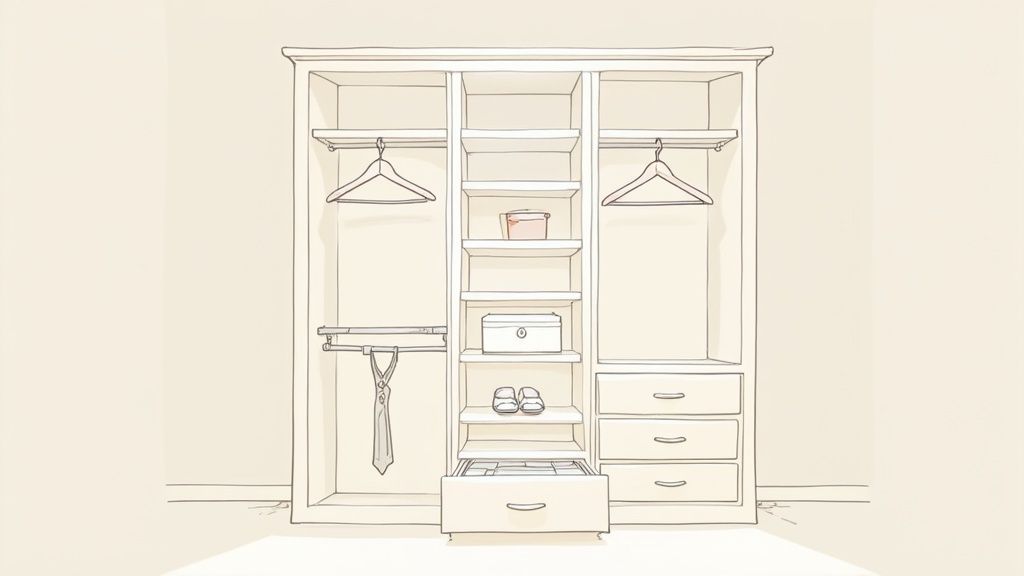
You’ve built the bones of your closet, and it’s looking great. But hold on—the job isn't quite done. Now comes the part that turns a functional box into a truly polished, personalized space that makes your daily routine feel just a little bit easier.
Think of this next step as accessorizing the closet itself. These are the small, clever additions that solve all those little daily annoyances, like a tangled mess of belts or that drawer where all your socks go to get jumbled.
Don't underestimate the power of these final details. A well-designed closet isn't just about storage; it's about giving yourself a calmer, less stressful start to every single morning. A more organized home can reduce stress and improve your overall well-being.
Smart Accessories for Maximum Functionality
The right accessories are what truly elevate a closet from good to great. Instead of just stacking and stuffing, these tools give every single item a dedicated home, making things ridiculously easy to find and, just as importantly, put away. It’s a core principle we’ve stood by since 1978: a space should be effortless to maintain.
Ready to take your closet to the next level? Here are a few high-impact additions to consider:
- Pull-Out Valet Rods: These are brilliant. A simple rod that slides out lets you stage tomorrow's outfit or hang up your dry cleaning without crushing anything.
- Dedicated Tie and Belt Racks: Stop shoving these into a drawer. A simple slide-out rack keeps them neat, visible, and ready to go.
- Custom Drawer Dividers: These are a total game-changer for socks, underwear, scarves, and other small items. You can create perfectly sized compartments so everything stays in its lane.
- Specialized Shoe Storage: Whether you love angled shelves that put your collection on display or prefer pull-out racks that keep them neatly tucked away, proper shoe storage gets them off the floor for good.
Don't Overlook Lighting and Hardware
Great lighting is probably the single most overlooked element in closet design. A dim, shadowy closet makes it impossible to tell your navy socks from your black ones. You don't need to call an electrician, either. Simple, battery-powered LED puck lights or stick-on strip lighting can work wonders in dark corners.
Hardware is the jewelry of your closet. Upgrading the drawer pulls and knobs to match your bedroom's decor is a small detail that makes a huge difference, creating a cohesive, high-end feel. At Tip Top Furniture, we obsess over these details. Our Custom Order options include a massive selection of hardware, so you can perfectly match your new closet to your existing furniture.
For more ideas on how to get organized throughout your home, you can solve clutter issues once and for all with our comprehensive guide.
Have Questions About Building a Closet Organizer? We Have Answers.
Taking on a closet organizer project is exciting, but it almost always comes with a few questions. For homeowners here in the Albany Capital Region, getting solid, expert answers can be the difference between a project that gets stuck and one that ends with a perfectly organized space. Here’s our take on some of the most common questions we hear in our Freehold showroom.
We’ve pulled from our 45+ years of experience to help you plan your project with total confidence.
How Much Is This Project Going to Cost?
The final price tag for a closet organizer can swing pretty dramatically depending on which route you take. The key is to match your budget with how you want the finished product to look and how long you expect it to last.
Here’s a rough idea of the costs for a standard-sized closet:
- DIY from Scratch: If you're handy and plan to build everything yourself with materials from a big-box hardware store, you can expect to spend somewhere between $200 and $500. This is definitely the most wallet-friendly option, but it also demands the most time and skill.
- Modular Kits: Those closet-in-a-box systems you see at stores usually land in the $400 to $1,500 range. The price will climb depending on the size and number of components in the kit you select.
- Custom-Built Solution: Going with a professionally designed and installed system is the top-tier choice. For a custom solution made from heirloom-quality solid wood, like the Amish-made organizers we specialize in, pricing typically starts around $1,500 and goes up from there, depending on your design.
To make that dream closet a reality without the financial stress, we offer flexible financing options to help you manage the investment.
What’s the Best Material for a Closet System?
When it comes to pure durability and a high-end feel, nothing beats solid wood. It’s incredibly strong, won’t sag under the weight of your wardrobe, and has the unique benefit of being refinished years down the line if you ever want a change. It's exactly why our family-owned business has focused on Amish-made furniture since 1978—it’s built to be passed down through generations.
Cheaper alternatives like melamine or wire systems are popular, but they're just not in the same league. They're far more likely to chip, bend, or sag over time. If you want to build an organizer that becomes a permanent, valuable part of your home, solid wood is the way to go.
Can I Build an Organizer in Any Kind of Closet?
You bet! The basic rules of organization work in any space, but you’ll definitely need to tweak your strategy based on the closet’s size and shape.
- Walk-In Closets: With more room to play, you can get creative. Think about creating separate "zones" for different types of clothes, using L-shaped shelving to make the most of corners, or even adding a center island or a small bench.
- Reach-In Closets: For a smaller reach-in, the name of the game is vertical space. You have to think up. Double-hang rods and shelving that goes all the way to the ceiling are essential for squeezing every last inch of storage out of a tight spot.
Our Professional Design Services team, which we established back in 1984, has designed custom plans for just about every closet imaginable in the Greater Albany area—from historic Troy townhouses to new builds in the suburbs.
A Quick but Critical Safety Note: Any closet system mounted to the wall, whether you build it yourself or have it professionally installed, must be anchored securely into wall studs. Just using drywall anchors is a major safety risk that could lead to the whole thing collapsing. Always, always use a stud finder to locate solid wood supports.
Of course, when you opt for professional delivery and installation from Tip Top, our experienced team handles this crucial step for you, guaranteeing a safe, secure, and perfectly level setup every single time.
Ready to finally get that closet organized with a solution that's built to last? At Tip Top Furniture & Mattresses, our team in Freehold, NY, is here to help you design the perfect custom organizer for your home. We're the Capital Region's one-stop shop for local expertise and high-quality furniture that lasts a lifetime.