Best Solid Wood Furniture Brands: A Value & Quality Guide


You’re probably doing what most Albany-area families do when they start shopping for a dining set, bedroom suite, or new living room tables. You open a few browser tabs, visit a couple of stores, and quickly run into a wall of claims. “Solid wood.” “Heirloom quality.” “Amish made.” “Premium finish.” After a while, it all starts to sound the same.
The problem isn’t that there are too many choices. The problem is that most advice about the best solid wood furniture brands stops at names and reputation. It rarely helps you answer the question that matters in a real household. Is this piece worth the money over the long haul?
That’s where smart furniture buying changes. A table isn’t just a table if your family uses it every day. It’s homework central, holiday seating, the place where coffee mugs get set down too fast, and where somebody eventually drags a science project across the top. If you live in the Capital Region, it also has to survive the dry indoor heat of winter and the humidity swings of summer.
I’ve spent a lifetime around furniture, and the best buyers aren’t the ones chasing logos. They’re the ones who learn how wood is cut, how joints are built, how finishes protect the surface, and how all of that affects long-term value. That’s the difference between buying a piece you tolerate for a few years and buying one you keep because it still works, still looks right, and still feels worth owning.
Investing in Lifelong Furniture Beyond the Brand Name
A lot of people start with one question. “What brand should I buy?” That’s understandable, but it’s not the best first question.
A better one is this. What will this piece cost me over the years I own it? Online brand roundups often skip that part. As noted by BILTRITE’s discussion of value-focused furniture buying, shoppers need more help understanding durability, repair costs, and resale value, not just brand prestige.
That matters even more for families trying to furnish a whole home in Albany, Schenectady, Troy, or Greene County. It's rarely a matter of buying one occasional table and calling it a day. They’re trying to make careful decisions room by room, often balancing style, budget, and timing.
Why the cheapest price can be the most expensive choice
A low sticker price can feel safe in the moment. It often isn’t.
If a piece loosens up, chips badly, or stops fitting your needs after a short stretch of family use, you haven’t saved money. You’ve only delayed spending more. That’s why furniture purchases are what many of us in the business call high-consideration decisions. There’s a helpful explanation of that mindset in this article on why furniture purchases are high consideration decisions.
Practical rule: Don’t compare two pieces by price alone. Compare them by price, construction, repairability, and how likely you are to still want them in your home years from now.
Another thing gets overlooked. A good solid wood piece often works with the rest of your home longer because it doesn’t date as quickly. If you’re planning to refresh a family room around a durable wood coffee table or console, these ideas for how to transform your living room can help you think beyond the single furniture purchase.
What long-term value really means
Long-term value isn’t just “expensive equals better.” That’s too simple.
It usually comes down to four questions:
- Can it handle daily use without wobbling, splitting, or looking worn out too fast?
- Can it be maintained or repaired if life leaves marks on it?
- Will it still suit your home if your style changes a little over time?
- Would you keep it long enough for the higher upfront cost to make sense?
That’s how experienced buyers look at solid wood furniture. Brand matters, but brand is only a shortcut. Construction tells the full story.
What Truly Defines Quality in Solid Wood Furniture
When people get confused about solid wood furniture, it’s usually because they’re looking at the outside first. Finish color, hardware style, and showroom lighting can distract you from what really matters. Quality starts underneath that polished surface.
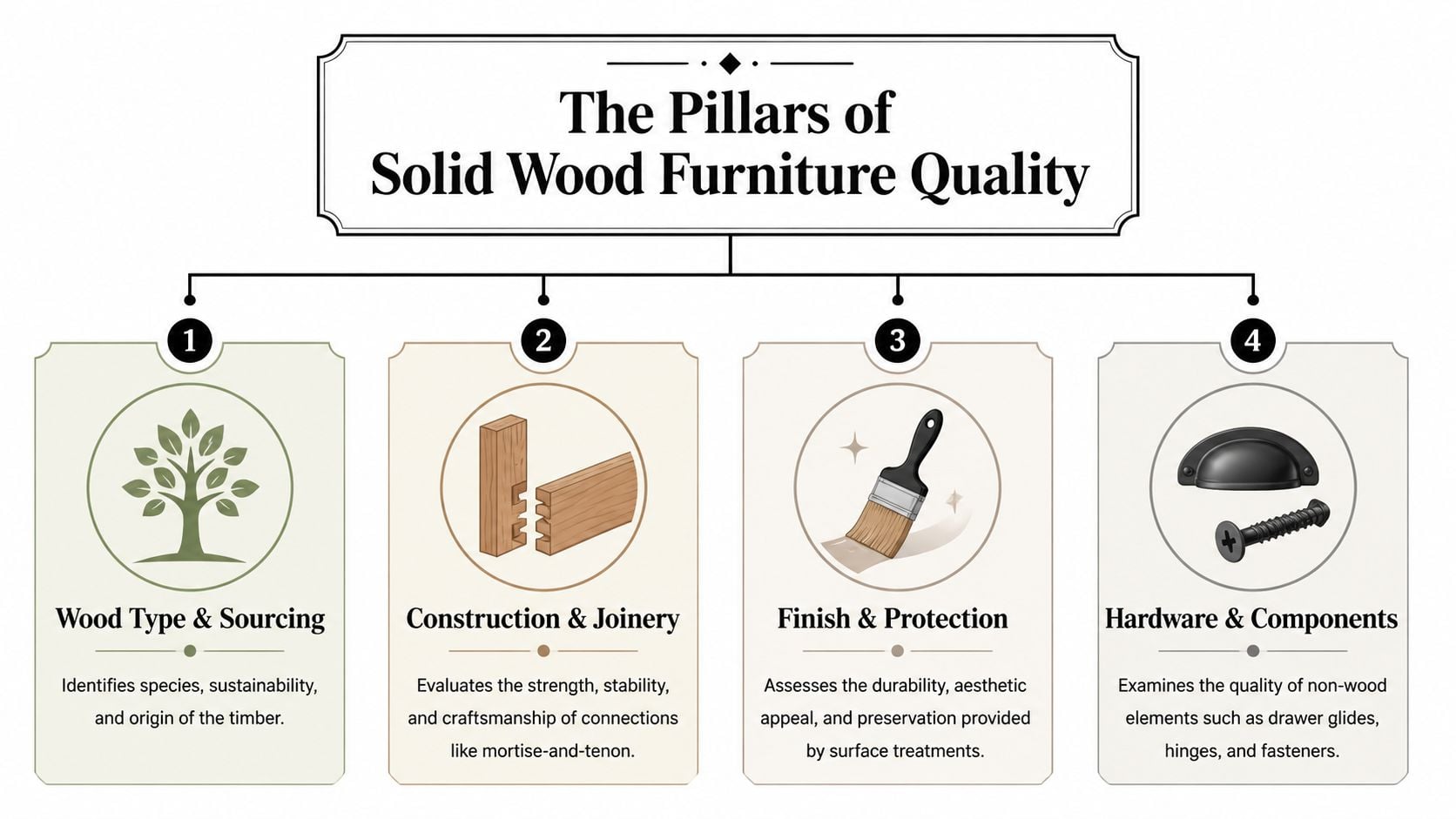
The easiest way to judge a piece is to think in four parts. The wood itself. The way it’s joined. The finish. The supporting components.
Wood type and cut matter more than most shoppers realize
“Solid wood” isn’t one thing. Oak, cherry, maple, walnut, and mahogany all behave differently. Even the way a board is sawn changes how it performs.
A strong example is quarter-sawn oak. According to Slone Brothers’ discussion of Stickley and quarter-sawn construction, quarter-sawing can minimize wood expansion and contraction by up to 50% compared to plain-sawn lumber, which helps resist warping in places with seasonal humidity swings like Upstate New York.
That matters in plain everyday terms. When indoor air dries out in winter and turns muggy in summer, wood moves. Better cuts help control that movement.
If you want a useful companion read on wood species for interiors, this guide to selecting the right hardwood for your home gives a practical view from the flooring side that also helps furniture shoppers think more clearly.
Joinery tells you whether a piece was built fast or built well
Furniture that lasts usually uses mechanical joinery, not just glue and shortcuts.
Look for signs of methods such as:
- Mortise-and-tenon joints in table bases and chair frames
- Dovetail joints in drawers
- Wood-on-wood connections that lock parts together before the finish ever goes on
These methods matter because stress travels through furniture every day. Kids lean back in chairs. Someone drags a bench instead of lifting it. A drawer gets opened hard when everybody is in a rush. Good joinery spreads that strain through the frame instead of concentrating it at one weak point.
Well-made furniture usually feels calm and quiet. It doesn’t creak, rack, or shift when you use it.
A shortcut-built piece may look fine on day one. Trouble often shows up later as looseness, drawer misalignment, or joints that never feel quite solid again after one move.
Finish is protection, not decoration alone
People often judge finish by color alone. That misses the point.
A good finish seals the wood, helps it resist everyday moisture, and makes cleaning easier. The best finishes also feel even to the touch. Run your hand across the top and along the edges. You shouldn’t feel rough patches, drips, or abrupt changes in texture.
Here’s a quick showroom guide:
| What to inspect | What you want to notice | Why it matters |
|---|---|---|
| Tabletop surface | Smooth, even feel | Suggests care in sanding and finishing |
| Edges and corners | Consistent coverage | Weak finish often fails first on edges |
| Color depth | Clear grain, not muddy | Better finishing usually preserves wood character |
| Underside treatment | Reasonably tidy work | Good makers don’t ignore hidden areas |
Hardware and supporting parts complete the job
Drawers, glides, hinges, pulls, and leveling details may not sound romantic, but they affect daily satisfaction.
A beautiful solid wood dresser with poor drawer action will annoy you every single morning. A cabinet door that won’t stay aligned makes an otherwise good piece feel cheap. That’s why I always tell people to inspect the whole piece, not just the wood story.
For a deeper look at hardwood choices and why they affect longevity and appearance, this article on choosing the right hardwood for longevity and style is worth your time.
Exploring the Tiers of Solid Wood Furniture Brands
Once you understand what quality looks like, brand shopping gets easier. You stop asking, “Which name is best?” and start asking, “Which level of construction fits the way my family lives?”
That’s a better question because the market isn’t one big pile. It breaks into clear tiers.
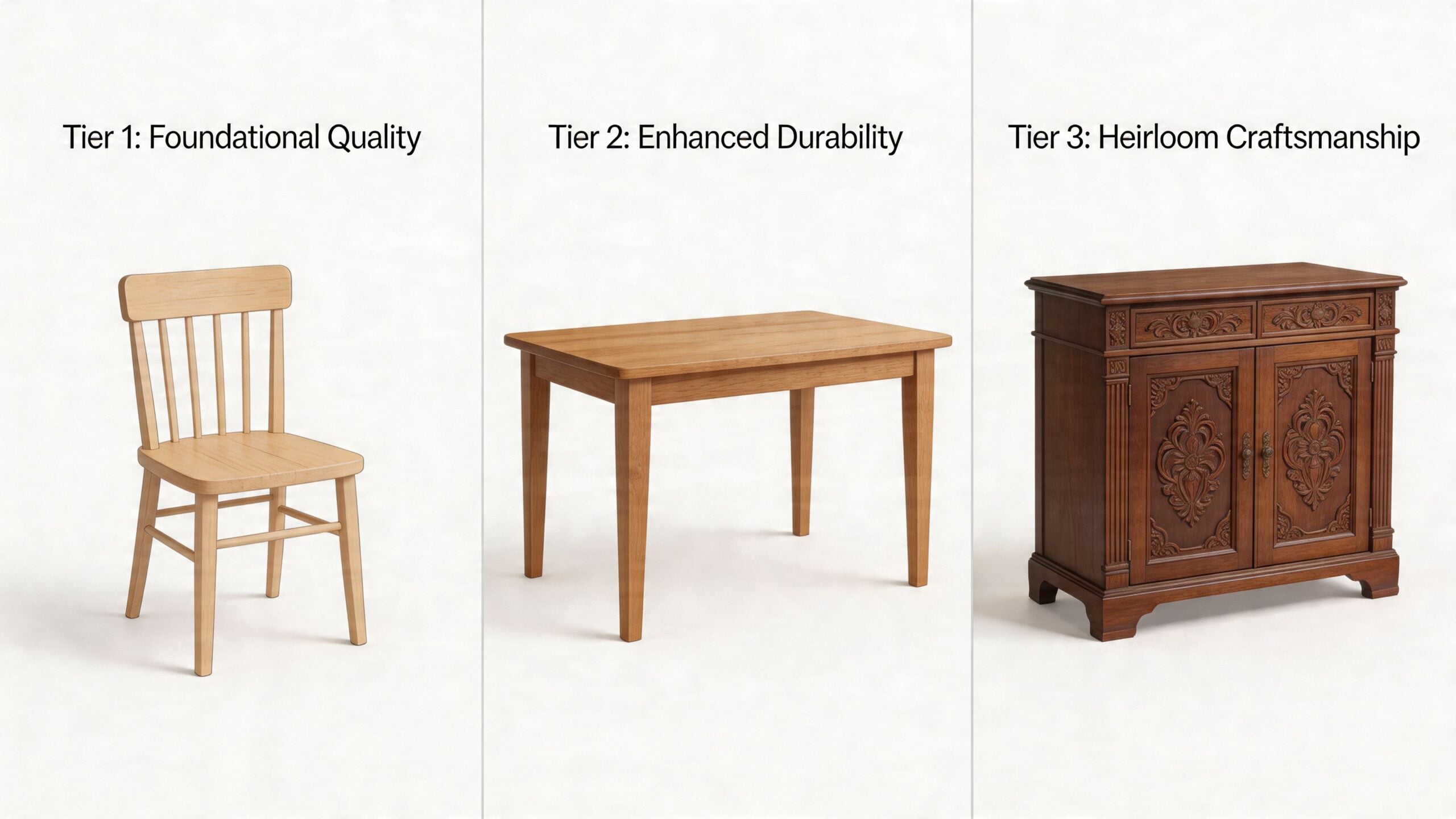
Heirloom and Amish brands
This is the tier people usually mean when they talk about furniture built for generations. These makers focus on traditional construction, solid hardwoods, customization, and patient craftsmanship.
A strong example is MAVIN, an Amish-crafted brand from Ohio. According to Furniture Fair’s overview of real wood brands, MAVIN builds dining furniture with old-school mortise-and-tenon joinery and kiln-dried hardwoods like walnut and mahogany. That source also notes that MAVIN offers 20+ wood species, stains, and hardware for customization.
For a busy household, that matters in practical ways:
- Dining tables stay steadier under daily use
- Chairs hold up better when people lean, shift, and move them often
- Custom sizing and finish choices help the piece fit your room instead of forcing the room to fit the piece
If you’re shopping for heirloom quality near Albany, many families start by exploring Amish furniture near me so they can compare that level of build quality with other options.
Premium USA-made brands
The next tier includes respected American manufacturers that combine heritage, design consistency, and broad distribution. These brands often offer a polished showroom experience, recognizable collections, and long-standing reputations.
Stickley sits squarely in this group. A published brand overview notes that Stickley has been family-owned for 125 years since 1900 and is known for 100% solid wood construction without veneers or particleboard, with furniture produced in New York and North Carolina (Home Bridge China brand overview). That same source describes Stickley as a cornerstone of American solid wood craftsmanship.
Stickley appeals to shoppers who want:
- A well-established design language, especially Mission and Arts & Crafts looks
- Solid wood construction with a long manufacturing history
- A premium finish and a strong reputation for consistency
Another useful point from that source is context. It places Stickley within a U.S. furniture market valued at USD 94.5 billion in 2024, with residential furniture making up 55% of sales, and notes a global wood furniture market projected to reach USD 139.09 billion by 2029. Those figures help explain why quality-focused American brands continue to stand out in a crowded field.
Mass-market brands
Mass-market brands serve a real purpose. Not every shopper needs heirloom construction in every room.
If you need a fast solution for a guest room, a first apartment, or a short-term phase of life, a lower tier can make sense. The trade-off is usually less customization, simpler construction, and less confidence that the piece will improve with age.
That doesn’t mean all mass-market furniture is bad. It means you should buy it with open eyes. For some households, it’s the right answer for low-use rooms. For primary dining, bedroom, and everyday living spaces, families who want better long-term value often end up moving toward Amish or premium USA-made lines.
A quick way to choose your tier
Use this simple comparison:
| Tier | Best for | Typical strength |
|---|---|---|
| Heirloom and Amish | Long-term ownership, custom fit, family-use dining and bedroom pieces | Traditional craftsmanship and customization |
| Premium USA-made | Buyers who want heritage, consistency, and strong design identity | Trusted construction with established collections |
| Mass-market | Shorter-term needs or lighter-use spaces | Lower upfront commitment |
Buy the highest construction quality you can reasonably afford for the pieces you use every day. That’s usually where value shows up fastest.
How to Inspect Furniture Like an Expert in Our Showroom
You are more capable in a showroom than you think. You don’t need special tools. You need a method.
When I walk a family around a floor display, I’m not looking for fancy language. I’m looking for clues. The piece tells you a lot if you know where to touch it, where to open it, and what to ask.

Start with stability
Before you admire the stain color, test the structure.
Place your hands lightly on a table, chair, dresser, or nightstand and give it a gentle check for movement. You’re not trying to be rough. You’re checking whether the piece feels planted.
Watch for these signs:
- Rocking or wobble on a flat showroom floor
- Twisting movement when pressure is applied from one corner
- Loose feel at the legs on chairs and tables
- Door or drawer misalignment that suggests the case isn’t square
A well-built piece usually feels settled. Even before it’s in your home, it should carry its own weight with confidence.
Open every drawer you can
Drawers are one of the best truth-tellers in furniture.
Pull them all the way out if the store allows it. Look at the corners, sides, and bottom support. If you’re not sure what mortise-and-tenon means when discussing case goods and frames, this explanation of what is mortise and tenon joint will help you recognize why traditional joinery matters.
Here’s what I want shoppers to do in person:
Look at the drawer corners
Interlocking joints are a good sign. Simple stapled construction is not in the same class.Slide the drawer several times
It should move smoothly and predictably, not scrape, bind, or lurch.Check the bottom panel support
A drawer that feels flimsy empty won’t improve once you fill it.Notice the fit
Gaps should look intentional and even, not sloppy.
Showroom habit: If a drawer annoys you in the store, it will frustrate you even more at home.
Feel the finish with your hand, not your eyes alone
Lighting can flatter almost anything. Your hand is harder to fool.
Run your fingertips over the top, along an edge, and under the lip of the piece. A careful finish tends to feel smooth and consistent in all three places. If the visible top feels polished but the edges feel neglected, that tells you something about the maker’s priorities.
A few questions worth asking the salesperson:
- What wood species is this made from
- Is the piece kiln-dried
- How are the joints constructed
- What kind of finish protects the surface
- Can this piece be custom ordered in another size or wood
Don’t ignore the back and underside
A surprising amount of furniture reveals itself from the less glamorous angles.
Walk around the piece. Look at the back panel. Peek underneath the table apron. Check whether hidden areas still look thoughtfully built. You’re not expecting decoration there. You are expecting competence.
That’s one of the oldest tricks in furniture evaluation. Good makers usually build properly all the way around.
Protecting Your Investment for Generations
A good buying decision can still go wrong if the piece is treated carelessly once it gets home. Solid wood is durable, but it isn’t indestructible. It rewards steady, sensible care.
In Upstate New York, the biggest challenge is often the indoor environment. Wood responds to moisture in the air. That means your home’s seasonal swings matter.
Keep the room environment steady
You don’t need to fuss over furniture every day. You do want to avoid extremes.
Try to keep these habits:
- Use coasters and placemats on dining and occasional tables
- Wipe spills promptly instead of letting moisture sit
- Avoid placing pieces right next to heat sources when possible
- Limit prolonged direct sunlight on exposed wood surfaces
These aren’t difficult tasks. They’re the furniture equivalent of regular oil changes for a car you plan to keep.
Cleaning should be gentle and consistent
Many people do more harm with aggressive cleaning than with normal family use.
Dust with a soft cloth. Clean with products appropriate for finished wood, and follow care guidance for the specific finish. If you want a practical overview focused on prevention, this guide on protecting wood furniture from scratches and stains is useful.
A quality finish helps, but common sense still wins. Heat, standing water, and harsh chemicals are the usual troublemakers.
Customization often protects value better than people expect
There’s another kind of protection that starts before the furniture is even built. Customization.
When a table is the right length for the room, when the wood species matches your home, and when the finish fits your taste, you’re less likely to replace it just because your style evolved a bit. A custom piece usually stays relevant longer because it wasn’t chosen off a floor in a hurry. It was chosen for your house.
That’s part of total cost of ownership people miss. A generic piece can be cheaper upfront and still leave faster because it never felt fully right. A custom piece tends to earn its place.
Why heirloom furniture stays in families
Lower-quality furniture often leaves the house one of three ways. It breaks, it stops working, or nobody wants to move it to the next home.
Heirloom-quality solid wood furniture has the opposite pattern. It can be touched up, refinished, repaired, and reused. It often carries memories with it, and that gives it a kind of value no spreadsheet can fully capture.
That’s why the best solid wood furniture brands aren’t just selling wood and finish. They’re building pieces people can live with for a long time without regretting the choice.
Your One-Stop Shop for Quality Furniture in the Capital Region
Once you understand how to judge wood, joinery, finish, and long-term value, shopping gets easier. You stop being impressed by surface claims and start looking for the place that can help you compare options objectively, customize when needed, and coordinate the whole project.
That matters for homeowners around Albany, Troy, Schenectady, Greene County, and the broader Capital Region. Shoppers don’t shop for furniture in isolation. A dining set affects lighting, flooring, wall color, traffic flow, and often the next room over.
What a better shopping experience looks like
A strong local showroom should help you do more than point at a catalog. It should help you answer practical questions such as:
- Will this scale fit my room
- Can I get this in a different wood or finish
- How do I match this bedroom group to my flooring
- What can I buy now, and what makes sense to custom order
- If budget matters, where should I spend more and where can I save
That’s the kind of guidance families need when they’re furnishing a house for real life instead of just filling space.
Why local expertise still matters
Online research is useful. It’s not enough by itself.
A local expert can show you the difference between a drawer that only looks good in photos and one that operates well in person. They can explain why one table top suits a busy family better than another. They can also help you balance immediate needs with long-term plans, especially if you’re furnishing in stages.
In the Capital Region, that often means mixing priorities:
| Need | Smart local solution |
|---|---|
| Main dining room investment | Compare Amish and premium USA-made solid wood |
| Whole-room coordination | Use design help to align furniture, décor, and flooring |
| Tight budget this month | Consider financing or value options for the first phase |
| Fast move-in timeline | Shop in-stock and clearance opportunities for immediate availability |
The convenience factor is bigger than people think
One-stop shopping isn’t just a slogan if it saves you from making disconnected decisions.
When you can coordinate furniture, mattresses, home décor, and flooring in one place, you avoid the common mistake of buying each category separately and hoping it all works together at the end. That’s especially useful for new movers, growing families, and homeowners remodeling more than one room at once.
The same goes for design support. Professional guidance helps people avoid buying pieces that are fine on their own but awkward together. In a real home, the room has to function before it can impress anybody.
Value includes financing and clearance options
Budget-conscious shoppers sometimes hear “quality” and assume it means “out of reach.” It doesn’t have to.
A careful showroom should have a range of approaches. Some buyers want to custom order the dining set they’ll keep for years and save with in-stock or clearance pieces in secondary rooms. Others want flexible financing so they can buy the right primary furniture now instead of settling for placeholders they’ll replace later.
That’s a smarter way to think about value. Not cheap versus expensive. Useful versus wasteful.
The best purchase is often the one that fits your home well enough, works hard enough, and lasts long enough that you don’t feel the need to redo it.
Frequently Asked Questions About Solid Wood Furniture
Is solid wood always superior to furniture with veneers
Not always in every single application, but for buyers focused on long-term durability and repairability, solid wood usually offers the stronger long-range case.
A well-made veneer piece can look beautiful and serve well in the right setting. The issue is usually what happens over time. Solid wood is generally easier to live with if you want a piece that can age gracefully, be maintained, and remain desirable after years of use. For heavily used dining, bedroom, and living room furniture, many shoppers prefer solid wood because it aligns better with the goal of long-term ownership.
How can I identify real solid wood in a store
Start by looking at the grain pattern across edges and surfaces. On solid wood, the grain usually appears natural and continuous rather than like a thin surface layer applied over a different core.
Then check the weight and feel. Solid wood tends to feel substantial. Open drawers, inspect the underside, and look for honest construction rather than decorative surfaces hiding weaker materials.
A simple in-store checklist:
- Check the edges for natural grain continuation
- Look inside drawers for better construction details
- Feel the weight and overall steadiness
- Ask what the piece is made of, not just what the finish color is called
What makes Amish furniture a benchmark for quality
Amish furniture has earned that reputation because it’s closely associated with traditional joinery, solid hardwood construction, customization, and careful handcraftsmanship.
That doesn’t mean every Amish-made piece is identical, but the category is respected because many shops still build with methods that prioritize strength and longevity over speed. Buyers who want furniture for daily family use often respond to that combination of practical durability and timeless design.
Does solid wood furniture require difficult maintenance
No. It requires regular, sensible maintenance, not difficult maintenance.
Dust it. Protect it from standing moisture and heat. Use coasters and placemats. Clean it with appropriate products. Keep the home environment reasonably stable. That’s enough for most households.
The bigger point is this. Quality solid wood furniture isn’t high-maintenance. It’s just worth maintaining.
If you’re ready to compare the best solid wood furniture brands in person, Tip Top Furniture & Mattresses is a strong place to start. Their family-owned Freehold, NY showroom has served the Greater Albany Capital Region since 1978, with Amish furniture, USA-made options, custom ordering, design services, flooring, mattresses, clearance values, and flexible financing all under one roof. Visit the showroom, explore custom possibilities, or talk with their team about furnishing one room well instead of refurnishing the same room twice.