
Daybed vs Futon: Which Fits Your Room and How You Sleep


Which matters more in your spare room, the seat someone uses every evening or the bed a guest sleeps on twice a year? Most daybed vs futon advice skips that question and jumps straight to a verdict: daybeds sleep better, futons sit better. That label sounds tidy, but it doesn't tell you who's using the piece, how often, or whether the floor in front of it is free when the bed opens.
The quick answer: a daybed suits a surface that stays made for regular overnight use, and a futon suits a piece that gets sat on daily and converts when company arrives. Everything else, mattress thickness, frame hardware, clearance, follows from that one choice.
Why Daybed vs Futon Depends on How You Sleep
A spare room off the hallway may need a real bed for weekend guests, while the den downstairs hosts someone every evening and an overnight visitor a few nights a year. Same square footage, opposite priorities. The useful question is simple: which surface gets used most often, and by whom? A practical futon vs daybed guide frames the choice around daily use, but the better test is how often the piece sleeps someone and how much floor space must stay clear when it converts.
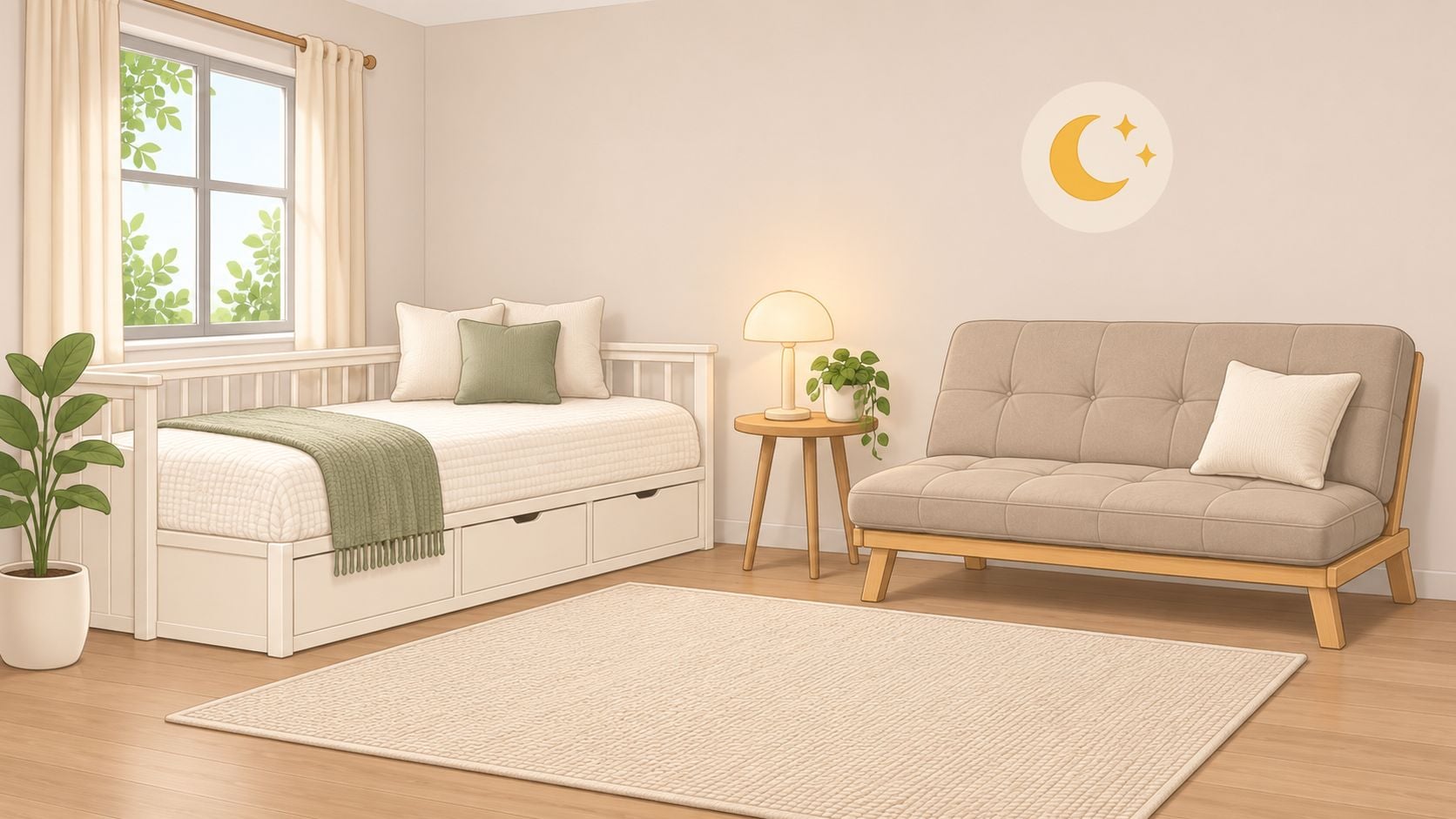
Two different family trees
The structure of each piece comes from its history. Long couch-like platforms appear in ancient Egypt, Greece and Rome, where people sat, dined, read and slept on them. Greek reclining couches called klinai were adapted by Roman makers, and Roman work helped establish the idea of adding backs to couches.
The daybed later became a fixed piece of furniture, one that stays assembled in a room and looks like furniture whether it is dressed with cushions or sheets. Its roots sit in long chairs with multiple legs and angled backs, then in lounge seating blended with alcove-bed ideas. The futon came from the opposite direction: bedding built to be folded and put away. The word entered Japan from China, first describing a round meditation seat used by Buddhist priests, then growing into cushions and bedding. Western frames turned that fold-and-store concept into a sofa that flattens.
The daybed is a bed that pretends to be a sofa. The futon is a sofa that flattens into a bed. Buy for the job it does most days.
Three numbers to settle before shopping
- Nights per month: Count them. A guest who stays every other weekend needs a different mattress than a cousin who visits once a year.
- Number of sleepers: One adult, a teenager, or a couple. Width decides this before style does.
- Daily sitting hours: If someone watches the game there every night, seat depth and back angle matter more than the sleep surface.
Households across Albany, Schenectady and Troy can answer those questions at the Freehold, NY showroom, where Tip Top Furniture & Mattresses helps shoppers match sleepers to beds and carries USA-made mattresses, sleep accessories and furniture for the living room, bedroom and more. Staff use a series of questions to narrow down the bedding choice. Shoppers who want to sort the sleep side first can start with choosing the right mattress for your sleeping style, then bring the answer to the frame decision.
Daybed vs Futon Side by Side
| Criterion | Daybed | Futon |
|---|---|---|
| Sleeping surface | Standard twin mattress in a fixed frame | Flexible futon mattress that folds with the frame |
| Typical mattress thickness | Full-depth twin, set by the frame's specifications | Thinner folding construction; compressed budget models perform worse |
| Converts between sitting and sleeping | No, stays made as a bed | Yes, moves between sofa and bed |
| Daily seating comfort | Upright; needs back cushions to feel like a sofa | Built as a sofa for long sitting |
| Overnight guest comfort | Predictable, bed-like support | Depends on mattress thickness and quality |
| Mattress replacement | Standard twin, widely available | Must be rated for the frame's folding geometry |
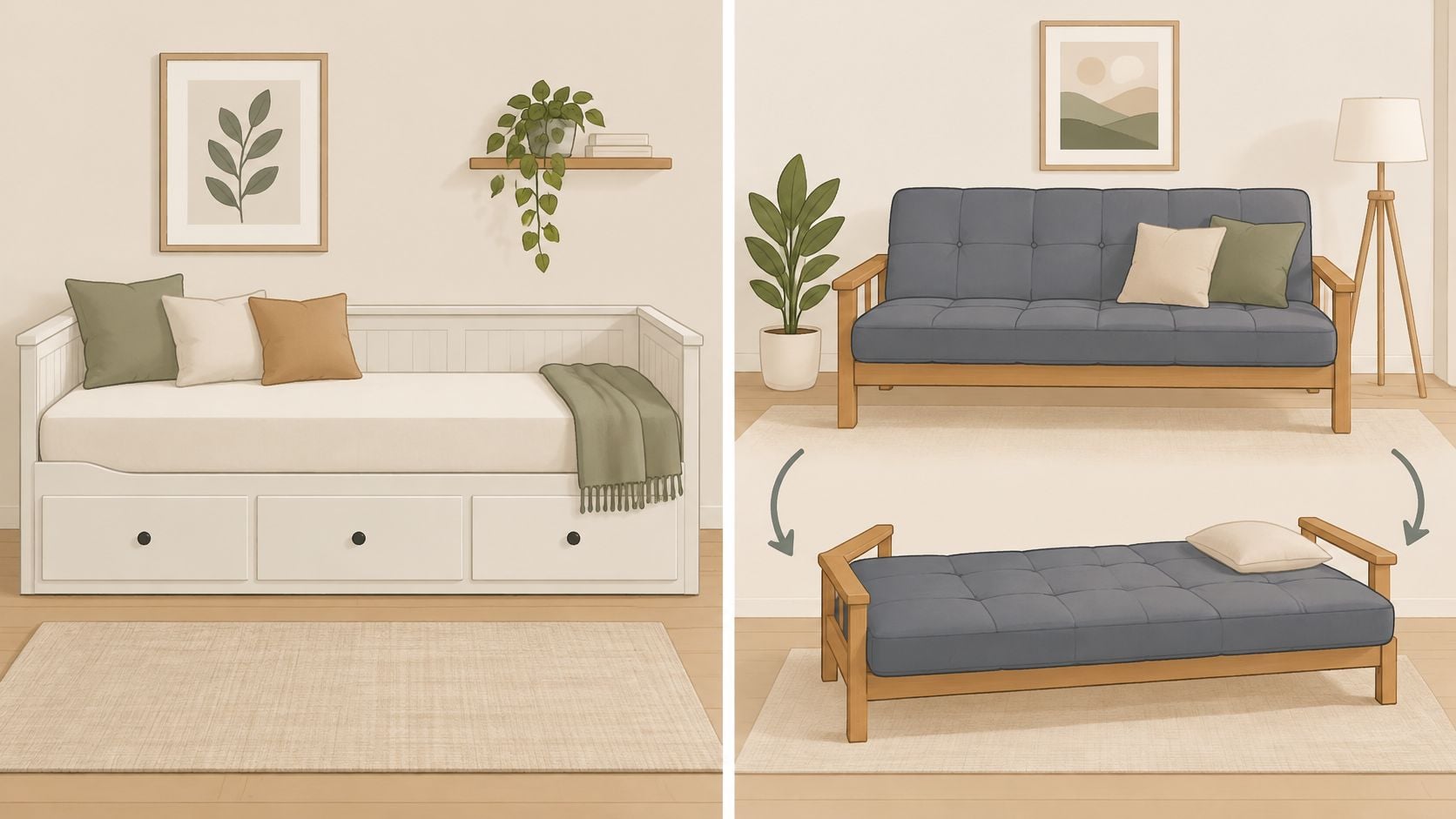
The mattress row decides most purchases
A daybed takes a normal mattress and keeps it flat, which means the whole twin market is open to you and a tired mattress swaps out in an afternoon. A futon mattress has to bend every time the frame moves, so it runs thinner than a standard twin by design. That thinness is the trade. Inexpensive futon mattresses compress under repeated folding, and once the fill packs down, the frame's hinge line starts printing through to the sleeper.
A daybed's mattress never creases. That single difference drives everything else in the table.
The conversion row decides how the room works
A futon's back or seat section moves, so the frame carries hinges, pivots and fasteners that a daybed doesn't have. Those joints are what make daytime seating feel natural and the upright footprint shallow. They're also the parts that wear, which is why frame alignment and hardware quality matter more on a futon than on any fixed bed. Check the hinge action before anything else when you try one in person: it should travel smoothly and lock without wobble in both positions.
The seating row decides whether anyone uses it
A futon is proportioned like a sofa: a back at a sitting angle, a seat depth that supports your thighs, arms at the right height. A daybed sits deeper and flatter, so without a row of firm back cushions and a bolster or two, people perch on the edge rather than settle in. If the piece will serve as a room's main seat for hours at a stretch, that difference shows up on the first evening.
Buying rule: Match the piece to the surface used most often, then use the table to confirm what you're giving up.
Whichever direction you lean, treat the manufacturer's load limits and assembly instructions as the final word on any frame you bring home.
Sleeping Comfort and Mattress Fit
Comfort starts with the mattress system, not the frame's finish. A daybed is structurally close to a conventional bed: most models use a stationary standard twin mattress measuring approximately 38 × 75 inches, inside a frame that commonly runs roughly 42–44 inches wide and 78–82 inches long (typical dimensions across the category, not a fixed standard). That opens up innerspring, foam, hybrid and medium-firm options, and it makes replacement simple years later.
A futon mattress is engineered to fold, and the hinge line is where support problems show up first. That strip gets creased every time the frame converts, so it deserves the closest look in any showroom test.
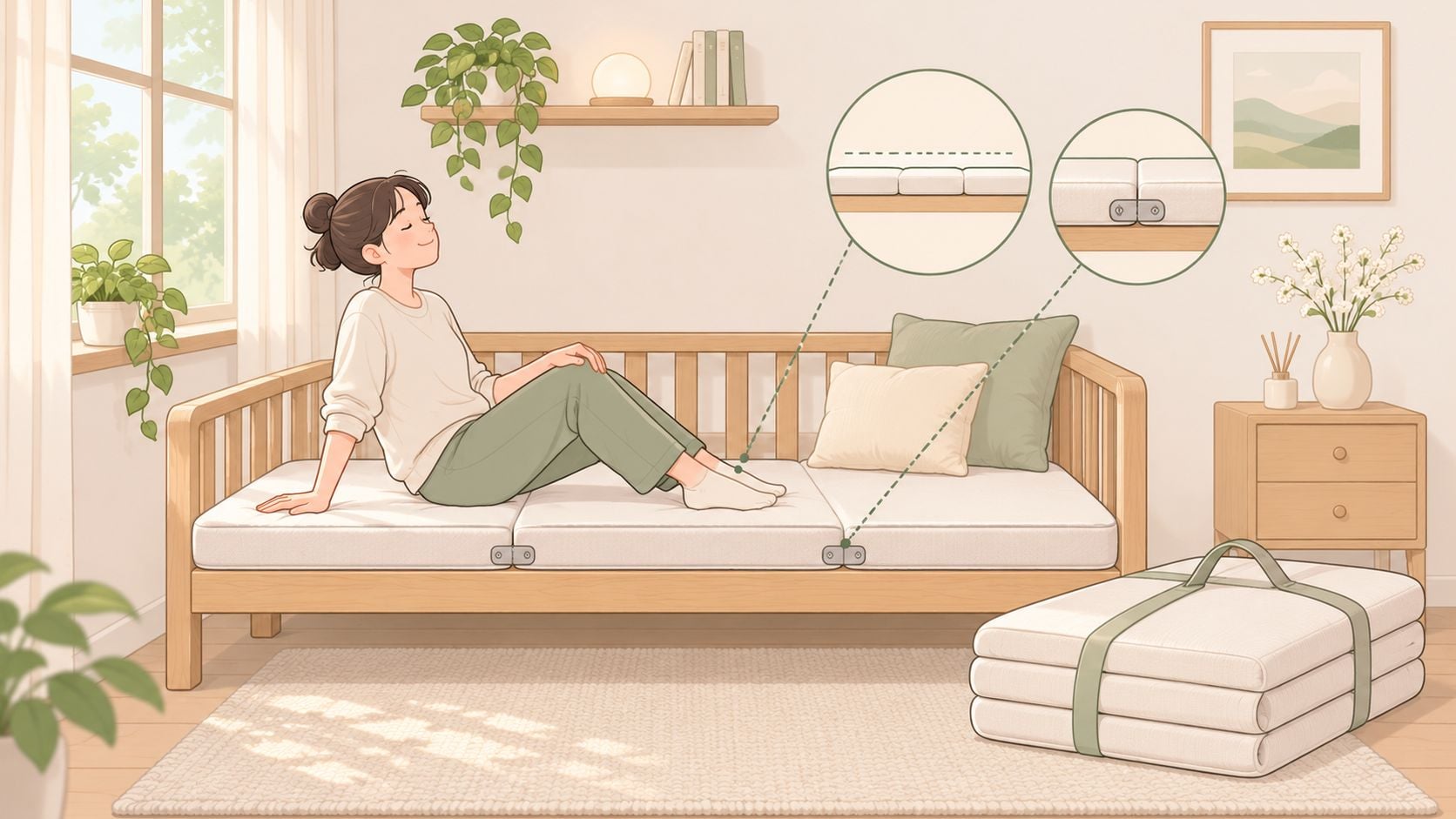
Firmness and the fold
Firmness isn't a matter of taste alone. For a guest surface that has to work for different body types on different weekends, medium-firm is the safest default, since it keeps the spine level for back and side sleepers without feeling rigid to lighter guests.
On a futon, the frame does part of the supporting work. Check that it locks securely in both the upright and flat positions, that the sleeping platform stays planar with no ridge at the hinge, and that the mattress rebounds after you compress it with a knee. Loose fasteners and a hinge that won't seat fully are the two faults worth walking away from.
A fit check you can run in the showroom
- Confirm the daybed's required mattress thickness so the sleeping surface doesn't sit too high relative to the arms and backrest. A mattress that towers over the back ruins the seating and looks wrong.
- Confirm the futon mattress is explicitly rated for that frame's hinge geometry and for both sitting and sleeping positions. Our futon mattress size guide covers how those dimensions line up.
- Lie down for a full ten minutes in your usual sleeping position, then sit on the perimeter. Check rebound when you stand and edge support when you perch.
Ten minutes feels long in a showroom. It's the shortest test that tells you anything real.
Sizing for the people who'll sleep there
A twin suits one guest well and can feel narrow for a couple, while a full or queen futon accommodates two sleepers if the room allows the open footprint. Think through who uses the piece most often. A nightly sleeper justifies a deeper, higher-quality mattress; an occasional guest surface can trade some of that for easier conversion and storage.
Tip Top Furniture & Mattresses stocks USA-made mattresses in Twin, Twin XL, Full, Queen, King, California King and Split Head options, in Hybrid, Innerspring, Memory Foam and Pillow Top constructions, so the mattress can be matched to the sleeper rather than to the furniture category. Staff use a series of questions about sleep position and comfort preference to narrow the choice, which matters more here than the frame decision itself.
One practical extra for a futon that lives in a family room: a washable cover keeps the sleeping surface clean between guests. Shoppers looking for that layer can browse sofa bed covers at Casamé Home for fitted styles that stay put through the fold.
Floor Space and Clearance in Capital Region Homes
The advertised footprint isn't the number that decides whether a piece works. A futon needs open floor in front of it to unfold, plus a usable route around the extended sleeping surface once it's flat. In a room with a desk, a doorway, a radiator or a heating vent in the wrong place, that sleeping zone can shut down the room's whole function.
A daybed takes a deeper, fixed footprint and asks for nothing in front of it. Some models add a trundle or drawers underneath, so the same floor area does double duty. That produces a counterintuitive result: a daybed can be the more space-efficient choice in a small guest room where the bed stays deployed, while a futon wins in a narrow multipurpose room where it stays upright most of the week.

| Setup | Daybed | Futon |
|---|---|---|
| Floor area occupied | Fixed frame, about 42–44 × 78–82 inches | Closed sofa footprint: shallower than the open bed, set by the frame's listed sofa depth |
| Open-position footprint | Same as closed; no conversion | Adds the sleeping zone when opened: the full mattress length projected forward from the back |
| Clearance needed to convert | None | Open floor in front of the frame equal to the opened depth minus the closed depth |
| Walkway with the piece open | Normal room path | A clear route around the open sleeping surface, wide enough to carry bedding through |
| Ease for older adults or back limits | Raised, no folding | Folding effort depends on the hinge, so test it in person before buying |
Who can operate it, and who can get out of it
Frequent folding is hard work for older adults, anyone with back or joint limits, and children. A raised daybed is often easier to enter and exit than a low futon, because standing up from a low, soft surface asks more of the knees. A small-space furniture market report tracks growing demand for multifunctional and modular designs, but no market trend answers the question that matters here: can every user safely convert the piece, make the bed, and walk through the room with it open?
The measuring routine
- Measure the closed and open dimensions of any futon you're considering, and the full outer frame of any daybed. Write both pairs down.
- Add walking clearance around the open sleeping surface, not just at the foot of it. Someone will need to reach the far side to tuck a sheet.
- Mark doors, radiators and vents on the floor with painter's tape, then lay out the open footprint with the same tape. Older Albany, Schenectady and Troy homes often have narrow hallways and radiators under the windows, exactly where a folding back wants to land. Our room measuring guide walks through the rest of the layout math.
- Test the conversion force in person. If it takes two hands and a hip to move the back, it won't get folded on a Tuesday night.
Measure the room with the bed open. That's the version of the room your guests will live in.
Tip Top's free online Room Planner shows each piece to scale before anyone commits, which is faster than moving a dresser twice.
Best Choice by Room and Sleeper Pattern
| Room or Situation | Better Choice | Why | Watch For |
|---|---|---|---|
| Guest room, occasional adult guests | Daybed with standard twin mattress | Stays made; predictable mattress | Thin futon mattress compresses |
| Den or family room, daily sitting | Futon | Converts; sits like a sofa | Needs open floor to unfold |
| Home office that doubles as bedroom | Daybed | Permanent sleep surface | Twin is narrow for couples |
| Child or teen room | Low daybed | Lower frame, no bunk-style risks | Raised designs need guardrails and age limits |
| Narrow multipurpose room | Futon if it stays upright; daybed if it stays out | Depends on how often it converts | Route to doors and vents |
The guest room and the home office
For a room whose main job is hosting, the daybed usually wins. It stays made, the mattress is a standard size you can replace without hunting for a proprietary part, and nobody has to clear the floor at eleven at night. The one thing that flips the answer is couples: a twin surface is narrow for two adults, so a full or queen futon may serve better if the room can absorb the open footprint.
A home office that moonlights as a bedroom follows the same logic. If the bed stays deployed, the daybed reads as a tidy lounge during work hours and asks for zero conversion space beside the desk. Pair it with a firm back cushion row and it passes for seating on video calls.
The den that gets sat on every night
Here the futon earns its place. It's shaped for long sitting, it stays shallow while upright, and it flattens for the occasional guest. The risk is floor space: a den with a coffee table, a bookcase and a doorway in the swing path may not have the open zone the frame needs. Shoppers working through that puzzle can lean on the roundup of furniture for small spaces to see which layouts keep a walkway intact.
A child's room, and the elevation question
A conventional low daybed is a sensible pick for a child or teen, and it's a different category from a bunk. Raised and bunk-style designs bring federal requirements with them. The Consumer Product Safety Commission's federal bunk bed safety standard states that upper-bunk openings must be smaller than 3.5 inches to help prevent a child's torso from passing through, and warns against placing children under age 6 on an upper bunk.
The height trigger is specific. Under the federal bunk bed requirements in 16 CFR Part 1513, the rules apply when the underside of the foundation is more than 30 inches above the floor, and a guardrail's upper edge must sit at least 5 inches above the top of the mattress at the manufacturer's maximum specified thickness. That's why a thicker replacement mattress isn't just a comfort upgrade on a raised bed.
Judge a child's daybed by its actual elevation, guardrails and openings, not by how much it looks like a sofa.
The manufacturer's instructions control the permitted mattress dimensions and the age warnings. Follow them over any advice from a sales floor, including this one.
Confirm the Right Piece Before You Buy Near Albany
A final visit works best when you arrive with the decision already narrowed. Use the three numbers from the earlier sections to set the shortlist, then spend your time on the checks that only make sense in person. Bring the taped-out layout photos, the frame's required mattress size and maximum thickness, and a clear picture of who will use the piece most.
What the showroom team does with those details
Tip Top Furniture & Mattresses trains its staff to help customers determine which bedding is right for them using a series of questions to narrow down the choice. That makes the final visit more useful, because the conversation can start with the frame, the sleeper and the room, then move to comfort and support. The family-owned store has served the Capital Region since 1978, with 45+ years behind the counter and professional design services running since 1984. Our mattress shopping guide covers the bedding side of that conversation in more depth.
At the showroom, sit down as you would after work, lie back as you would at night, and work the conversion several times. Pay attention to thehinge motion, the weight of the mechanism and whether the sleep surface feels stable once it is open. A futon that looks fine in a brochure can feel awkward if the folding motion fights the space around it. A daybed can feel more settled for frequent sitting, but the mattress still has to match the frame's limits.
Budget, custom work and the rest of the room
- Clearance Corner: Deep discounts on quality pieces, useful when a guest room needs furnishing before the holidays.
- Monthly specials: Savings of at least 10% to 60% off retail value on furniture and mattress brands.
- Flexible financing: A variety of payment and financing options, including special financing on purchases made with a Synchrony Home Card (see store for details).
- Custom ordering: Choose the style, size, wood type and finish, including heirloom-quality Amish furniture handcrafted in the USA, when stock dimensions won't fit an odd alcove.
- Design consultation: Help coordinating the piece with décor and window treatments, plus flooring from over 25 manufacturers, so the guest room doesn't look like an afterthought.
A daybed or futon rarely sits alone. It shares a wall with a dresser, a rug and often new flooring, which is why one-stop shopping with local expertise saves more than a trip across the county.
Bring your saved measurements and layout photos to Tip Top Furniture & Mattresses in Freehold, NY, and the team will walk you through daybeds and folding frames you can sit and lie on before deciding. Shoppers from Albany, Schenectady, Troy and across Greene County can also ask about design services to match the piece to the room's flooring and décor, or check the Clearance Corner and monthly specials for a guest-ready setup that fits the budget.