Custom Amish Cabinets: Expert Craftsmanship for Your Home

A lot of homeowners around Albany reach the same point at the same time. The kitchen still works, but it doesn't work well. The cabinets look tired, storage feels awkward, and every shortcut from the last remodel starts to show itself once the counters are crowded and the family is standing in the same room.
That's usually when custom Amish cabinets move from being a nice idea to a serious option. They appeal to people who want more than a cosmetic update. They want cabinetry that feels settled, solid, and worth living with for a long time.
For homeowners in Greene County, Albany, Schenectady, Troy, and across the Capital Region, the decision usually isn't just about style. It's about making sense of a major purchase, understanding what “custom” really means, and avoiding expensive disappointment. A kitchen project ties into flooring, appliances, lighting, and how the room is used every day.
This guide is built for that real-world decision. It gives a practical way to think about materials, construction, budget, measurements, and the line between semi-custom and fully custom. For anyone already comparing heirloom furniture quality across rooms, this look at solid wood furniture brands and craftsmanship helps frame why cabinet construction matters so much in the first place.
Table of Contents
- Your Guide to Heirloom Quality Custom Cabinets
- The Enduring Appeal of Amish Craftsmanship
- Designing Your Dream Cabinets Wood Style and Finish
- What Custom Amish Cabinets Really Means
- Planning Your Project Budget Timeline and Measurements
- Finalize Your Order at Our Freehold Showroom
- Caring for Your Cabinets and FAQs
Your Guide to Heirloom Quality Custom Cabinets
You walk into the kitchen at 6:30 on a Tuesday, and the room shows you exactly what is not working. The mixer has no real home. Pantry items are stacked where platters should go. One shallow drawer catches every time it opens. In many Albany-area homes, that is the moment a cabinet project stops being about looks alone and starts being about function, fit, and longevity.
Custom Amish cabinets appeal to homeowners who want cabinetry built with the same care they expect from well-made furniture. The goal is not just a nicer kitchen. The goal is a room that works better every day and still feels right ten or fifteen years from now. That long-view matters in older homes, where stock sizes and quick fixes often leave awkward gaps, wasted corners, or a style that never quite belongs.
The first decision is not wood species or paint color. It is scope.
Some projects need semi-custom cabinetry with smart modifications. That can solve a lot of kitchens at a more comfortable price point and with fewer delays. Other rooms need fully custom work because the house has uneven walls, unusual ceiling lines, radiator conflicts, tight appliance clearances, or a layout that standard sizing cannot handle cleanly. Homeowners get into trouble when those two categories are treated as if they are the same. They are not, and your budget and timeline depend on knowing the difference early.
I have found that confident cabinet decisions usually come from looking at the whole room, not a door sample by itself.
Cabinets have to live with the flooring, the table, the island stools, the trim, and the way the family moves through the space. If you already own quality wood furnishings, it helps to study how good casework is built and finished before choosing a cabinet line. Our guide to the best solid wood furniture brands is a useful starting point for understanding the materials and construction details that tend to hold up well over time.
Good cabinetry also needs an honest match between expectations and daily use. A household that cooks every night needs different storage than one that wants a showpiece kitchen for holidays and entertaining. Deep drawers for pots may matter more than extra uppers. A paneled end or furniture-style island may be worth the cost in an open floor plan, while decorative extras in a tight kitchen may take money away from better hardware or smarter interior storage.
That is the practical framework for this guide. Start with how the room lives. Separate semi-custom from fully custom before you fall in love with details. Then judge craftsmanship, design, and price in that order.
Homeowners around Freehold and the greater Albany area usually appreciate that approach because it replaces guesswork with clear trade-offs and a plan they can trust.
The Enduring Appeal of Amish Craftsmanship
A cabinet line earns its reputation in the parts you rarely notice on day one. Five or ten years later, those hidden choices are the reason a kitchen still feels solid, or starts showing sagging shelves, loose doors, and drawers that never quite close right again.
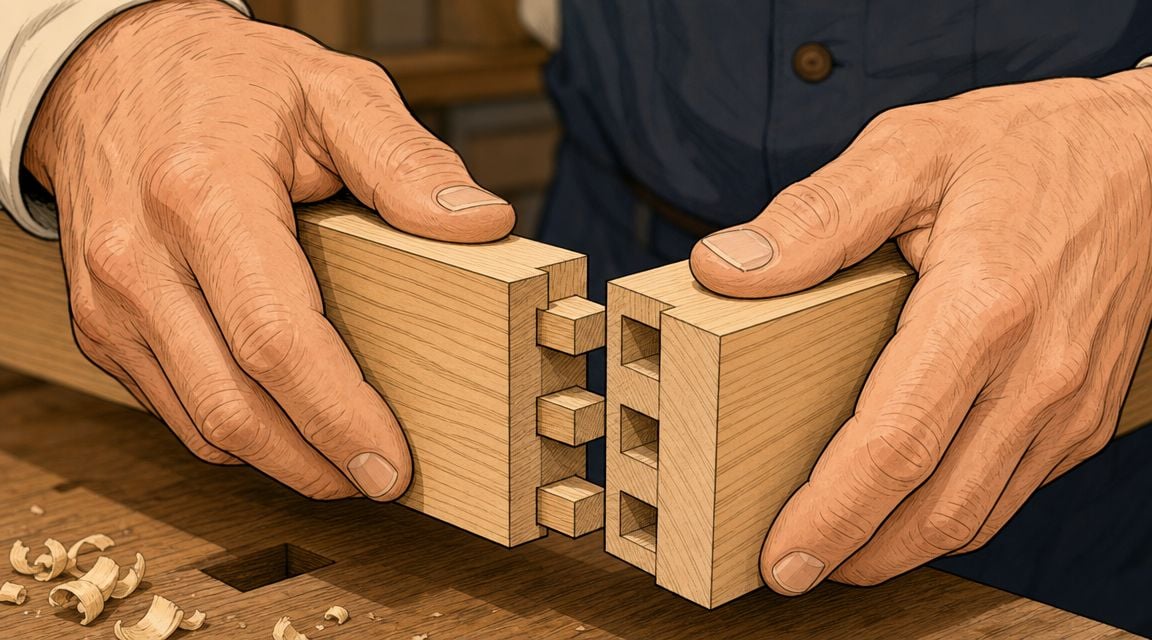
That is the lasting appeal of Amish craftsmanship. Good Amish cabinetry is usually built more like furniture than mass-produced casework, with attention paid to joinery, wood movement, repairability, and the stress points that take the most abuse in a working kitchen.
The practical details matter.
- Mortise-and-tenon doors tend to stay tighter over time than shortcut construction.
- Dowel-pinned or otherwise well-secured face frames add rigidity at the front of the cabinet, where daily use shows up first.
- Thicker all-wood shelves usually carry kitchen weight better than lighter alternatives.
- Plywood cabinet boxes generally hold screws and hardware more reliably than particle-based materials.
In Upstate New York, seasonal humidity is part of the job. Wood expands and contracts. Finish gets tested by steam, cooking grease, and constant cleaning. Better-built cabinets handle those conditions with fewer complaints, especially in busy family kitchens where drawers are packed and doors are opened all day.
I always tell homeowners to look past the door style for a minute and ask a few plain questions. What is the box made from? How are the doors joined? What supports the shelves? Can a hinge, drawer slide, or finish be repaired years from now? Those answers say more about value than a stain sample ever will.
For shoppers comparing Amish furniture options near Albany, the same rule applies across dining rooms, bedrooms, and kitchens. A piece can look beautiful under showroom lights and still fall short in the bones.
Long-term value is also where many Albany-area homeowners start to see the line between semi-custom and fully custom more clearly. Both can look attractive when new. The difference often shows up in material choices, construction options, and how far the maker will go to fit the cabinet to the room instead of forcing the room to fit the cabinet. That distinction affects budget, lead time, and how much flexibility you really get during the streamlined kitchen design process.
A good custom cabinet should earn its keep for decades. It should feel sturdy, accept maintenance, and remain worth refinishing or updating instead of replacing. That is why Amish craftsmanship still carries weight. The appeal is not nostalgia. It is dependable construction that holds up under real household use.
Designing Your Dream Cabinets Wood Style and Finish
The design side of custom Amish cabinets can feel overwhelming at first. There are woods, door styles, stains, paint choices, hardware looks, and all the small decisions that suddenly seem permanent once samples hit the table.
The easiest way to keep it manageable is to separate the choices into three layers. First pick the wood. Then settle the cabinet style. After that, narrow the finish.
Choosing the right wood for the way the kitchen lives
Different woods create different moods. Some look formal. Some feel relaxed. Some show grain boldly. Others stay quieter and let the shape of the cabinet do more of the visual work.
A practical starting point is to compare a few familiar options side by side.
| Solid Wood Comparison for Custom Cabinets | Grain Pattern | Hardness (Janka) | Best For |
|---|---|---|---|
| Oak | Prominent, open grain | Qualitatively harder-wearing | Busy family kitchens, traditional and mission looks |
| Cherry | Fine, smooth grain with rich character | Qualitatively stable for furniture-grade work | Warm, classic spaces that benefit from natural depth |
| Maple | Smooth, subtle grain | Qualitatively durable and clean-looking | Painted finishes, transitional kitchens, lighter visuals |
This table stays qualitative on purpose. The useful decision isn't chasing a number. It's matching the wood to the room, the finish, and the amount of visual texture a homeowner wants.
A household with a lot of existing oak furniture may prefer continuity. A cleaner, lighter kitchen may lean toward maple. A more traditional home often looks especially comfortable with cherry because the wood has natural richness without needing ornate styling.
Picking a cabinet style that fits the house
Door style should match the architecture and the mood of the home, not just the latest showroom trend.
Some common directions include:
- Shaker doors for clean lines and broad flexibility. They work in farmhouse, transitional, and many updated traditional kitchens.
- Mission-inspired details when the home already has visible wood character, straight lines, and craftsman influence.
- Simple flat or slab-inspired looks for homeowners who want less visual interruption and a more refined feel.
- Framed traditional styles when the room needs warmth and more furniture-like presence.
A smart way to narrow these choices is to look beyond the cabinets themselves. Flooring, window trim, dining furniture, and nearby built-ins usually reveal what style belongs in the space. Homeowners planning the room as a whole may also find this outside guide to a streamlined kitchen design process useful because it keeps layout and function tied closely together.
If the cabinets feel right but out of place with the rest of the house, the project will never feel fully finished.
Finishes that look good now and age well later
Finish selection changes the mood as much as the wood species does. It also affects how forgiving the cabinets will be in daily life.
A few practical guidelines help:
- Mid-tone stains often balance warmth and flexibility. They don't show every mark as quickly as very dark finishes can.
- Lighter finishes can open up smaller kitchens and pair well with rooms that need more visual brightness.
- Painted finishes suit homes that want a crisp, refined look, but they should still be chosen with the architecture in mind.
- Low-drama finish choices usually age better than highly fashion-driven colors.
Matching finish to other wood pieces in the home can also matter more than many buyers expect. Cabinetry doesn't need to be identical to a dining table or nearby hutch, but it should feel related. That's one reason homeowners often spend time reviewing custom wood finish options before making a final choice.
The best cabinet designs usually aren't the loudest. They're the ones that still make sense after the excitement of the remodel fades and ordinary life moves back into the room.
What Custom Amish Cabinets Really Means
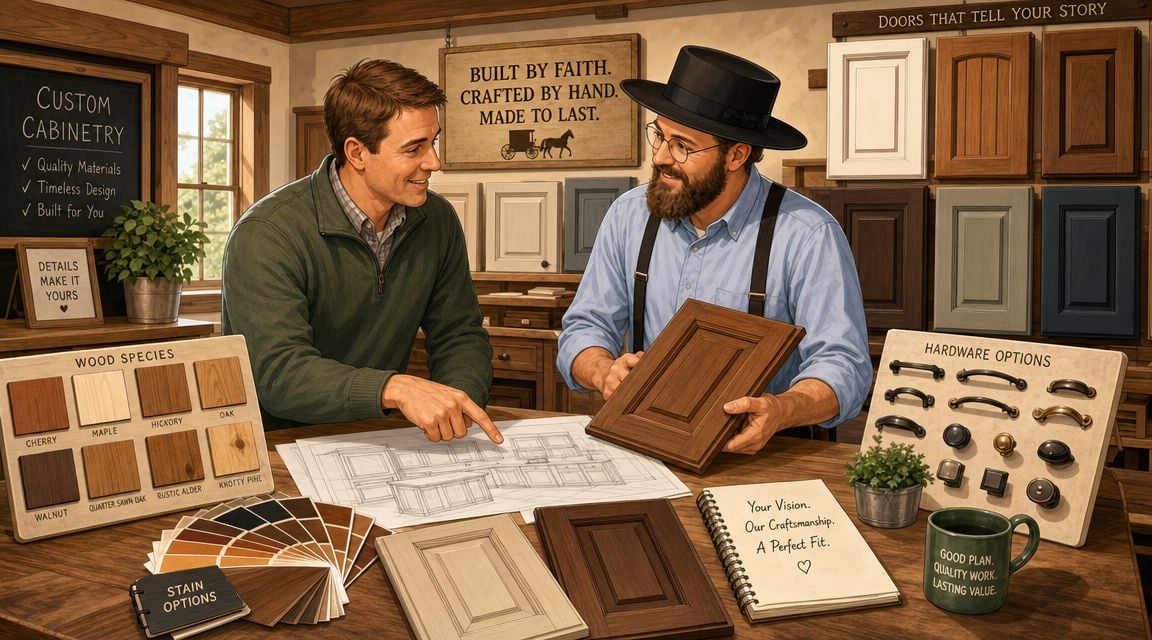
A homeowner walks into our store with a floor plan, a few inspiration photos, and one clear request: custom Amish cabinets. Five minutes later, the true question usually comes out. Do they want a cabinet line with flexible options, or cabinets built from scratch for their exact room?
That distinction matters more than the word "custom."
In day-to-day cabinet work, "custom Amish cabinets" can describe two different paths. One is semi-custom cabinetry, where a shop offers a proven cabinet system with choices in size, wood, finish, door style, and storage features. The other is fully custom cabinetry, where each cabinet is built for the room with fewer standard limits on dimensions, details, and construction.
Both can be excellent. The right choice depends on the room, the level of precision required, and how much of the budget should go toward solving unusual conditions rather than adding features.
Semi-custom fits many homes better than buyers expect
Semi-custom works well when the kitchen has a fairly normal footprint and the project needs smart flexibility without rebuilding every cabinet from zero. In many Albany-area homes, that covers a lot of ground.
It often makes sense for:
- Straightforward wall runs with only moderate size adjustments
- Common appliance layouts that do not need unusual panel widths or custom filler strategies
- Homes with standard ceiling heights and reasonably square walls
- Projects with a defined budget where careful choices matter as much as one-of-a-kind detailing
A good semi-custom line can still deliver a beautiful, long-lasting kitchen. The trade-off is simple. You get meaningful choices inside a cabinet system that already has rules.
Fully custom earns its keep when the room is the problem
Older homes tend to expose the difference quickly. A wall may lean. A ceiling may drop. A pantry opening may be off by enough that standard sizing leaves awkward fillers or wasted space. That is where fully custom cabinetry starts to justify its cost.
Fully custom is usually the better fit for:
- Integrated appliances that require exact panel reveals and consistent spacing
- Out-of-square rooms where standard modules create layout compromises
- Furniture-style pieces such as hutches, built-ins, and specialized pantry storage
- Detailed trim coordination where cabinetry needs to relate cleanly to molding, flooring, and existing millwork
Construction also matters. Joinery affects how a cabinet handles weight, movement, and years of daily use. Homeowners comparing premium cabinet options often ask about mortise-and-tenon joint construction because it helps explain why one piece feels solid and another feels temporary.
Price usually follows complexity. A project with more one-off sizing, more hand-fit details, and more coordination time costs more to build and install. For a broad look at how cabinet costs can vary, see Domicile Construction Inc. on cabinet pricing.
The practical goal is not to pay for "full custom" on principle. It is to match the cabinet approach to the room. If a semi-custom program handles the layout cleanly, that is often the better buy. If the house has quirks that will bother you every day unless they are solved properly, fully custom is money spent in the right place.
Planning Your Project Budget Timeline and Measurements
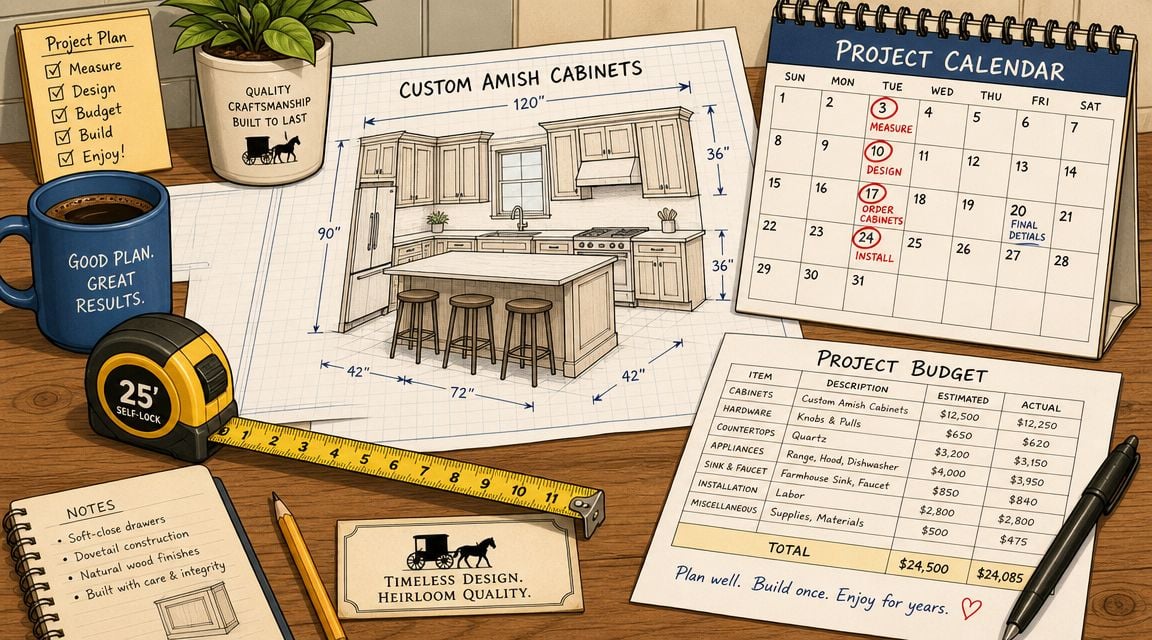
A cabinet project usually feels manageable once three things are clear. What you want to spend, how long you can wait, and what the room offers for the design.
I have seen Albany-area homeowners lose weeks because they started with stain colors before settling the layout, appliance sizes, or installation window. Good planning saves money because it keeps revisions down and helps you decide early whether a semi-custom line will handle the room cleanly or whether full custom work is justified.
What the numbers mean before a project starts
Custom Amish cabinetry belongs in the long-term investment category. The price reflects more than wood alone. It reflects labor, finish work, custom sizing, storage features, delivery coordination, and the amount of hand-fitting the room requires.
The biggest budget mistake is assuming every "custom" quote covers the same scope. One proposal may be based on standard cabinet widths with a few modifications. Another may include true one-off sizing, furniture-style end panels, appliance panels, trim work to the ceiling, and installation adjustments for walls that are out of square. Those are not small differences.
That is why the practical question is not merely, "What do custom Amish cabinets cost?" The better question is, "What level of custom work does this room need?"
Homeowners who want another plain-language perspective on project variables can review Domicile Construction Inc. on cabinet pricing. It helps connect layout complexity and material choices to the final scope.
Budget planning goes better when you separate required features from upgrades you would enjoy but could live without.
A simple way to do that is to split your list into three groups:
- Must-have items such as cabinet capacity, appliance fit, and a layout that works for daily use
- Strong preferences such as a specific wood species, painted finish, or full-height pantry storage
- Optional upgrades such as specialty inserts, decorative end treatments, or more involved interior accessories
That exercise also helps draw the line between semi-custom and fully custom. If your priorities are mostly finish, door style, and a few storage upgrades, semi-custom may cover the room well. If the house has crooked walls, unusual depths, or built-in details you want handled properly, full custom often earns its cost.
Measurements to gather before a consultation
Early measurements do not need to be perfect, but they do need to be clear. A rough sketch with usable dimensions is far more helpful than a handful of numbers written on scrap paper.
Bring these basics:
- Overall wall lengths where cabinetry may go
- Ceiling height at each wall, especially in older homes where it may vary
- Window and door locations with rough widths and heights
- Appliance dimensions for anything staying, plus model information for anything being replaced
- Plumbing, gas, and vent locations that affect sink, range, or hood placement
- Obstacles such as soffits, radiators, trim, posts, or uneven corners
Photos matter just as much. Wide shots show how the room relates to nearby spaces. Close shots reveal the trouble spots, including trim conflicts, sloped floors, and window casings that can affect cabinet sizing.
Tip Top Furniture & Mattresses offers planning support through its online room-planning tools and in-store design services. That kind of prep helps when cabinetry needs to work with existing flooring, dining furniture, or nearby built-ins instead of being treated as a stand-alone purchase.
Financing can be part of good project planning too. A homeowner coordinating cabinets with counters, flooring, and appliances may want to review flexible financing options early so the cabinet purchase fits the full remodel schedule and budget.
Timeline deserves the same attention as cost. Custom work takes longer than stock cabinetry, and the lead time can shift with wood selection, finish complexity, and the season you place the order. If the kitchen must be ready before a holiday, a move-in date, or a contractor's installation slot, say that up front. It is much easier to build a realistic schedule early than to force one later.
Finalize Your Order at Our Freehold Showroom
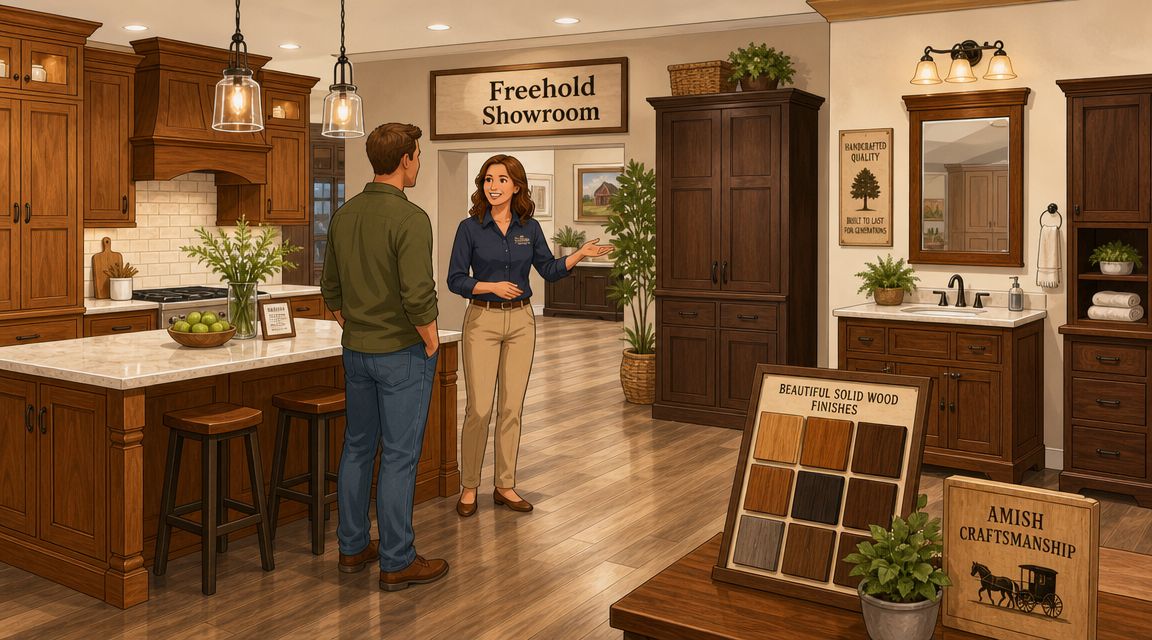
A cabinet order usually becomes clear once you are standing in front of the samples. A door style that looked perfect on a phone screen can feel too busy in person. A stain that seemed rich online can read much darker under showroom lighting, which is often a good warning for how it may behave in a North Country kitchen through winter and summer light changes.
That visit matters for another reason. It is where the line between semi-custom and fully custom stops being abstract and starts affecting your order, your budget, and your install schedule.
What an in-person cabinet conversation solves
At the Freehold showroom, the useful questions are usually practical ones.
- Does this finish make sense with the floors, trim, and nearby furniture already in the house?
- Will this wood species feel too heavy for the size of the room?
- Is the door profile simple enough to age well, or decorative enough to justify the added detail?
- Are we pricing a modified standard cabinet line, or a true custom build with more sizing and design freedom?
That last question saves people money and headaches. Some homeowners come in asking for "custom Amish cabinets" when what they really need is a semi-custom line with the right finish, storage features, and a few size adjustments. Others have a room with unusual dimensions, existing architectural quirks, or a furniture-grade look in mind that calls for a fully custom shop. The showroom is where those two paths get sorted out before paperwork is signed.
For customers driving in from Albany, Troy, Schenectady, or nearby Greene County towns, that face-to-face review also helps tie the cabinet plan back to the rest of the home. Cabinetry rarely stands alone. It has to live with your table, your flooring, your wall color, and the way your family uses the room.
Questions to settle before you sign
Ask direct questions. Good cabinet conversations should leave very little to guesswork.
Buyers should confirm where the cabinets are built, what materials are used in the boxes and doors, which modifications are standard, and which changes move the order into a more expensive custom category. If a price jumps, the reason should be clear. It might be a specialty finish, a non-standard depth, a furniture-style end panel, or extra interior storage. Those are real upgrades, but they should be chosen on purpose.
A premium cabinet order also deserves a clear review of lead time, finish expectations, and what happens if field measurements change after the order is placed.
Ask what is standard, what is optional, and what cannot be changed once production starts. That one conversation prevents a lot of expensive surprises.
While you are finalizing the order, it also helps to think a step ahead. Cabinet finish care should fit real life, especially in kitchens that see daily use. A quick review of these wood furniture care basics for long-term finish protection can help you choose a finish and color that will wear well in your home, not just look good on a sample board.
Caring for Your Cabinets and FAQs
Custom Amish cabinets are built for long service, but good care still matters. Solid wood responds best to regular, gentle maintenance and a stable home environment.
Simple care that protects solid wood cabinetry
Day-to-day care should stay simple.
- Use a soft cloth for regular dusting and routine wipe-downs.
- Clean spills promptly so moisture doesn't sit on edges, around sink areas, or near hardware.
- Choose mild cleaners rather than harsh products that can dull or damage the finish.
- Watch humidity swings in kitchens that get very dry in winter or very humid in summer.
Hardware can also loosen over time through normal use. Hinges and pulls should be checked periodically, especially in a busy kitchen where drawers and doors get constant use.
For broader guidance on maintenance habits, homeowners can review how to care for wood furniture. The same common-sense approach applies to furniture-grade cabinetry.
Frequently asked questions
Can custom Amish cabinets match other wood furniture in the home?
Often, yes. Exact duplication isn't always the goal, because woods and finishes respond differently across products, but a coordinated look is usually achievable when the buyer brings photos, samples, and realistic expectations.
Are custom Amish cabinets always fully bespoke?
No. Some are semi-custom, using a standard construction platform with selected modifications. Others are built from scratch for unusual layouts or special design requirements. That distinction should be discussed early.
Are they worth the higher cost?
They can be, especially for homeowners who value solid wood construction, repairability, and a cabinet that's meant to stay in service for decades rather than be replaced on a shorter cycle.
What's the biggest mistake buyers make?
They focus on style before confirming construction, origin, and scope of customization. That order should be reversed.
Should care products be aggressive if the cabinets get greasy?
Usually not. Gentle cleaning done consistently is safer than occasional heavy scrubbing with harsh chemicals.
For homeowners across Freehold, Albany, Schenectady, Troy, and the wider Capital Region, the next smart step is a hands-on conversation. Tip Top Furniture & Mattresses can help review wood choices, finishes, room measurements, and custom-order options so the cabinet plan fits the home, the budget, and the rest of the project.