
Board Under Mattress: A Local Expert’s Guide to Better Support for 2026

A board under a mattress is a solid, flat panel—usually plywood or a specially made “bunkie board”—that you slide directly under your mattress for extra firmness and support. People most often use one to fix a sagging mattress, especially if their bed frame has slats that are too far apart or if they have an old, worn-out box spring. It's a surprisingly simple fix that can drastically improve support and even get a few more years out of your mattress.
What Is a Board Under a Mattress and Why Use One?
Think of a board under your mattress as the unsung hero of your bedroom. It’s a simple solution to a very common problem, creating a firm, even surface for your mattress to rest on. It’s a bit like building a house—you wouldn't build on soft sand, you'd want a solid rock foundation. That board acts like a rock-solid foundation, preventing your mattress from sinking into gaps and developing those uncomfortable dips.
Here at Tip Top Furniture & Mattresses, a family-owned business since 1978, we've seen this small change completely revitalize a bed. It ensures the high-quality USA-made mattresses we sell provide the best possible comfort for years to come in homes all over the Greater Albany Capital Region.
This trick isn't new at all. In fact, people have been using boards to firm up their beds since innerspring mattresses became common in the early 20th century. Today, having the right support is more critical than ever. Industry stats show that a whopping 35% of mattress returns are due to poor support—an issue that adding a board can often solve completely.
The Primary Reasons for Using a Mattress Board
So, why exactly would you need one? Since our family started this business back in 1978, we've helped countless customers in Freehold, NY, and the surrounding areas troubleshoot their sleep problems. We’ve found that a mattress board is the perfect fix for a few key situations.
It's a fantastic way to solve support issues without having to buy a whole new bed frame or foundation. Here are the most common reasons our customers grab one:
- To Firm Up a Sagging Mattress: This is the number one reason, hands down. If your mattress is starting to dip in the middle, a solid board provides the reinforcement it needs to feel level and firm again.
- To Support a Modern Mattress on an Old Frame: Many newer mattresses, especially memory foam and hybrids, need a solid, uniform base. If you put one on an old-school box spring or a frame with slats more than 3 inches apart, it can start to sag way too soon.
- To Replace a Broken or Worn-Out Box Spring: A good box spring is great, but its springs can weaken over time. A sturdy board is a cost-effective fix, giving your mattress the flat, rigid surface it craves. You can learn more by checking out our guide on why you might need a box spring for your bed.
- To Add Support to Inadequate Slats: If your bed frame’s slats are too thin, flimsy, or spaced too far apart, they just can't hold the weight of a mattress and the people on it. A board spreads that weight out evenly across the frame, getting rid of pressure points and stopping the mattress from dipping between the slats.
Choosing The Right Material For Your Mattress Board in the Albany Area
So, you’ve figured out that a board under the mattress might be just the ticket to fix that annoying sag. Great! But now comes the next big question: what kind of board should you get? This decision is a lot like choosing the right tires for your car—the wrong material won't give you the support you need.
Here at Tip Top Furniture & Mattresses, we've spent over 45 years helping folks from Albany to Schenectady find the perfect fix for their beds. Based on our family's experience, let’s walk through the most common materials so you can feel confident in your choice.
DIY vs. Pre-Made Options
You really have two main paths you can take here: build it yourself or buy one ready-made. Going the DIY route with a sheet of plywood or MDF (Medium-Density Fiberboard) from the hardware store is usually the most wallet-friendly option. It also gives you total control over the exact size and thickness.
On the other hand, you can buy a pre-made bunkie board. These are built specifically for mattress support, often come wrapped in fabric, and are ready to go straight out of the box in standard bed sizes. No tools, no fuss.
Expert Insight from Tip Top: "For our customers who love a good weekend project, plywood is a fantastic, sturdy choice. But for anyone who wants a guaranteed fit without the guesswork, a quality bunkie board saves a ton of time and gives a really polished result. It’s that trustworthy, local advice we’ve been giving since 1978."
Not sure if a board is even what you need? This little flowchart breaks down the main reason people end up using one.
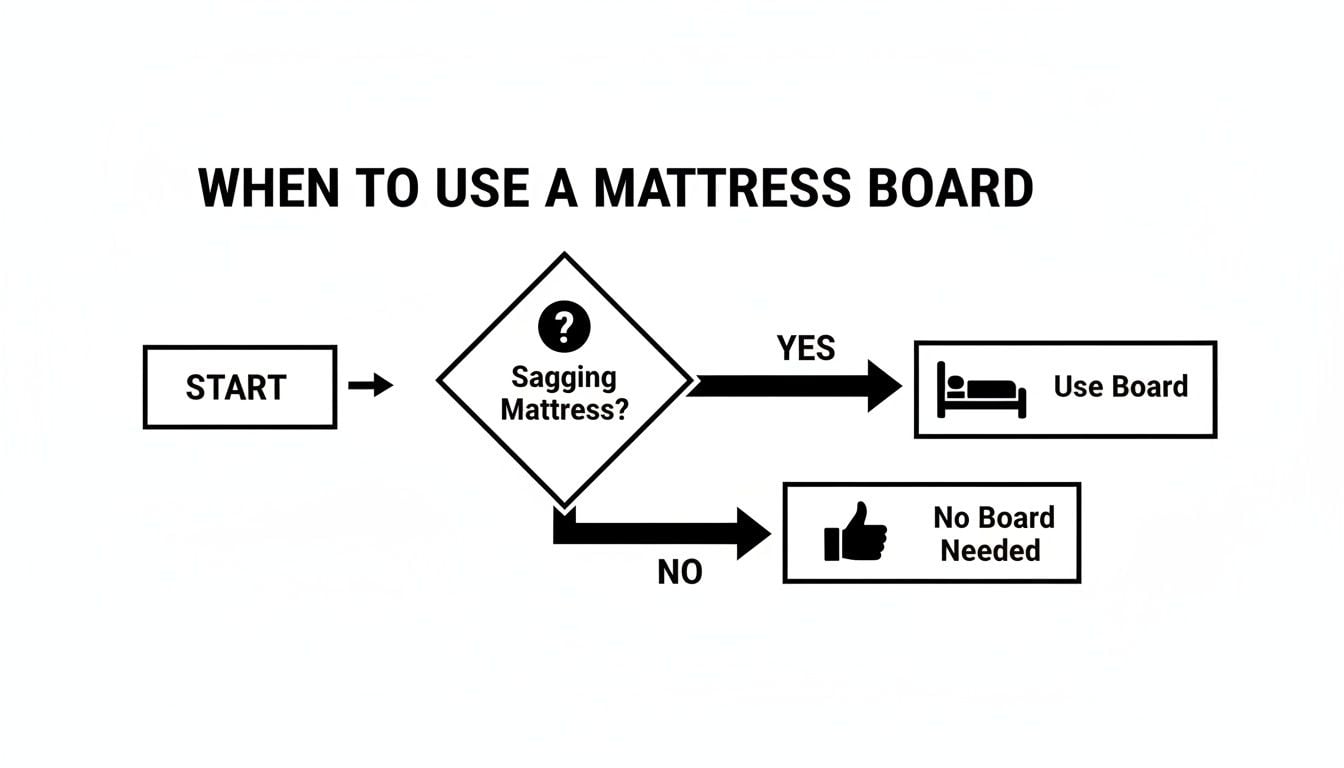
As you can see, it really comes down to one thing: if your mattress is sagging, a board is a solid solution. If it’s not, you probably don’t need one.
Common Materials And Their Properties
Let's dig into the most popular materials for a mattress board. Each one has its own set of pros and cons, making them better for different situations and budgets. Knowing the difference is a bit like understanding why our Amish furniture uses specific woods—it helps you pick the right tool for the job. You can learn more in our guide on the best wood for custom tables.
Here’s a quick look at the most common materials used for a mattress support board and how they stack up against each other.
Mattress Support Board Comparison
| Material | Typical Cost | Durability | Best For | Considerations |
|---|---|---|---|---|
| Plywood | $ | High | DIY projects and achieving maximum, even firmness. | Needs to be sanded to prevent splinters and snagging the mattress. |
| MDF | $ | Medium | A perfectly smooth surface, especially on a tight budget. | Heavier than plywood and can be damaged by moisture. |
| Bunkie Board | $$ | High | Convenience, mattress protection, and a perfect fit for standard beds. | Higher upfront cost compared to a DIY board. |
As you can see, there's no single "best" material—it all depends on your budget, how much work you want to put in, and the level of finish you're after.
Plywood: This is the go-to for DIYers for a good reason. It’s made from layers of wood glued together, which makes it incredibly strong and resistant to bending. It provides that firm, solid surface that modern memory foam and hybrid mattresses love.
MDF (Medium-Density Fiberboard): Made from pressed wood fibers, MDF is denser and heavier than plywood. Its main advantage is a perfectly smooth surface. The downside? It doesn't handle moisture well and isn't quite as rigid as plywood over the full length of a bed.
Bunkie Boards: These are the "plug-and-play" solution. They are purpose-built supports, usually a wood frame with slats, all wrapped in a layer of fabric. They provide excellent support while also protecting your mattress from the raw wood.
Getting The Thickness And Sizing Right
The thickness of your board is more important than you might think. If it’s too thin, it will just bow along with the mattress, which defeats the whole purpose. If it's too thick, you might find your bed is suddenly too high to climb into comfortably.
For most beds, a board between 1/2-inch and 3/4-inch thick is the sweet spot. This range offers plenty of firm support without adding too much height or weight.
When it comes to sizing, make sure you measure the inside of your bed frame, not the mattress itself. You’ll want the board to be about a quarter-inch smaller than the frame on all sides. This little bit of wiggle room makes it much easier to get the board in and out and helps with air circulation. If you're tackling this yourself and have questions, remember our team at the Tip Top Furniture showroom in Freehold is always here to help out.
Will a Board Work With Your Type of Mattress?
This is easily the most common question we hear from our customers in Freehold, NY, and all across the Capital Region: “Will putting a board under my mattress actually help?” The short answer is, it really depends on what kind of mattress you have. The great news is that for many of today's beds, a support board isn't just helpful—it can be absolutely essential.
Since our family started helping our neighbors sleep better back in 1978, we’ve seen mattress technology change in ways we never could have imagined. Let’s break down which mattresses get the biggest boost from a solid foundation, based on our 45+ years of experience.
Memory Foam and Hybrid Mattresses
For memory foam and hybrid mattresses, the answer is almost always a resounding yes. These mattresses are built with sophisticated foam layers that are designed to contour perfectly to your body. To do their job right, they need a completely solid, non-flexing surface underneath them.
Think of it this way: memory foam acts a bit like soft dough. If you were to place it on a wire rack (like old bed slats spaced too far apart), the dough would just sag and push through the gaps. The exact same thing happens to your mattress, causing the foam to break down way too soon and leaving you with zero support.
- Warranty Protection: A lot of mattress brands will state right in the paperwork that the warranty is void if the mattress is used on a foundation with slats more than 2-3 inches apart. A solid board or a bunkie board is the easiest way to make sure you're covered.
- Better Performance: A solid base lets the foam layers compress and rebound exactly as the engineers intended, giving you the best possible pressure relief and support night after night.
- Longer Lifespan: Simply preventing the foam from sinking into gaps is the single best thing you can do to get the most years out of your memory foam or hybrid mattress.
Traditional Innerspring Mattresses
If you have a traditional innerspring mattress, adding a board can be a fantastic trick to bring back some of its original firmness. If your trusty innerspring is starting to feel a little too soft, sliding a board underneath can provide the extra rigidity it needs to fight off sagging and feel supportive again.
This is especially true if your mattress is sitting on an old, weakened box spring or a bed frame with flimsy slats. The board creates a new, stable platform that lets the coils inside the mattress get back to work.
Our Local Expertise: "Here in our Freehold showroom, we often suggest a board as a great budget-friendly fix for customers who aren't quite ready to buy a whole new bed set. It’s an effective way to improve comfort while you plan your next purchase, maybe from our Clearance section or by using our flexible Financing options."
Critical Considerations for All Mattresses
While a board is a great tool, it’s not a perfect fix for every single situation. The biggest potential issue you need to think about is airflow. A solid piece of plywood can trap the heat and moisture your body naturally releases overnight, which might lead to mildew or just make you sleep a bit warmer.
This is a really important point in today's mattress world. The global market, valued at $46.48 billion in 2026, is expected to hit $67.51 billion by 2030, with foam mattresses driving a huge part of that growth. Since foam can already sleep warmer than innersprings, airflow is key. You can explore the latest mattress market research from Grand View Research to see more on how the industry is changing.
Luckily, there are a few easy ways to get support without sacrificing airflow:
- Choose a Bunkie Board: These are often made with a breathable fabric cover and sometimes have a slatted design inside, giving you a great balance of solid support and air circulation.
- Drill Ventilation Holes: If you’re going the DIY route with a sheet of plywood, drilling a simple pattern of 1-inch holes across the surface can dramatically improve airflow without making the board any less supportive.
- Consult an Expert: Protecting your mattress is the main goal. Our professional design team, serving the Albany area since 1984, can help you find that perfect balance. We can take a look at your current setup and recommend the best plan, whether it's a simple board, a new foundation, or helping you explore our guide on various mattress types and what they need.
How to Install a Board Under Your Mattress
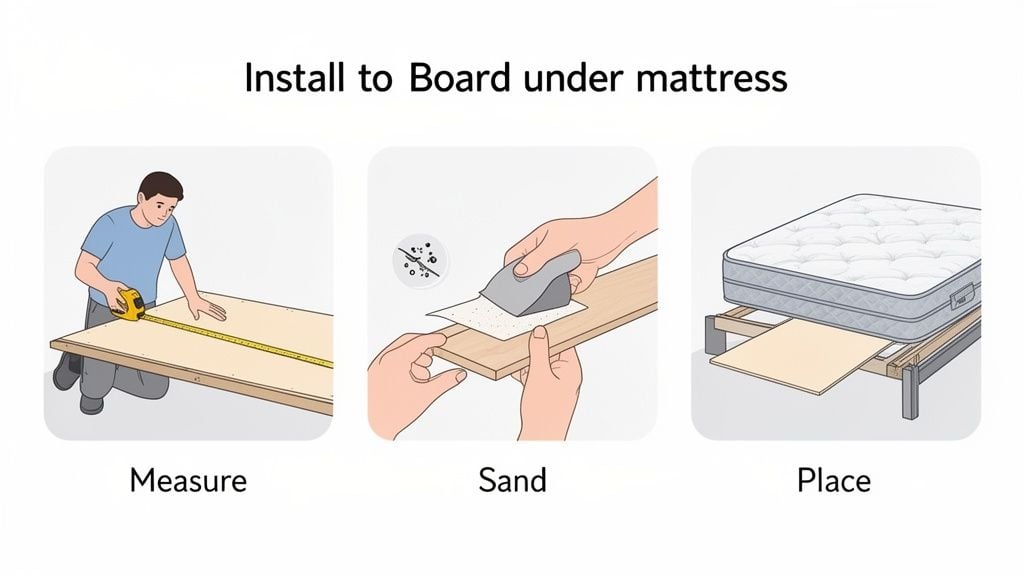
Ready to bring that firm, supportive feeling back to your bed? Putting a board under your mattress is a simple project that can make a world of difference for your sleep and the lifespan of your mattress.
Think of it as having one of our Tip Top Furniture experts from Freehold walking you through it. We've broken it down into a few easy steps, covering everything from measuring just right to getting the board ready for a perfect, safe fit.
Step 1: Prep Your Bed Frame
Before you start, let's get the bed ready. This is a quick but important part of the process.
Clear the Deck: First, carefully lift your mattress off the bed frame. The best spot for it is leaning against a wall where it won't get scuffed or dirty. Don't forget to strip off all the bedding first!
A Quick Cleanup: This is the perfect chance to do a little deep cleaning. Grab your vacuum and get any dust bunnies out from inside the bed frame and off the slats.
Inspect Your Foundation: Give your bed frame a quick look-over. Are all the slats in good shape? Is the frame itself still sturdy? A support board does its best work when it's placed on a solid structure.
Step 2: Measure and Prep the Board
Getting the measurements right is everything. A board that's too small will slide around, and one that's too big… well, it just won't fit.
Measure the Frame's Interior: Grab a tape measure and find the length and width inside the bed frame—the area where the mattress actually sits. You're measuring the space, not the mattress itself.
Leave a Little Wiggle Room: From both the length and width, subtract 1/4 inch to 1/2 inch. This tiny gap is your best friend during installation, making it easier to place the board and letting air circulate underneath.
Cut and Smooth the Edges: If you're going the DIY route with plywood, most hardware stores will cut it to your exact measurements. Once you get it home, give any rough edges or sharp corners a light sanding to prevent splinters that could tear your mattress.
Our Pro Tip: "After you've sanded the board, run an old towel along the edges. If it snags, you know that spot needs a little more work. This simple check we’ve shared with our neighbors for decades can save your mattress from future damage!"
Step 3: Put the Board in Place
You’re on the home stretch! This is the easiest part.
With your bed frame clean and your board ready, just slide the board into the frame. It should rest flat right on top of your slats or foundation. That little gap you measured for earlier should make it drop into place without any fuss.
Now, just put your mattress back on top of your new board. That's it! You've just installed a board under your mattress and given your bed a serious support boost. Small projects like this are a great way to protect your furniture investments, just like learning how to protect your floors from your furniture protects your home.
If going the DIY route sounds like too much trouble, don't you worry. Our family is always here to help yours, from Albany and Troy to Schenectady. Just stop by our Freehold showroom, and we can show you some fantastic bed frames, foundations, and beautiful Amish furniture that offer perfect support from day one.
Exploring Alternatives to a Simple Mattress Board
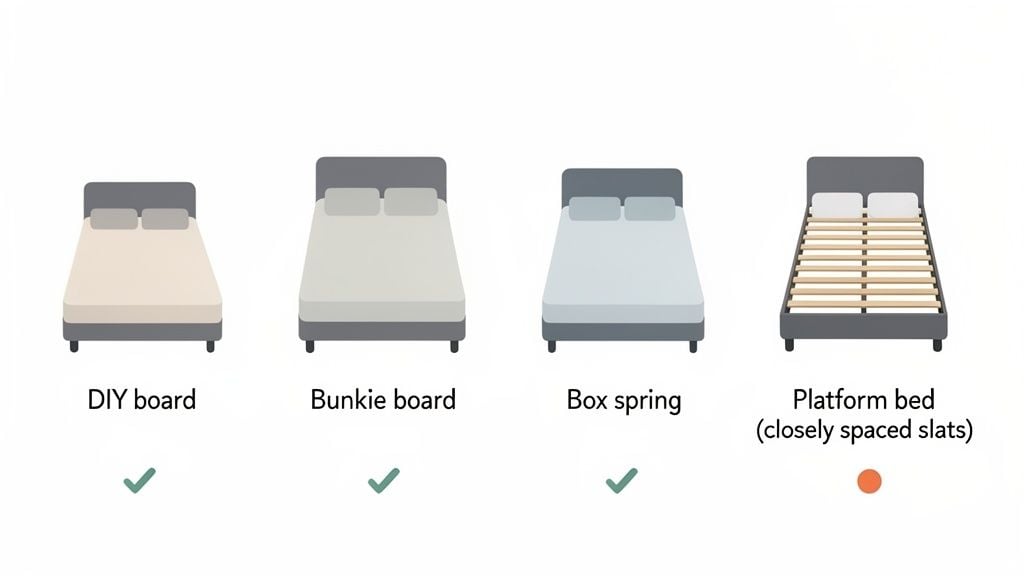
While a simple board under your mattress is a fantastic and wallet-friendly fix for a sagging bed, it’s not your only choice. As your trusted local experts since 1978, we want to give you the full picture so you can make the best decision for your home here in the Greater Albany Capital Region.
A DIY board is a great starting point, but it's always wise to explore all other mattress support options to find what truly fits your mattress, your budget, and your lifestyle. Let's look at how a simple board stacks up against other modern solutions.
Bunkie Boards
Think of a bunkie board as the professionally finished cousin of a DIY plywood board. They were originally designed for bunk beds (hence the name!) and are low-profile foundations, typically just one to three inches thick. They come pre-sized and are often wrapped in fabric, which is great for protecting your mattress from splinters.
- Pros: They’re convenient with no cutting or sanding needed, and they provide the same solid, even support you’d get from plywood.
- Cons: You’ll pay more than you would for a DIY board, but you aren't really getting any more support than a properly sized piece of plywood.
For many of our customers in Greene County and the Capital Region, the sheer convenience of a ready-to-use bunkie board is well worth the slightly higher cost. It's perfect for a quick and easy bedroom upgrade.
Box Springs and Foundations
Many folks use the term "box spring" for any base under a mattress, but there’s a big difference between older and newer models. A true, old-school box spring has actual springs inside to add bounce and absorb shock. What's often called a box spring today is actually a "foundation"—a rigid, springless box made of wood and metal.
For today’s mattresses, especially memory foam and hybrids, a rigid foundation is a much better choice. It gives you the same solid, unwavering support as a board, but with added height. If your bed feels too low to the ground, a foundation is an excellent alternative.
Platform Beds
This is where great design meets excellent function. A high-quality platform bed has a built-in support system of strong, closely spaced wooden slats. If those slats are less than 3 inches apart, you often don’t need any extra board or foundation at all!
This is a perfect chance to highlight the beautiful and sturdy Amish-made furniture we carry in our Freehold showroom. Many of our Amish platform beds are designed with robust, solid wood slats that provide incredible, long-lasting support for any mattress type. They offer a gorgeous, all-in-one solution that’s built to last for generations—part of our "One-Stop Shopping with Local Expertise" promise.
For families financing projects through our flexible plans, investing in a quality platform bed can be more cost-effective long-term, eliminating the need for future fixes.
This decision has real financial implications. Since 1984—the year Tip Top launched our expert design services—we've seen that 55% of mattress failures are linked to foundation flaws. A simple board can fix this, saving families $300-$600 per bed.
Adjustable Bed Bases
For the ultimate in customized comfort, nothing beats an adjustable base. These let you elevate your head and feet, which is fantastic for reading, watching TV, or even helping with issues like snoring and acid reflux. Most modern mattresses are compatible, and if you’re considering this upgrade, you should learn about the many benefits of an adjustable bed.
Ultimately, whether it’s a simple board or a full bedroom set from our Freehold showroom—complete with flooring and custom order furniture—our goal is to help you make the right choice for your home.
Your Local Mattress Support Experts in Freehold, NY
For over 45 years, our family here at Tip Top Furniture & Mattresses has been helping folks all across the Greater Albany Capital Region get a better night's sleep. We've just walked through how a simple board can sometimes be a quick fix, but true comfort comes from experience and a personal touch. That’s the kind of attentive, expert advice you’ll only find at a family-owned business like ours, which we started right here back in 1978.
We’d love for you to come by our Freehold showroom and experience the Tip Top difference for yourself. Don't guess what your mattress needs or risk doing something that might void your warranty. Our team of non-commissioned experts has decades of hands-on experience and is ready to help you find the right solution.
More Than Just Advice—We’re Your One-Stop-Shop
Our commitment to helping our neighbors extends beyond just advice. When you stop in, you can see and feel a wide range of quality solutions for your entire home.
- Discover Heirloom Quality: Come feel the difference of our solid wood Amish bed frames. They’re built with such superior support that you often won't even need an extra board.
- Find Instant Savings: Take a look through our Clearance Corner for some incredible deals on high-quality foundations, bed frames, and floor models that are ready to go home with you today.
- Experience American-Made Comfort: Let us introduce you to our fantastic selection of USA-made mattresses. We’ll help you find the perfect one for your sleep style and make sure it’s paired with the ideal foundation.
At Tip Top Furniture & Mattresses, our philosophy is simple: we help our neighbors sleep better. We’re not just selling furniture; we're building lasting relationships with families from Albany to Troy and beyond. Let our family help your family get the best night's sleep.
Don’t spend another night tossing and turning on a sagging, unsupportive bed. Visit our Freehold, NY showroom today and let our experts guide you to a perfect night’s rest. Or, if you’re ready to start your next home project, you can easily apply for our flexible financing options online and make your dream bedroom a reality.
Frequently Asked Questions About Mattress Boards
When it comes to getting the most out of your mattress, we hear all sorts of questions from folks here in the Albany Capital Region. We’ve been a local, family-owned business for over 45 years, and in that time, we've learned a thing or two about getting a great night's sleep.
Let's dive into some of the most common questions our customers ask about using a board under a mattress.
How Thick Should a Board Under a Mattress Be?
For the best support, you’ll want a mattress board that's between 1/2-inch and 3/4-inch thick. This is the sweet spot.
A board in this range is sturdy enough to stop a mattress from sagging but won’t add a ton of extra height to your bed. Go any thinner, and it might start to bend under the weight. Anything thicker is usually overkill and can make it awkward to hop into bed at night.
If you're ever in doubt, a 3/4-inch piece of sanded plywood is a fantastic, reliable choice. It provides rock-solid support for just about any mattress, from traditional innersprings to modern memory foam.
Can a Board Under the Mattress Cause Mold?
Yes, this is something you definitely need to watch out for. A solid board can trap moisture and heat, which is a perfect recipe for mold and mildew. Mattresses need to breathe to let out everything your body releases overnight.
Thankfully, preventing this is pretty straightforward. You've got a few simple options:
- Drill Some Holes: If you’re using a DIY piece of plywood, drilling several 1-inch to 2-inch holes across the surface is a great way to boost air circulation.
- Choose a Bunkie Board: Most bunkie boards are designed with airflow in mind, either with internal slats or a breathable fabric cover. They give you support and ventilation.
- Create an Air Gap: You can also lay thin wood strips between your bed frame's slats and the support board to lift it up just enough for air to move underneath.
What Is a Bunkie Board and Is It Better?
A bunkie board is basically a modern, low-profile mattress foundation, usually between one and three inches thick. They were first designed for bunk beds (hence the name!) but have become a go-to solution for anyone needing a solid surface for their mattress.
A bunkie board is like a ready-to-go, polished version of a DIY plywood board. You get the same firm support without any of the hassle of cutting, sanding, and prepping the wood yourself.
It's a fantastic choice if you want convenience and a guarantee that your mattress is safe from splinters. While it isn’t necessarily "better" than a well-prepared piece of 3/4-inch plywood for pure support, it's a wonderful, no-fuss option.
Still have questions? We've put together a quick table with some more common concerns we hear in the showroom.
FAQ on Using a Board Under Your Mattress
| Question | Answer |
|---|---|
| Do I need a board with a platform bed? | Usually not. If your platform bed has slats that are less than 3 inches apart, you likely have enough support. If they're wider, a board can prevent sagging. |
| Can I use particle board instead of plywood? | We don't recommend it. Particle board can sag, crumble, or break down over time, especially when exposed to moisture. Plywood is much more durable. |
| Will a board make my mattress feel firmer? | Yes, it will. By creating a solid, flat surface, a board eliminates any give from the slats below, which can make your mattress feel noticeably firmer. |
| Does using a board void my mattress warranty? | It can. Always check your mattress manufacturer's warranty. Many modern mattresses require specific types of support, and using an unapproved board could void it. |
We hope this clears things up! The goal is always to protect your investment and ensure you're sleeping comfortably.
At Tip Top Furniture & Mattresses, we believe in finding the right solution for every family. From our high-quality USA-made mattresses to our beautiful Amish bed frames, we have the perfect foundation for your best night's sleep.
Visit our Freehold, NY showroom to get expert advice from our family!