Cheap Teen Room Decor: A Budget Plan That Looks Expensive


A sixteen-year-old wants a room that looks like the ones in their feed. The adults in the house want a number they can live with, and a room that still works in eighteen months. Both requests are reasonable, and both are achievable on a budget that would surprise most families.
Teens take the project seriously. In a 2023 YPulse survey of Gen Z consumers ages 13 to 22, 35% planned to buy décor and pillows, making that category their top purchase priority ahead of electronics at 33%, according to Home Textiles Today's summary of the survey. The same research found that 82% of Gen Z respondents preferred an orderly home environment, which is a useful lever when the conversation turns to storage.
The gap between wanting a calm, finished room and having a modest budget is where most of the money gets wasted. The fix isn't a longer shopping list. It's a plan that puts sleep, safety and total cost ahead of how the room photographs.
Set a Budget and Split It by Zone
One number controls every decision that follows: the maximum total budget, written down before any shopping starts. A range invites drift. A written figure forces the trade-offs into the open while they're still cheap to make.
Split that figure across five zones, with the sleep zone holding the largest share of the money.
| Budget Zone | Share of Budget | Spend Here First | Skip or Delay |
|---|---|---|---|
| Sleep zone | 35 to 40% | Bedding, blackout curtains, bed frame | Extra decorative pillows beyond four |
| Study zone | 20 to 25% | Supportive desk chair, task lamp | Oversized desk accessories |
| Storage | 15 to 20% | Anchor kit, bins, one dresser or shelf | Tall pieces that cannot be anchored |
| Accents and decor | 10 to 15% | Wall graphics, rug, framed prints | Repainting or trend-specific pieces |
| Hardware and extras | 10 to 15% | Anchors, hooks, tape, cable clips | Do not cut this row |
Sleep comes first because bedding, blackout curtains and a bed frame change how the room feels every night, and they're the cheapest route to a room that looks finished. Study comes next, since a supportive chair and a task lamp get used daily and a wobbly chair is a false economy that gets replaced inside a year. Storage and accents follow in that order.
Overruns in this kind of project are routine rather than exceptional. A neutral homeowner survey cited by Hippo's guide to DIY project mistakes found that 58% of DIY participants spent more than anticipated, 47% underestimated the time requirement and 38% underestimated the budget. Those figures aren't a teen-bedroom success rate, but they name the failure modes precisely: scope creep, incomplete measurements and forgotten ancillary costs.
Teens do bring some of their own money to the project. Teen self-reported annual spending reached $2,388 in 2025, up 6% year over year, according to the semiannual teen survey from Piper Sandler and DECA, and a slice of it usually goes toward the room.
At a $1,000 total, the split looks like this. Sleep takes about $375 for a twin platform frame, bedding and blackout curtains. Study takes about $225 for a supportive chair and task lamp. Storage takes about $175 for an anchor kit, two bins and one dresser. Accents take about $125 for wall graphics and a rug, and hardware and extras take about $100. Scale the same percentages to a $500 or a $2,000 total; these are illustrations, not price quotes.
Write the Sheet Before You Shop
A single page beats a mental tally. Five zone rows, a dollar amount beside each, and a total that does not move. The guide to decorating on a budget applies the same discipline to the buying stage.
Practical rule: record each item's price, tax, delivery fee and return policy on the sheet before checkout, not after. The delivery fee is the line most often left off a teen room budget.
Measure, Lay Out and Anchor the Room Safely
Start with a tape measure, not a shopping cart. Ten minutes of measuring prevents the most expensive mistake in the whole project: a dresser that blocks a closet door, or a desk arrangement that leaves no clear route from the bed to the hallway.
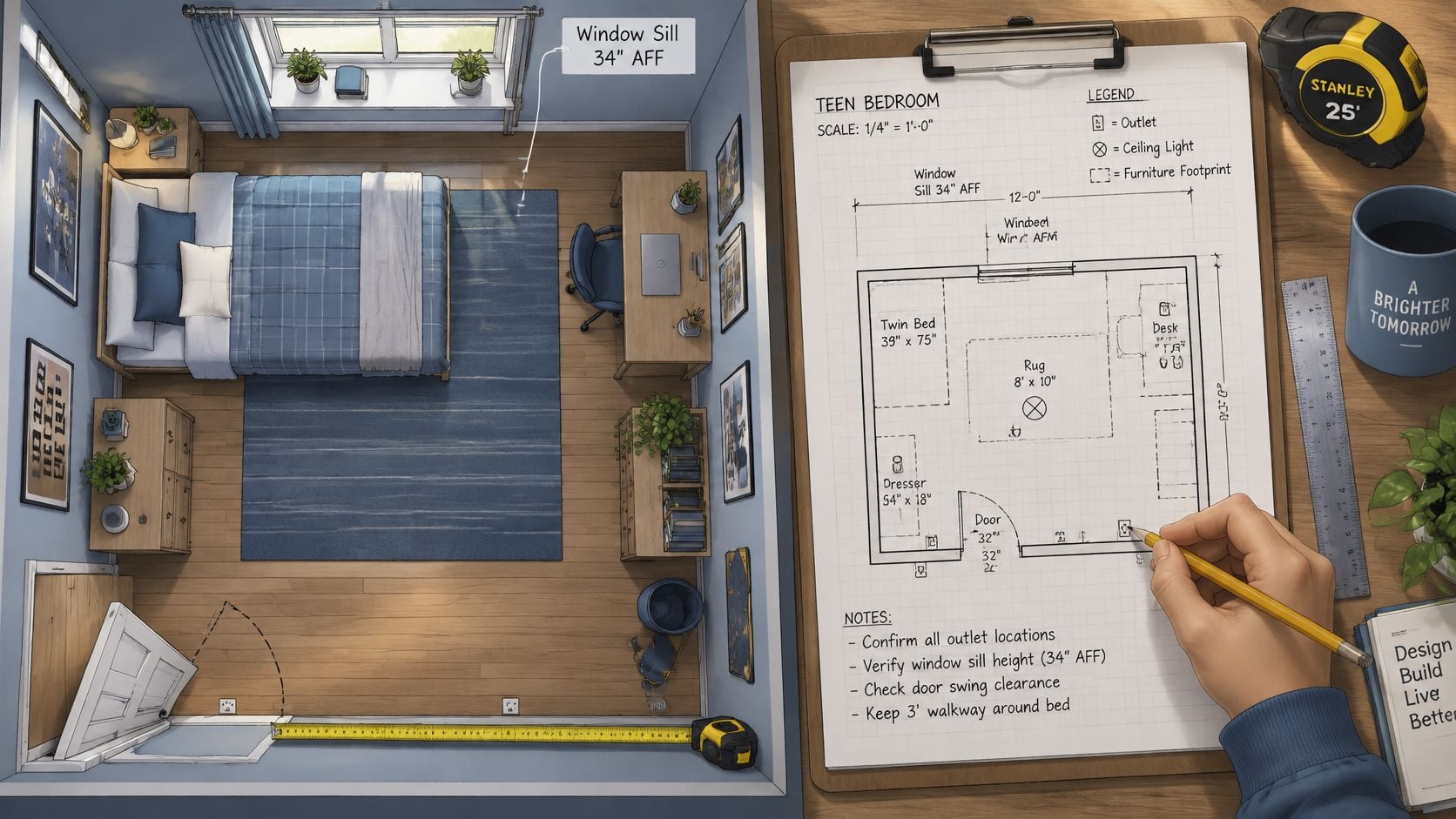
- Measure every surface. Record wall lengths, door swing, window sill height, outlet positions and the footprint of the furniture already in the room. Write each number on the sketch, not on a receipt.
- Draw the room to scale. Paper and pencil work fine, and Tip Top Furniture & Mattresses offers a free online room planner that does the same job with drag-and-drop furniture. Test two or three layouts before a single item is bought.
- Protect the walking route. Keep an unobstructed path from the bed to the door, and leave enough clearance for drawers and closet doors to open fully. A room that can't be crossed safely gets rearranged in a hurry.
- Move the charging point. Place the bed away from the room's main outlet and put the charging station on the far side of the room, so the phone never sits within arm's reach of the pillow.
- Anchor every tall piece. Dressers, bookcases, shelving units and wardrobes get an appropriately rated anti-tip device driven into a structural wall member, following the manufacturer's hardware instructions. Drywall-only fasteners do not count as anchored.
- Load from the bottom up. Heavier objects belong on lower shelves. Nothing heavy and nothing tempting goes high enough to be pulled down.
- Run the acceptance test. Load shelves with the items they'll hold, confirm the drawers can't be used as climbing steps, check that nothing rocks, and walk the bed-to-door route one more time.
The order of that list matters because of where accidents happen. U.S. Consumer Product Safety Commission data for 2019 to 2021 estimated an average of 7,200 emergency-department-treated furniture tip-over injuries a year among children under 18, while 45% of all tip-over injuries occurred in bedrooms, and the CPSC also reported that 50% of child tip-over fatalities occurred in bedrooms, per the CPSC tip-over report.
Common shortcuts undo the work. Anchoring only the television while the dresser underneath stays loose, hanging a shelf with the fasteners that came in the box for drywall, stacking heavy books on the top shelf because that's where the space is. Oversized décor that blocks egress belongs in the same list.
Removable wall graphics, textiles, framed prints and an LED task lamp can go in once stability and clearance are settled, not before. Mark each anchored piece on the sketch so a later purchase doesn't land in front of a dresser that needs room to open.
Pick a Color Palette and Theme That Lasts
A room with a clear palette looks intentional even when nothing in it cost much. The fastest way to get there is the three-color rule: one dominant neutral covering about 60% of the room, one supporting color at about 30%, and one accent at about 10% in pillows, art or a lampshade.
Choose one theme family and commit to it, because a consistent theme does more for a small budget than any single purchase. Tip Top Furniture & Mattresses sorts its furniture by style, with filters for Casual, Coastal, Contemporary, Cottage, Craftsman, Global/Bohemian, Industrial, Mid-Century Modern, Rustic Farmhouse, Scandinavian, Shaker, Traditional, Tropical and Vintage, so a look can be browsed before anything is bought.
| Theme | Core Palette | Cheapest Way to Get It | Tip Top Style Filter |
|---|---|---|---|
| Coastal | Soft blue, sand, white | Striped textiles and a rattan wall mirror | Coastal |
| Scandinavian | Warm white, light oak, gray | Light bedding and a wood-look lamp | Scandinavian |
| Global Bohemian | Terracotta, mustard, woven texture | Layered rugs and a macramé wall hanging | Global/Bohemian |
| Mid-Century Modern | Walnut, olive, cream | Peel-and-stick wall art and a simple table lamp | Mid-Century Modern |
| Industrial | Charcoal, black metal, exposed wood | Black metal hooks and simple black frames | Industrial |
Test the Palette Before You Commit
Paint a sample on a piece of poster board and tape it to the wall for a week. Check it in morning light and again at night with the lamp on, because a color that reads warm at noon can go gray under a cool bulb. This costs nothing and prevents the most expensive mistake in the palette step.
Trends that require repainting walls or custom-sized furniture deserve a pause unless the teen has held the same look for several years. A friend's room, a album cover and a two-week fixation all look identical from the outside.
The bedroom color scheme ideas collection covers pairing options for each of these palettes. One check settles the question: if the room looks coherent in a single photo taken from the doorway, the palette works.
Multipurpose Furniture and Storage That Doubles Up
The bed is the best storage opportunity in the room, and it's usually the piece families think about last. A platform frame with under-bed bins holds off-season clothes and keeps the floor visible, which makes a small room feel larger.
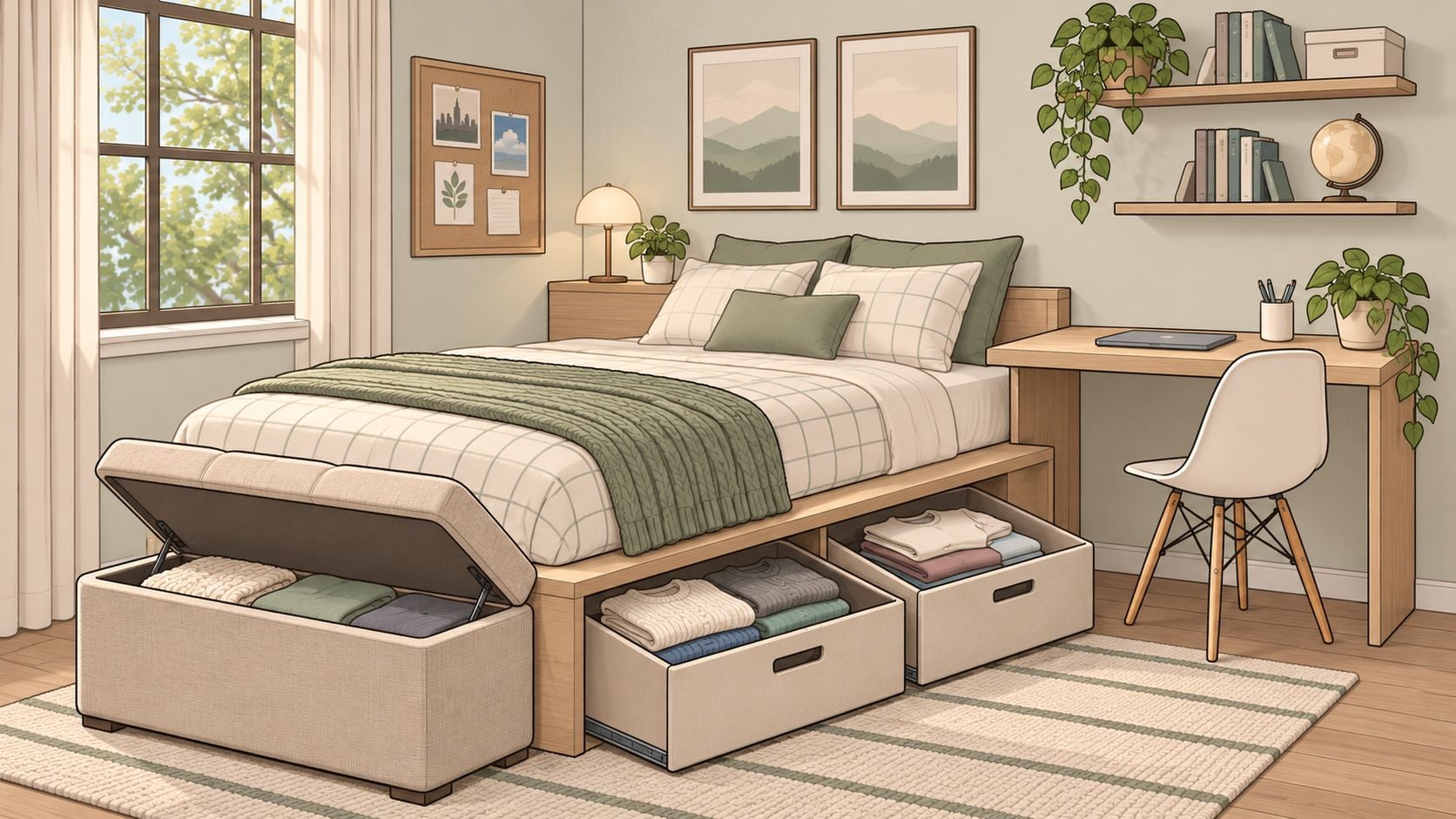
An ottoman with a lid does double duty as seating and a place to hide blankets. A desk can serve as a nightstand, a study surface or a vanity depending on where it sits against the wall. Each of those choices removes a piece of furniture the room would otherwise need.
- Over-door organizers take hats, bags and headphones off the floor without drilling anything.
- Stackable cube units should be anchored to each other and to the wall, since a stack of cubes is a ladder with handholds.
- Pegboard or a rail above the desk gets supplies off the work surface and onto the wall where they're visible.
- Tension rods inside the closet double hanging space without a single tool.
- Clear, labeled bins on the top shelf hold seasonal items, and clear sides mean nobody has to unstack them to find out what's inside.
Cheap Now Versus Low Total Cost
Ready-to-assemble furniture is the cheapest way into a room, but the savings evaporate if the piece sags within two years. Check the stated weight limits, look at how the joints are fastened, and keep heavy books off particleboard shelves. Neutral foundational pieces that survive a color change or a move are worth more than a trend piece that doesn't.
The market is pushing hard in the other direction, which makes the trade-off worth naming. A 2025 home-retail survey found that 31% of consumers planned to spend less on furniture because of price pressures, while 55% of cost-cutting shoppers targeted ready-to-assemble furniture, according to the Furniture Winter 2026 report. A bed, dresser and desk chosen well can serve through several room changes.
Materials deserve a check too. Inexpensive desks, shelving and storage cubes often use pressed wood, and the EPA identifies pressed-wood products made with urea-formaldehyde adhesives as among the most significant potential sources of formaldehyde in homes, as its indoor air quality guide explains. Choose solid wood where the budget allows, look for products certified to applicable emissions standards, and avoid adding several composite items to the same room in one week.
A bedroom collection that runs from beds and dressers to nightstands, chests and storage options covers the foundation pieces in one place, which keeps the palette and the finish consistent. The bedroom storage ideas for small spaces guide covers the layout side of the same problem.
Where to Find Affordable Pieces Near Albany
Sourcing moves the price more than any design decision. The same bed and dresser can land at three different totals depending on where they're bought, what condition they're in, and how far they have to travel.
| Channel | Best For | Price Advantage | Check Before Buying |
|---|---|---|---|
| Thrift and secondhand stores | Dressers, lamps, frames | Lowest sticker price | Drawers, joints, bottoms, odor |
| Marketplace listings | Bulky pieces a local buyer can collect | Negotiable prices | Measurements and pickup logistics |
| Clearance Corner | Brand-name furniture for less | Savings up to 70% off | Stock levels and fit in the measured space |
| Monthly specials | Furniture and mattress brands | Save at least 10% to 60% off retail | Compare with the posted clearance price |
| Online shopping | Decor, textiles, lighting | Easy price comparison | Shipping cost and return policy |
Secondhand rewards patience more than speed. Pull every drawer all the way out and look at the joints and the drawer bottom, open the doors and smell the interior, and set the piece on a level floor to check for a wobble. A dresser that smells of damp or smoke will keep smelling in a small bedroom.
Marketplace listings make sense for one bulky item within reasonable driving distance, and the two questions that matter are the exact measurements and whether the seller can help load it. A piece that doesn't fit through a stairwell is free furniture that costs a morning.
What Clearance and Financing Change
Tip Top Furniture & Mattresses advertises savings of up to 70% off in its Clearance Corner, and monthly specials can save at least 10% to 60% off retail on furniture and mattress brands. That pricing makes a brand-name dresser or a USA-made mattress reachable on a teen budget, provided the shopper brings the measurements.
Shoppers in Freehold, Albany, Schenectady, Troy and across Greene County can compare a posted clearance price against the budget sheet and confirm stock in person before committing. For a larger order that would stretch the total, flexible financing options and a Synchrony Home Card plan are worth reviewing before checkout rather than after.
Online browsing still shapes the list. In a February 2024 national survey of 1,845 U.S. consumers, Gen Z had the highest online-purchase share of any generation, with 44.89% of its home decor purchases made online and 75% saying they preferred shopping online, per the 2024 home decor ecommerce research report. Nearly half of all respondents in a separate 2024 survey of 5,500 people, 46%, ranked cost above aesthetics when designing a home.
The best time to buy furniture calendar helps with timing, since a sale two weeks out is worth waiting for on a large piece. One rule holds regardless of the discount: never buy a clearance item that doesn't fit the measured space.
What to skip: any dresser, desk or shelf bought before it has been measured against the sketch. A bargain that blocks a closet door is a storage problem wearing a price tag.
Personal Touches That Keep the Room Calm at Night
Most budget teen room advice treats the bedroom as a visual project. LED strips, a gaming corner, a wall of collages and a shelf of aesthetic accessories photograph well, and several of them work against the room's main job, which is sleep.
Start with a single warm, dimmable lamp on the nightstand, so the teen never needs a phone screen to see across the room. Keep the charging station on the far side of the room, where the layout step put it, so the phone leaves the bed at night. Add blackout curtains if a streetlight or an early summer sunrise hits the pillow.
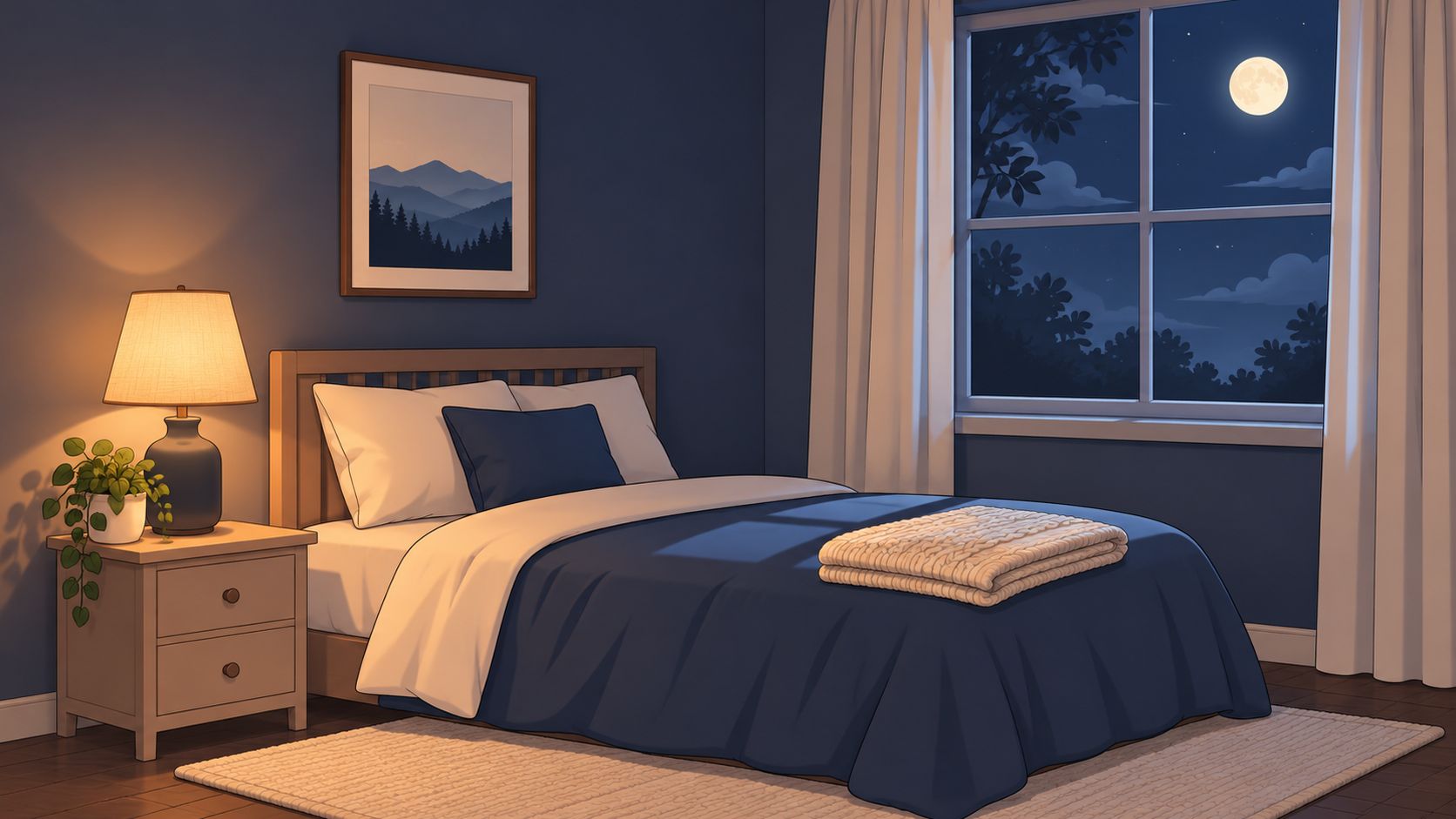
Personal touches can carry the personality without the light pollution:
- Removable peel-and-stick graphics on one wall, chosen in the palette's accent color.
- Thrift-store frames with printed art, hung as a small group rather than a full wall.
- Washable textiles, meaning a throw and pillow covers that go in the machine instead of the trash.
- A teen-built project, such as a shelf or a wall display assembled from one secondhand find and one paint color.
- A tech-light sleep zone, separated from the desk or gaming area by a rug edge or a chair, which marks the boundary without a renovation.
The stakes are worth naming. Survey data cited by the BBC's reporting on teen screen time shows that 38% of surveyed teens spend five or more hours a day on their phones, while 39% would consider removing technology from their bedrooms to cut device use. That willingness is an opening, and it costs nothing to design around.
One caution keeps the advice honest: a cited study found no significant association between measured bedroom environment and adolescent sleep, so treat these changes as supportive habits rather than medical solutions. A quieter room supports a routine. It doesn't replace one.
Lighting, mirrors, rugs and occasional tables in the home decor collection can finish the room in the palette colors without another shopping trip. The guide to designing a room that helps reduce stress goes further into the calm-room side of this.
Schedule Your Teen Room Makeover This Month
Four weekends covers a room that has been measured and budgeted before anything is bought.
- Week one. Finish the budget sheet, complete the layout sketch, and mark every anchor point on it.
- Week two. Buy the foundation pieces: the bed, the anchor kit and the desk chair. Install the anchors before the rest of the order arrives, not after.
- Week three. Add storage, lighting and textiles, checking each piece against the sketch as it comes through the door.
- Week four. Add personal touches and cable clips, clear the boxes, and run the acceptance test from the safety step.
Ventilation belongs in that last week. EPA design guidance sizes a room fan at about five air changes per hour and offers a shortcut: divide the room's volume in cubic feet by 12 to estimate minimum exhaust capacity in cubic feet per minute, as set out in the EPA's indoor air quality design tools. A 10-by-12-foot bedroom with an 8-foot ceiling holds 960 cubic feet, and 960 divided by 12 gives about 80 CFM, which is a useful number to bring to a contractor. Actual work should follow applicable building requirements and professional advice.
The Final Checklist
Three items belong on the list that the earlier steps don't cover: the reserve row of the budget, spent or explicitly held; every receipt filed with its return date marked; and any financing terms read in full before a large order is signed.
For a teen who wants one wall built around a passion, football-themed gallery wall inspiration shows how a collection of framed pieces can hang as a group rather than a clutter of tacks and tape.
Tip Top Furniture & Mattresses runs one-stop shopping for furniture, mattresses, window treatments and floor coverings, which means the foundation pieces, the rug and the curtains can be chosen against the same palette on the same visit. Shoppers in Freehold, Albany, Schenectady and Troy can browse the Clearance Corner, book a complimentary design consultation, or apply for financing before placing a large order.
A room that fits its measurements, stays anchored to the wall and supports sleep at night is already a success. Everything after that is decoration.
A room like this comes together fastest when the bed, the storage and the lighting are chosen together, and Tip Top Furniture & Mattresses has served families across the Greater Albany Capital Region from its Freehold, NY showroom since 1978 with bedroom collections, home decor, window treatments and USA-made mattresses under one roof. Bring the measurements, the budget sheet and a photo of the space to the 35,000 square foot showroom, or start with the Clearance Corner for savings of up to 70% off. Visit Tip Top Furniture & Mattresses to browse the bedroom collection and plan the room before the first anchor goes into the wall.